Kirjojen hintavertailu – 12 903 725 kirjaa ja 27 kauppaa

Kirjailija

Robert H. Bradley

Kirjat ja teokset yhdessä paikassa: 4 kirjaa, julkaisuja vuosilta 2016–2022, suosituimpiin kuuluu Gender in Low and Middle-Income Countries. Vertaile teosten hintoja ja tarkista saatavuus suomalaisista kirjakaupoista.

4 kirjaa

Kirjojen julkaisuvuodet: 2016–2022.

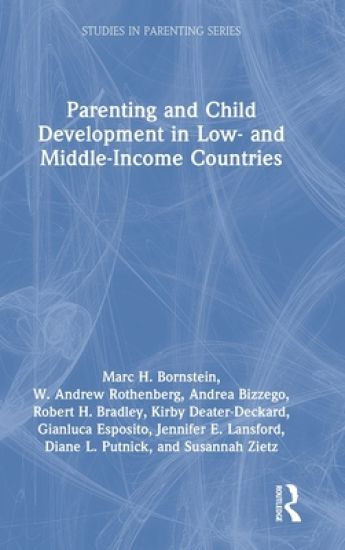
Parenting and Child Development in Low- and Middle-Income Countries

Parenting and Child Development in Low- and Middle-Income Countries

Marc H. Bornstein; W. Andrew Rothenberg; Andrea Bizzego; Robert H. Bradley; Kirby Deater-Deckard; Gianluca Esposito; Jennifer E. Lansford; Diane L. Putnick; Susannah Zietz

TAYLOR FRANCIS LTD
2022
sidottu
This compelling volume advances the understanding of what parenting and related sociodemographic, demographic, and environmental variables look like and how they are associated with child development in low- and middle-income countries around the world. Specifically, expert authors document how child growth, caregiving practices, discipline and violence, and children’s physical home environments, along with child and primary caregiver sociodemographic characteristics and household and national development demographic characteristics, are associated with central domains of early childhood development across a substantial fraction of the majority world using contemporary 21st-century data from the UNICEF Multiple Indicator Cluster Surveys and the UNICEF Early Childhood Development Index. The lives of nearly 160,000 girls and boys aged 3 to 5 years in nationally representative samples from 51 low- and middle-income countries are sampled to address 7 principal questions about children, caregiving, and contexts. Parenting and Child Development in Low- and Middle-Income Countries takes an authentically international approach to parenting, the environment, and child development in cultural contexts that more fully characterize the world’s diversity. Parenting and Child Development in Low- and Middle-Income Countries is essential reading for researchers and students of parenting, psychology, human development, family studies, sociology, and cultural studies, as well as governmental and non-governmental professionals working with families in low- and middle-income countries.
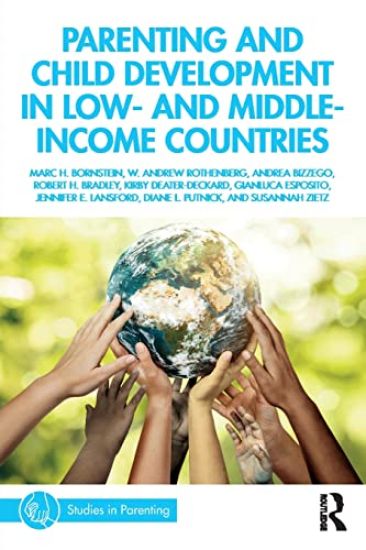
Parenting and Child Development in Low- and Middle-Income Countries

Parenting and Child Development in Low- and Middle-Income Countries

Marc H. Bornstein; W. Andrew Rothenberg; Andrea Bizzego; Robert H. Bradley; Kirby Deater-Deckard; Gianluca Esposito; Jennifer E. Lansford; Diane L. Putnick; Susannah Zietz

TAYLOR FRANCIS LTD
2022
nidottu
This compelling volume advances the understanding of what parenting and related sociodemographic, demographic, and environmental variables look like and how they are associated with child development in low- and middle-income countries around the world. Specifically, expert authors document how child growth, caregiving practices, discipline and violence, and children’s physical home environments, along with child and primary caregiver sociodemographic characteristics and household and national development demographic characteristics, are associated with central domains of early childhood development across a substantial fraction of the majority world using contemporary 21st-century data from the UNICEF Multiple Indicator Cluster Surveys and the UNICEF Early Childhood Development Index. The lives of nearly 160,000 girls and boys aged 3 to 5 years in nationally representative samples from 51 low- and middle-income countries are sampled to address 7 principal questions about children, caregiving, and contexts. Parenting and Child Development in Low- and Middle-Income Countries takes an authentically international approach to parenting, the environment, and child development in cultural contexts that more fully characterize the world’s diversity. Parenting and Child Development in Low- and Middle-Income Countries is essential reading for researchers and students of parenting, psychology, human development, family studies, sociology, and cultural studies, as well as governmental and non-governmental professionals working with families in low- and middle-income countries.

The Child's Environment

The Child's Environment

Robert H. Bradley

Cambridge University Press
2020
pokkari
The focus of this Element is on the environment and how it is implicated in children's development. A very broad array of social and physical features connected to children's home life and to the neighborhoods where children live, including multiple aspects of parenting, housing characteristics and the increased prevalence of media in daily life are addressed. Attention is also given to the broader social, economic, and geographic contexts in which children live, such as neighborhood surroundings and conditions in less developed countries. There is a focus on how various aspects of the home context (e.g., crowding) and key parental characteristics, such as mental illness and substance abuse problems, affect the behavior of parents. Consideration also given to how various forms of chaos and instability present challenges for parents and children and how those circumstances are implicated in both children's development and caregiver behavior.
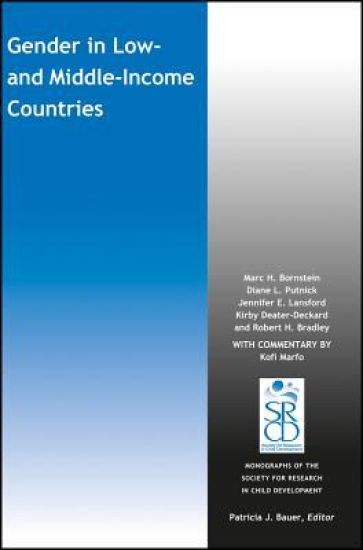
Gender in Low and Middle-Income Countries

Gender in Low and Middle-Income Countries

Marc H. Bornstein; Diane L. Putnick; Jennifer E. Lansford; Kirby Deater-Deckard; Robert H. Bradley

John Wiley Sons Inc
2016
nidottu
How do girls and boys in low- and middle-income countries (LMIC) in the majority world vary with respect to central indicators of child growth and mortality, parental caregiving, discipline and violence, and child labor? How do key indicators of national gender equity and economic development relate to gender similarities and differences in each of these substantive areas of child development? This monograph of the SRCD is concerned with central topics of child gender, gendered parenting, gendered environments, and gendered behaviors and socializing practices in the underresearched and underserved world of LMIC. To examine protective and risk factors related to child gender in LMIC around the world, we used data from more than 2 million individuals in 400,000 families in 41 LMIC collected in the Multiple Indicator Cluster Survey, a household survey that includes nationally representative samples of participating countries. In the fi rst chapter of this monograph, we describe the conceptual "gender similarities" and "bioecological" frameworks that helped guide the monograph. In the second chapter, we detail the general methodology adhered to in the substantive chapters. Then, in topical chapters, we describe the situations of girls and boys with successive foci on child growth and mortality, parental caregiving, family discipline and violence, and child labor. We conclude with a general discussion of fi ndings from the substantive chapters in the context of gender and bioecological theories. Across 41 LMIC and four substantive areas of child development, few major gender differences emerged. Our data support a gender similarities view and suggest that general emphases on early child gender differences may be overstated at least for the developing world of LMIC.