

Kirjailija
Robert J. Bayley
Kirjat ja teokset yhdessä paikassa: 4 kirjaa, julkaisuja vuosilta 2001–2009, suosituimpiin kuuluu Sociolinguistic Variation in American Sign Language. Vertaile teosten hintoja ja tarkista saatavuus suomalaisista kirjakaupoista.
4 kirjaa
Kirjojen julkaisuvuodet: 2001–2009.

Language as Cultural Practice
Sandra R. Schecter; Robert J. Bayley
Routledge Member of the Taylor and Francis Group
2002
sidottu
Language as Cultural Practice:Mexicanos en el Norte offers a vivid ethnographic account of language socialization practices within Mexican-background families residing in California and Texas. This account illustrates a variety of cases where language is used by speakers to choose between alternative self-definitions and where language interacts differentially with other defining categories, such as ethnicity, gender, and class. It shows that language socialization--instantiated in language choices and patterns of use in sociocultural and sociohistorical contexts characterized by ambiguity and flux--is both a dynamic and a fluid process. The study emphasizes the links between familial patterns of language use and language socialization practices on the one hand, and children's development of bilingual and biliterate identities on the other. Using a framework emerging from their selection of two geographically distinct localities with differing demographic features, Schecter and Bayley compare patterns of meaning suggested by the use of Spanish and English in speech and literacy activities, as well as by the symbolic importance ascribed by families and societal institutions (such as schools) to the maintenance and use of the two languages. Language as Cultural Practice: *provides a detailed account of the diversity of language practices and patterns of use in language minority homes; *offers educators detailed information on the language ecology of Latino homes in two geographically diverse communities--San Antonio, Texas, and the San Francisco Bay Area, California; *shows the diversity within Mexican-American communities in the United States--families profiled range from rural families in south Texas to upper middle class professional families in northern California; *provides data to correct the prevalent misconception that maintenance of Spanish interferes with the acquisition of English; and *contributes to the study of language socialization by showing that the process extends throughout the lifetime and that it is an interactive rather than a one-way process. This book will particularly interest researchers and professionals in linguistics, anthropology, applied linguistics, and education, and will be useful as a text in graduate courses in these areas that address language socialization and learning.

Language as Cultural Practice
Sandra R. Schecter; Robert J. Bayley
Routledge Member of the Taylor and Francis Group
2002
nidottu
Language as Cultural Practice:Mexicanos en el Norte offers a vivid ethnographic account of language socialization practices within Mexican-background families residing in California and Texas. This account illustrates a variety of cases where language is used by speakers to choose between alternative self-definitions and where language interacts differentially with other defining categories, such as ethnicity, gender, and class. It shows that language socialization--instantiated in language choices and patterns of use in sociocultural and sociohistorical contexts characterized by ambiguity and flux--is both a dynamic and a fluid process. The study emphasizes the links between familial patterns of language use and language socialization practices on the one hand, and children's development of bilingual and biliterate identities on the other. Using a framework emerging from their selection of two geographically distinct localities with differing demographic features, Schecter and Bayley compare patterns of meaning suggested by the use of Spanish and English in speech and literacy activities, as well as by the symbolic importance ascribed by families and societal institutions (such as schools) to the maintenance and use of the two languages. Language as Cultural Practice: *provides a detailed account of the diversity of language practices and patterns of use in language minority homes; *offers educators detailed information on the language ecology of Latino homes in two geographically diverse communities--San Antonio, Texas, and the San Francisco Bay Area, California; *shows the diversity within Mexican-American communities in the United States--families profiled range from rural families in south Texas to upper middle class professional families in northern California; *provides data to correct the prevalent misconception that maintenance of Spanish interferes with the acquisition of English; and *contributes to the study of language socialization by showing that the process extends throughout the lifetime and that it is an interactive rather than a one-way process. This book will particularly interest researchers and professionals in linguistics, anthropology, applied linguistics, and education, and will be useful as a text in graduate courses in these areas that address language socialization and learning.
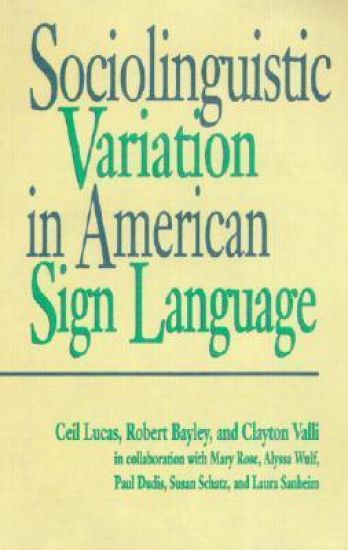
Sociolinguistic Variation in American Sign Language
Ceil Lucas; Robert J. Bayley; Clayton Valli
Gallaudet University Press,U.S.
2001
sidottu
The culmination of a seven-year project, this volume provides a complete description of American Sign Language (ASL) variation. For four decades, linguists have studied how people from varying regions and backgrounds have different ways of saying the same thing. Noted scholars Ceil Lucas, Robert Bayley, and Clayton Valli led a team of exceptional researchers in applying techniques for analyzing spoken language variation to ASL. Their observations at the phonological, lexical, morphological, and syntactic levels demonstrate that ASL variation correlates with many of the same driving social factors of spoken languages, including age, socioeconomic class, gender, ethnic background, region, and sexual orientation. Internal constraints that mandate variant choices for spoken languages have been compared to ASL as well, with intriguing results. Sociolinguistic Variation in American Sign Language stands alone as the new standard for students and scholars committed to this discipline.