Kirjojen hintavertailu – 12 903 725 kirjaa ja 27 kauppaa
Kirjailija
Robert J. Wenke
Kirjat ja teokset yhdessä paikassa: 3 kirjaa, julkaisuja vuosilta 1984–2009, suosituimpiin kuuluu The Ancient Egyptian State. Vertaile teosten hintoja ja tarkista saatavuus suomalaisista kirjakaupoista.
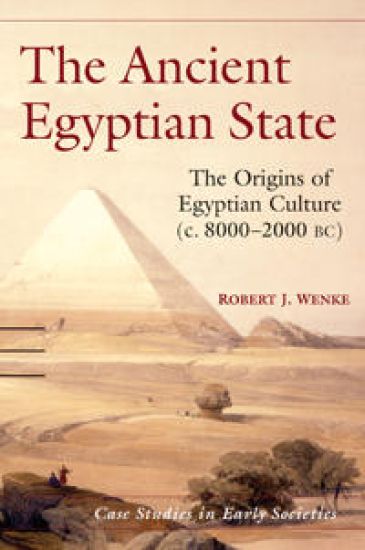
This book focuses on the development of Egypt in its formative phase, from c.5200 BC, when Egyptians first began farming wheat and barley, until 2160 BC, as Egypt's central government weakened and appears to have fallen into disorder. During these millennia, which coincide with the Predynastic, Early Dynastic, and Old Kingdom periods, Egyptian civilization became increasingly complex, and many of its greatest pyramids and other monuments were built. Robert Wenke examines this cycle of ancient Egypt's development by analyzing Egyptological, anthropological, and other forms of evidence, which are set into the larger context of early civilizations that developed in various areas of the world. Written in an accessible style, with many anecdotes, quotations, and personal reflections, this book is intended for use in undergraduate and graduate courses on early civilizations and states.
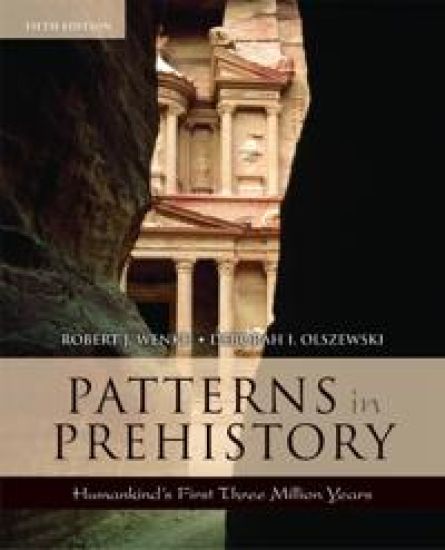
Who are we? How did the world become what it is today? What paths did humanity traverse along the way? Patterns in Prehistory, Fifth Edition, is a comprehensive and engaging survey of humanity's past three million years. It brings together theories and archaeological examples to pose questions about who we are and the means by which humanity evolved into what it is today. Ideal for introductory courses in world prehistory and origins of complex societies, Patterns of Prehistory, Fifth Edition, offers a unified and thematic approach to the four great transformations--or patterns--that characterize humanity's past: the origins and evolution of culture; the origins of modern humans and human behaviors; the origins of agriculture; and the origins of complex societies, civilizations, and pre-industrial states. Integrating theoretical approaches with archaeological data from the Middle East, Mesoamerica, North and South America, Egypt, China, the Indus Valley, and temperate Europe, Patterns of Prehistory, Fifth Edition, reveals how archaeologists decipher the past. It demonstrates how theory and method are combined to derive interpretations and also considers how interpretations evolve as a result of accumulating data, technological advances in recording and analyzing data sets, and newer theoretical perspectives. This new edition of Patterns of Prehistory provides: * Fresh insights with the addition of coauthor Deborah Olszewski, who has carefully reviewed and revamped the material with an eye toward making the text clearly understandable to today's students * Updated discussions throughout, including expanded information on post-processual archaeology, current methodologies, and technological advances * Approximately 250 illustrations and maps, more than half of which are new to this edition * Groundbreaking research on new discoveries of hominin fossils, genetic research, prehistoric migrations, the peopling of the Americas, and theories of the origins of agriculture and the origins of complex societies * Timelines for all relevant chapters as well as an overarching timeline for the entire book to help students place events in context * Extensively updated chapter bibliographies and chapter endnotes
Excavations, surface sampling topographic mapping, and other archaeological and Egyptological researches were conducted at the site, of el-Hibeh between February 11 and March 16, 1980. Results indicate that el-Hibeh, a large (approximately 13 hectares), walled "town" on the Nile's east bank across from el-Fashn, was first occupied in the late 2nd millennium B. C. and remained an important site through much of the 1st millennium B. C. and into the first several centuries A. D. Excavations were conducted in stratified deposits in two areas of 1st millennium B. C. occupations, producing samples of ceramics, floral and faunal remains, architecture, and other artifacts. Aspects of the settlement's occupational history are reconstructed, and suggestions for future research are made. Illustrated with 12 black and white plates.