Kirjojen hintavertailu – 12 859 829 kirjaa ja 27 kauppaa

Kirjailija

Robert Kagan

Kirjat ja teokset yhdessä paikassa: 14 kirjaa, julkaisuja vuosilta 2004–2025, suosituimpiin kuuluu Liberties Journal of Culture and Politics. Vertaile teosten hintoja ja tarkista saatavuus suomalaisista kirjakaupoista.

14 kirjaa

Kirjojen julkaisuvuodet: 2004–2025.

Rebellion: Donald Trump and the Antiliberal Tradition in America
Could the 2024 election have been the last free election held in a unified America? "A dire warning of the right's drift towards authoritarianism." --Financial Times Published in the run-up to Donald Trump's victory, Rebellion sounded a chilling and clear-eyed warning about the threats posed to American democracy by the increasingly radicalized Republican Party. With the Trump administration in place, and attempting a systematic dismantling of the traditionally liberal principles on which America was founded, Robert Kagan's lessons and insights have become only more urgent. Kagan dives deeper than the op-eds and think pieces to explore the historical forces that brought us to a second Trump term--in particular the long history of opposition to liberalism, and to government, that has shaped America's character from the time of the Revolution to today. Trump's unique capacity to tap into that tradition of dissent and circumvent the American system has brought us to the edge of dissolution--not for the first time in our history but possibly the last. Rebellion is an elegant and deeply informed synthesis of history, contemporary politics, and ideas that sheds light on this crucial moment.
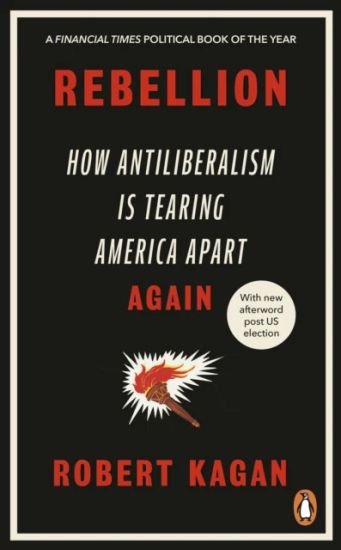
Rebellion

Rebellion

Robert Kagan

Ebury Publishing
2025
pokkari

Halvin toimitettuna 17,00 €

'The transformation of the US into an autocracy has advanced... Nobody has outlined this danger more compellingly than Robert Kagan.' - Martin Wolf, Financial TimesA chilling and clear-eyed warning about the threats to our democracy posed by the increasing radicalization of the Republican Party, from a leading historian and intellectualThe 2024 election could be the last free election held in a unified America. So warns Robert Kagan in this brilliant and terrifying analysis of the perilous state of democracy in the United States today. If Donald Trump loses the upcoming election, as he did in 2020, but refuses to accept the result, as he also did in the last election, he is likely to call on his millions of followers to repudiate the election results. It will be a short step from there to Republican-dominated states rejecting the legitimacy of the federal government and effectively seceding. The United States at that point will cease to be united, with grave consequences for both Americans and the world. In Rebellion, Kagan dives deeper than the op-eds and think pieces to explore the historical forces that have brought us to this moment—in particular the long history of opposition to liberalism, and to government, that has shaped America’s character from the time of the Revolution to today. Trump’s unique capacity to tap into that tradition of dissent and circumvent the American system has brought us to the edge of dissolution—not for the first time in our history but possibly the last. This is an elegant and deeply informed synthesis of history, contemporary politics, and ideas that sheds light on this crucial moment.
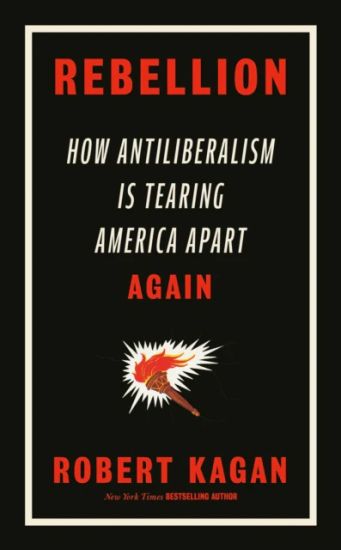
Rebellion

Rebellion

Robert Kagan

Ebury Publishing
2024
sidottu

Halvin toimitettuna 27,50 €

*** A Financial Times best political book of the year***'The transformation of the US into an autocracy has advanced... It might be irreversible [and] will change almost everything in the world. Nobody has outlined this danger more compellingly than Robert Kagan' - Martin Wolf, Financial TimesA chilling and clear-eyed warning about the threats to our democracy posed by the increasing radicalization of the Republican Party, from a leading historian and intellectual. The 2024 election could be the last free election held in a unified America. So warns Robert Kagan in this brilliant and terrifying analysis of the perilous state of democracy in the United States today. If Donald Trump loses the upcoming election, as he did in 2020, but refuses to accept the result, as he also did in the last election, he is likely to call on his millions of followers to repudiate the election results. It will be a short step from there to Republican-dominated states rejecting the legitimacy of the federal government and effectively seceding. The United States at that point will cease to be united, with grave consequences for both Americans and the world. In Rebellion, Kagan dives deeper than the op-eds and think pieces to explore the historical forces that have brought us to this moment—in particular the long history of opposition to liberalism, and to government, that has shaped America’s character from the time of the Revolution to today. Trump’s unique capacity to tap into that tradition of dissent and circumvent the American system has brought us to the edge of dissolution—not for the first time in our history but possibly the last. This is an elegant and deeply informed synthesis of history, contemporary politics, and ideas that sheds light on this crucial moment.
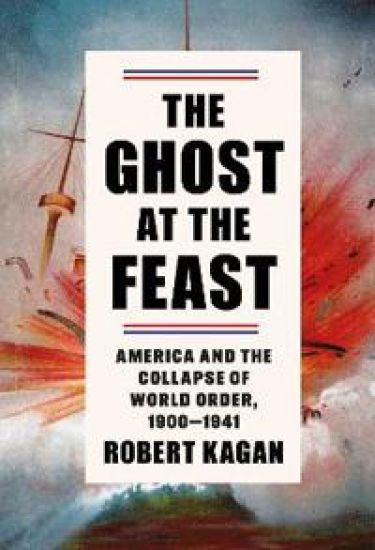
The Ghost at the Feast

The Ghost at the Feast

Robert Kagan

Atlantic Books
2024
nidottu
An NPR Book of the YearAt the dawn of the twentieth century, the United States was one of the world's richest, most populous, most technologically advanced nations. It was also a nation divided along numerous fault lines, with conflicting aspirations and concerns pulling it in different directions. And it was a nation unsure about the role it wanted to play in the world, if any. Americans were the beneficiaries of a global order they had no responsibility for maintaining. Many preferred to avoid being drawn into what seemed an ever more competitive, conflictual, and militarized international environment. However, many also were eager to see the United States taking a share of international responsibility, working with others to preserve peace and advance civilization. The story of American foreign policy in the first four decades of the twentieth century is about the effort to do both - "to adjust the nation to its new position without sacrificing the principles developed in the past," as one contemporary put it. This would prove a difficult task. The collapse of British naval power, combined with the rise of Germany and Japan, suddenly placed the United States in a pivotal position. American military power helped defeat Germany in the First World War, and the peace that followed was significantly shaped by a U. S. president. But Americans recoiled from their deep involvement in world affairs, and for the next two decades, they sat by as fascism and tyranny spread unchecked, ultimately causing the liberal world order to fall apart. America's resulting intervention in the Second World War marked the beginning of a new era, for the United States and for the world. Brilliant and insightful, The Ghost at the Feast shows both the perils of American withdrawal from the world and the price of international responsibility.
Rebellion: How Antiliberalism Is Tearing America Apart--Again

Rebellion: How Antiliberalism Is Tearing America Apart--Again

Robert Kagan

Knopf Publishing Group
2024
sidottu

Halvin toimitettuna 22,30 €

A chilling and clear-eyed warning about the threats to our democracy posed by the increasing radicalization of the Republican Party, from a leading historian and intellectual The 2024 election could be the last free election held in a unified America. So warns Robert Kagan in this brilliant and terrifying analysis of the perilous state of democracy in the United States today. If Donald Trump loses the upcoming election, as he did in 2020, but refuses to accept the result, as he also did in the last election, he is likely to call on his millions of followers to repudiate the election results. It will be a short step from there to Republican-dominated states rejecting the legitimacy of the federal government and effectively seceding. The United States at that point will cease to be united, with grave consequences for both Americans and the world. In Rebellion, Kagan dives deeper than the op-eds and think pieces to explore the historical forces that have brought us to this moment--in particular the long history of opposition to liberalism, and to government, that has shaped America's character from the time of the Revolution to today. Trump's unique capacity to tap into that tradition of dissent and circumvent the American system has brought us to the edge of dissolution--not for the first time in our history but possibly the last. This is an elegant and deeply informed synthesis of history, contemporary politics, and ideas that sheds light on this crucial moment.
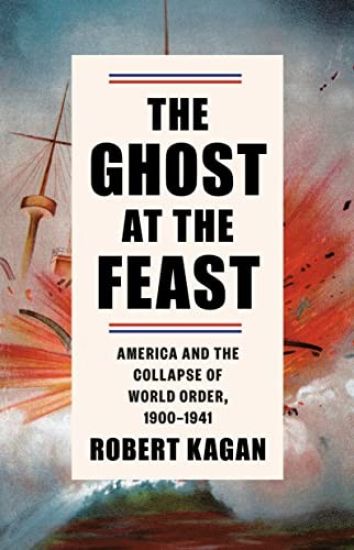
The Ghost at the Feast: America and the Collapse of World Order, 1900-1941
A comprehensive, sweeping history of America's rise to global superpower--from the Spanish-American War to World War II--by the acclaimed author of Dangerous Nation "With extraordinary range and research, Robert Kagan has illuminated America's quest to reconcile its new power with its historical purpose in world order in the early twentieth century." --Dr. Henry Kissinger At the dawn of the twentieth century, the United States was one of the world's richest, most populous, most technologically advanced nations. It was also a nation divided along numerous fault lines, with conflicting aspirations and concerns pulling it in different directions. And it was a nation unsure about the role it wanted to play in the world, if any. Americans were the beneficiaries of a global order they had no responsibility for maintaining. Many preferred to avoid being drawn into what seemed an ever more competitive, conflictual, and militarized international environment. However, many also were eager to see the United States taking a share of international responsibility, working with others to preserve peace and advance civilization. The story of American foreign policy in the first four decades of the twentieth century is about the effort to do both--"to adjust the nation to its new position without sacrificing the principles developed in the past," as one contemporary put it. This would prove a difficult task. The collapse of British naval power, combined with the rise of Germany and Japan, suddenly placed the United States in a pivotal position. American military power helped defeat Germany in the First World War, and the peace that followed was significantly shaped by a U. S. president. But Americans recoiled from their deep involvement in world affairs, and for the next two decades, they sat by as fascism and tyranny spread unchecked, ultimately causing the liberal world order to fall apart. America's resulting intervention in the Second World War marked the beginning of a new era, for the United States and for the world. Brilliant and insightful, The Ghost at the Feast shows both the perils of American withdrawal from the world and the price of international responsibility.
The Ghost at the Feast: America and the Collapse of World Order, 1900-1941
AN NPR BEST BOOK OF THE YEAR - A comprehensive, sweeping history of America's rise to global superpower--from the Spanish-American War to World War II--by the acclaimed author of Dangerous Nation "With extraordinary range and research, Robert Kagan has illuminated America's quest to reconcile its new power with its historical purpose in world order in the early twentieth century." --Dr. Henry Kissinger At the dawn of the twentieth century, the United States was one of the world's richest, most populous, most technologically advanced nations. It was also a nation divided along numerous fault lines, with conflicting aspirations and concerns pulling it in different directions. And it was a nation unsure about the role it wanted to play in the world, if any. Americans were the beneficiaries of a global order they had no responsibility for maintaining. Many preferred to avoid being drawn into what seemed an ever more competitive, conflictual, and militarized international environment. However, many also were eager to see the United States taking a share of international responsibility, working with others to preserve peace and advance civilization. The story of American foreign policy in the first four decades of the twentieth century is about the effort to do both--"to adjust the nation to its new position without sacrificing the principles developed in the past," as one contemporary put it. This would prove a difficult task. The collapse of British naval power, combined with the rise of Germany and Japan, suddenly placed the United States in a pivotal position. American military power helped defeat Germany in the First World War, and the peace that followed was significantly shaped by a U. S. president. But Americans recoiled from their deep involvement in world affairs, and for the next two decades, they sat by as fascism and tyranny spread unchecked, ultimately causing the liberal world order to fall apart. America's resulting intervention in the Second World War marked the beginning of a new era, for the United States and for the world. Brilliant and insightful, The Ghost at the Feast shows both the perils of American withdrawal from the world and the price of international responsibility.
Liberties Journal of Culture and Politics

Liberties Journal of Culture and Politics

Robert Kagan; Oksana Forostyna; Justin E.H. Smith

Liberties Journal Foundation
2022
pokkari
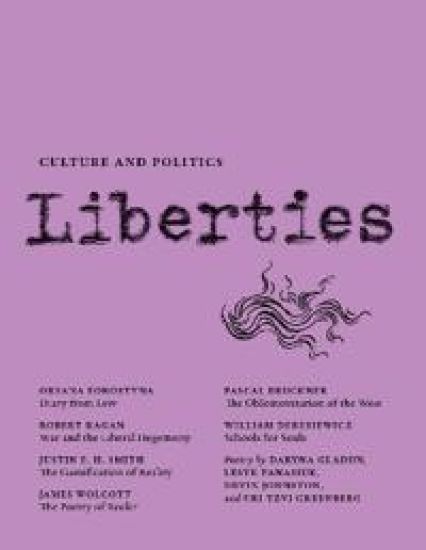
“A Meteor of Intelligent Substance” “Something was Missing in our Culture, and Here It Is” "Liberties is THE place to be.” Liberties, a journal of Culture and Politics, is essential reading for those engaged in the cultural and political issues and causes of our time. Liberties features serious, independent, stylish, and controversial essays by significant writers throughout the world; new poetry; and, introduces the next generation of writers and voices to inspire and impact the intellectual and creative lifeblood of today’s culture and politics. In this edition of Liberties: Oksana Forostyna’s A Diary from Lviv Robert Kagan argues All Wars are Wars of Choice Justin E. H. Smith grapples with The Gamification of Reality James Wolcott questions The Poetry of Rock Pascal Bruckner sees The Oblomovization of the West William Deresiewicz on higher education’s Schools for Souls Jaroslaw Anders writes An Open Letter to an Enemy in My Native Land Elliot Ackerman reveals The Politicization of the American Military Jonathan Baskin on Sheila Heti and the Fight for Art A Conversation About Modern History betweenIsaiah Berlin and Adam Michnik David Thomson goes back to Chinatown with Roman Polanski and John Huston Helen Vendler reads John Donne for How to Talk to God Celeste Marcus on Why Women Mortify Themselves Leon Wieseltier on Ukraine and Us And poetry from Valzhyna Mort, Daryna Gladun, Lesyk Panasiuk, Uri Tzvi Greenberg, Henri Cole, Claire Malroux, La Fontaine, and Devin Johnston
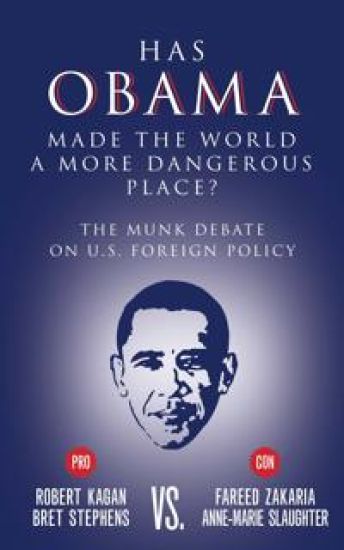
Has Obama Made the World a More Dangerous Place?

Has Obama Made the World a More Dangerous Place?

Bret Stephens; Fareed Zakaria; Robert Kagan; Anne-Marie Slaughter

House of Anansi Press Ltd ,Canada
2015
pokkari
The fourteenth semi-annual Munk Debate, which will be held in Toronto on November 5, 2014, pits Bret Stephens and Robert Kagan against Fareed Zakaria and Anne-Marie Slaughter to debate the legacy of President Obama. From Ukraine to the Middle East to China, the United States is redefining its role in international affairs. Alliance building, public diplomacy, and eschewing traditional warfare in favour of the focused use of hard power such as drones and special forces are all hallmarks of the so-called Obama Doctrine. Is this a farsighted foreign policy for the United States and the world in the twenty-first century — one that acknowledges and embraces the increasing diffusion of power among states and non-state actors? Or, is an America “leading from behind” a boon for the nations and blocs who want to roll back economic globalization, international law, and the spread of democracy and human rights? In this edition of the Munk Debates, Pulitzer Prize–winning journalist Bret Stephens and famed historian and foreign policy commentator Robert Kagan square off against CNN’s Fareed Zakaria and noted academic and political commentator Anne-Marie Slaughter to debate the legacy of President Obama. With ISIS looking to reshape the Middle East, Russia increasingly at odds with the rest of the West, and the Israeli-Palestinian conflict at a standstill, the Munk Debate on Foreign Policy asks: Has Obama’s foreign policy taken the U. S. in the right direction?
The World America Made

The World America Made

Robert Kagan

Vintage Books
2013
pokkari

Halvin toimitettuna 25,50 €

Robert Kagan, the "New York Times" bestselling author of "Of Paradise and Power" and one of the country s most influential strategic thinkers, reaffirms the importance of United States s global leadership in this timely and important book. Upon its initial publication, "The World America Made" became one of the most talked about political books of the year, influencing Barack Obama s 2012 State of the Union address and shaping the thought of both the Obama and Romney presidential campaigns. In these incisive and engaging pages, Kagan responds to those who anticipate or even long for a post-American world order by showing what a decline in America s influence would truly mean for the United States and the rest of the world, as the vital institutions, economies, and ideals currently supported by American power wane or disappear. As Kagan notes, it has happened before: one need only to consider the consequences of the breakdown of the Roman Empire and the collapse of the European order in World War I. This book is a powerful warning that America need not and dare not decline by committing preemptive superpower suicide."
The Return of History and the End of Dreams

The Return of History and the End of Dreams

Robert Kagan

VINTAGE
2009
nidottu

Halvin toimitettuna 22,40 €

Hopes for a new peaceful international order after the end of the Cold War have been dashed by sobering realities: Great powers are once again competing for honor and influence. The world remains "unipolar," but international competition among the United States, Russia, China, Europe, Japan, India, and Iran raise new threats of regional conflict, and a new contest between western liberalism and the great eastern autocracies of Russia and China has reinjected ideology into geopolitics. For the past few years, the liberal world has been internally divided and distracted by issues both profound and petty. Now, in The Return of History and the End of Dreams, Robert Kagan masterfully poses the most important questions facing the liberal democratic countries, challenging them to choose whether they want to shape history or let others shape it for them.
The Return of History and the End of Dreams
Hopes for a new peaceful international order after the end of the Cold War have been dashed by sobering realities. International competition between the United States, Russia, China, Europe, Japan, India, and Iran raises new threats of regional conflict. The expectation that after the Cold War the world had entered an era of international convergence has proved wrong. We have entered an age of divergence. In The Return of History and the End of Dreams, Robert Kagan masterfully poses the questions facing the democratic world today. For the past few years, it has been internally divided and distracted by issues both profound and petty. But now History has returned, and the peoples of the liberal world need to choose whether they want to shape it - or let others shape it for them.
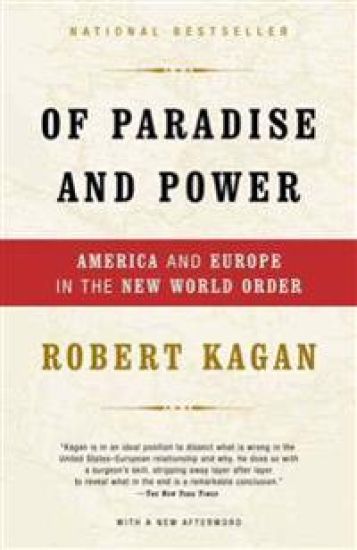
Of Paradise and Power: America and Europe in the New World Order
From Robert Kagan, a leading scholar of American foreign policy, comes an insightful analysis of the state of European and American foreign relations. At a time when relations between the United States and Europe are at their lowest ebb since World War II, this brief but cogent book is essential reading. Kagan forces both sides to see themselves through the eyes of the other. Europe, he argues, has moved beyond power into a self-contained world of laws, rules, and negotiation, while America operates in a "Hobbesian" world where rules and laws are unreliable and military force is often necessary. Tracing how this state of affairs came into being over the past fifty years and fearlessly exploring its ramifications for the future, Kagan reveals the shape of the new transatlantic relationship. The result is a book that promises to be as enduringly influential as Samuel Huntington's The Clash of Civilizations and the Remaking of World Order.