Kirjojen hintavertailu – 12 859 826 kirjaa ja 27 kauppaa

Kirjailija

Robert Kepczynski

Kirjat ja teokset yhdessä paikassa: 5 kirjaa, julkaisuja vuosilta 2018–2019, suosituimpiin kuuluu Implementing Integrated Business Planning. Vertaile teosten hintoja ja tarkista saatavuus suomalaisista kirjakaupoista.

5 kirjaa

Kirjojen julkaisuvuodet: 2018–2019.

Improving Forecasts with Integrated Business Planning

Improving Forecasts with Integrated Business Planning

Ganesh Sankaran; Federico Sasso; Robert Kepczynski; Alessandro Chiaraviglio

Springer Nature Switzerland AG
2019
sidottu
This book provides both a broad overview of the forecasting process, covering technological and human aspects alike, and deep insights into algorithms and platform functionalities in the IBP toolbox required to maximize forecast accuracy. Rich in technical and business explanations, it addresses short-, medium- and long-term forecasting processes using functionalities available in demand planning and demand sensing. There are also several theoretical concepts underpinning the algorithms discussed; these are explained with numerical examples to help demystify the IBP forecasting toolbox. Beyond standard procedures, the book also discusses custom approaches (e.g. new segmentation criteria, new outlier detection and correction methods) and new methods (e.g. the use of Markov chains for forecasting sporadic demands), etc. It subsequently benchmarks common practices using these innovative approaches and discusses the results. As measurement is an important precondition for improvement, an entire chapter is devoted to discussing process improvement and value using the Six Sigma methodology. In closing, the book provides several useful tips and tricks that should come in handy during project implementation.
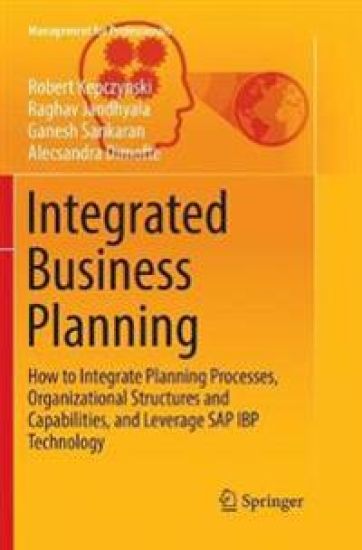
Integrated Business Planning

Integrated Business Planning

Robert Kepczynski; Raghav Jandhyala; Ganesh Sankaran; Alecsandra Dimofte

Springer Nature Switzerland AG
2019
nidottu
This book presents a comprehensive introduction to Integrated Business Planning (IBP), building on practitioner’s experience and showcasing the value gains when moving from disconnected planning to IBP. It also proposes a road map for the transformation of planning, including technological initiatives, business priorities and organizational processes, and demonstrates how to motivate different IBP stakeholders to work together, when and how to connect strategic (to be understood as long term SC&O), tactical and operational planning and how to leverage functional and data integration features of SAP IBP. Real-world business-process use cases help to show the practical implications of implementing SAP IBP. Furthermore the book explores new capabilities, talent acquisition and retention, career development leadership, IBP Center of Expertise. A discussion of how disruptive technology trends like big data, Internet of Things, machine learning and artificial intelligence can influence IBP now and in the near future rounds out the book.
Implementing Integrated Business Planning

Implementing Integrated Business Planning

Robert Kepczynski; Alecsandra Dimofte; Raghav Jandhyala; Ganesh Sankaran; Andrew Boyle

Springer Nature Switzerland AG
2019
nidottu
This book provides comprehensive guidance on leveraging SAP IBP technology to connect strategic (to be understood as long term SC&O), tactical and operational planning into one coherent process framework, presenting experience shared by practitioners in workshops, customer presentations, business, and IT transformation projects. It offers use cases and a wealth of practical tips to ensure that readers understand the challenges and advantages of IBP implementation. The book starts by characterizing disconnected planning and contrasting this with key elements of a transformation project approach. It explains the functional foundations and SAP Hybris, Trade Promotion Planning, Customer Business Planning, ARIBA, and S/4 integration with SAP IBP. It then presents process for integrating finance in IBP. Annual planning and monthly planning are taken as examples of explain Long term planning (in some companies labeled as strategic). The core of the book is about sales and operations planning (S&OP) and its process steps, product demand, supply review, integrated reconciliation and management business review, illustrating all steps with use cases. It describes unconstrained and constrained optimized supply planning, inventory optimization, shelf life planning. We explain how to improve responsiveness with order-based allocation planning, sales order confirmation, and big deal / tender management coupled with simultaneous re-planning of supply. The book closes with a chapter on performance measurement, measurement of effectiveness, efficiency, and adherence.
Implementing Integrated Business Planning

Implementing Integrated Business Planning

Robert Kepczynski; Alecsandra Dimofte; Raghav Jandhyala; Ganesh Sankaran; Andrew Boyle

Springer International Publishing AG
2018
sidottu
This book provides comprehensive guidance on leveraging SAP IBP technology to connect strategic (to be understood as long term SC&O), tactical and operational planning into one coherent process framework, presenting experience shared by practitioners in workshops, customer presentations, business, and IT transformation projects. It offers use cases and a wealth of practical tips to ensure that readers understand the challenges and advantages of IBP implementation. The book starts by characterizing disconnected planning and contrasting this with key elements of a transformation project approach. It explains the functional foundations and SAP Hybris, Trade Promotion Planning, Customer Business Planning, ARIBA, and S/4 integration with SAP IBP. It then presents process for integrating finance in IBP. Annual planning and monthly planning are taken as examples of explain Long term planning (in some companies labeled as strategic). The core of the book is about sales and operations planning (S&OP) and its process steps, product demand, supply review, integrated reconciliation and management business review, illustrating all steps with use cases. It describes unconstrained and constrained optimized supply planning, inventory optimization, shelf life planning. We explain how to improve responsiveness with order-based allocation planning, sales order confirmation, and big deal / tender management coupled with simultaneous re-planning of supply. The book closes with a chapter on performance measurement, measurement of effectiveness, efficiency, and adherence.
Integrated Business Planning

Integrated Business Planning

Robert Kepczynski; Raghav Jandhyala; Ganesh Sankaran; Alecsandra Dimofte

Springer International Publishing AG
2018
sidottu
This book presents a comprehensive introduction to Integrated Business Planning (IBP), building on practitioner’s experience and showcasing the value gains when moving from disconnected planning to IBP. It also proposes a road map for the transformation of planning, including technological initiatives, business priorities and organizational processes, and demonstrates how to motivate different IBP stakeholders to work together, when and how to connect strategic (to be understood as long term SC&O), tactical and operational planning and how to leverage functional and data integration features of SAP IBP. Real-world business-process use cases help to show the practical implications of implementing SAP IBP. Furthermore the book explores new capabilities, talent acquisition and retention, career development leadership, IBP Center of Expertise. A discussion of how disruptive technology trends like big data, Internet of Things, machine learning and artificial intelligence can influence IBP now and in the near future rounds out the book.