Kirjojen hintavertailu – 12 903 725 kirjaa ja 27 kauppaa

Kirjailija

Robert L. Bettinger

Kirjat ja teokset yhdessä paikassa: 6 kirjaa, julkaisuja vuosilta 1976–2016, suosituimpiin kuuluu Prehistoric Pinon Ecotone Settlements of the Upper Reese River Valley, Central Nevada. Vertaile teosten hintoja ja tarkista saatavuus suomalaisista kirjakaupoista.

6 kirjaa

Kirjojen julkaisuvuodet: 1976–2016.

Hunter-Gatherers

Hunter-Gatherers

Robert L. Bettinger; Raven Garvey; Shannon Tushingham

Springer-Verlag New York Inc.
2016
nidottu
Hunter-gatherer research has played a historically central role in the development of anthropological and evolutionary theory. Today, research in this traditional and enduringly vital field blurs lines of distinction between archaeology and ethnology, and seeks instead to develop perspectives and theories broadly applicable to anthropology and its many sub disciplines. In the groundbreaking first edition of Hunter-Gatherers: Archaeological and Evolutionary Theory (1991), Robert Bettinger presented an integrative perspective on hunter-gatherer research and advanced a theoretical approach compatible with both traditional anthropological and contemporary evolutionary theories. Hunter-Gatherers remains a well-respected and much-cited text, now over 20 years since initial publication. Yet, as in other vibrant fields of study, the last two decades have seen important empirical and theoretical advances. In this second edition of Hunter-Gatherers, co-authors Robert Bettinger, Raven Garvey, and Shannon Tushingham offer a revised and expanded version of the classic text, which includes a succinct and provocative critical synthesis of hunter-gatherer and evolutionary theory, from the Enlightenment to the present. New and expanded sections relate and react to recent developments—some of them the authors’ own—particularly in the realms of optimal foraging and cultural transmission theories. An exceptionally informative and ambitious volume on cultural evolutionary theory, Hunter-Gatherers, second edition, is an essential addition to the libraries of anthropologists, archaeologists, and human ecologists alike.
Hunter-Gatherers

Hunter-Gatherers

Robert L. Bettinger; Raven Garvey; Shannon Tushingham

Springer-Verlag New York Inc.
2015
sidottu
Hunter-gatherer research has played a historically central role in the development of anthropological and evolutionary theory. Today, research in this traditional and enduringly vital field blurs lines of distinction between archaeology and ethnology, and seeks instead to develop perspectives and theories broadly applicable to anthropology and its many sub disciplines. In the groundbreaking first edition of Hunter-Gatherers: Archaeological and Evolutionary Theory (1991), Robert Bettinger presented an integrative perspective on hunter-gatherer research and advanced a theoretical approach compatible with both traditional anthropological and contemporary evolutionary theories. Hunter-Gatherers remains a well-respected and much-cited text, now over 20 years since initial publication. Yet, as in other vibrant fields of study, the last two decades have seen important empirical and theoretical advances. In this second edition of Hunter-Gatherers, co-authors Robert Bettinger, Raven Garvey, and Shannon Tushingham offer a revised and expanded version of the classic text, which includes a succinct and provocative critical synthesis of hunter-gatherer and evolutionary theory, from the Enlightenment to the present. New and expanded sections relate and react to recent developments—some of them the authors’ own—particularly in the realms of optimal foraging and cultural transmission theories. An exceptionally informative and ambitious volume on cultural evolutionary theory, Hunter-Gatherers, second edition, is an essential addition to the libraries of anthropologists, archaeologists, and human ecologists alike.
Orderly Anarchy

Orderly Anarchy

Robert L. Bettinger

University of California Press
2015
sidottu
Orderly Anarchy delivers a provocative and innovative reexamination of sociopolitical evolution among Native American groups in California, a region known for its wealth of prehistoric languages, populations, and cultural adaptations. Scholars have tended to emphasize the development of social complexity and inequality to explain this diversity. Robert L. Bettinger argues instead that "orderly anarchy," the emergence of small, autonomous groups, provided a crucial strategy in social organization. Drawing on ethnographic and archaeological data and evolutionary, economic, and anthropological theory, he shows that these small groups devised diverse solutions to environmental, technological, and social obstacles to the intensified use of resources. This book revises our understanding of how California became the most densely populated landscape in aboriginal North America.
Hunter-Gatherer Foraging

Hunter-Gatherer Foraging

Robert L. Bettinger

Eliot Werner Publications Inc
2009
nidottu
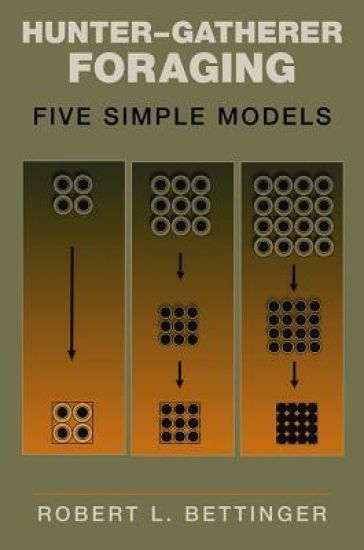
Within the last three decades, foraging theory has established itself as a major cornerstone for both archaeological and ethnographic hunter-gatherer research. Until now, however, no introductory treatment has presented the subject in a form that was quantitatively explicit and yet easy to follow. Designed as an introduction to undergraduate and graduate students new to the subject, and as a refresher for professionals seeking to broaden their command, Hunter-Gatherer Foraging: Five Simple Models presents the five foraging models that lend themselves best to hunter-gatherer application: diet breadth, linear programming, front- versus back-loaded resources, technological investment, and field processing. Each chapter begins with a hypothetical hunter-gatherer problem and takes the reader through the steps needed to state such problems in quantitative form and solve them. Exercises (with answers) at the end of each chapter reinforce key concepts and methodology. From Reference and Research Book News . . . 'A pioneer of hunter-gatherer foraging theory, Robert Bettinger offers a primer on foraging models for students new to them, especially those with little mathematical training; he also addresses professional ethnographers, ethnologists, and archaeologists who know the principles but not the details of the models or how to apply them to specific cases. He covers diet breadth, optimal foraging with constraints (linear programming), front-loaded and back-loaded resources, technological investment, and field processing. All of these models have concrete test implications that invite application across a broad range of human behaviors. For each chapter he provides exercises and answers to them. There is no index.'
A Hunter-Gatherer Landscape

A Hunter-Gatherer Landscape

Michael A. Jochim; Robert L. Bettinger

Kluwer Academic/Plenum Publishers
1998
nidottu
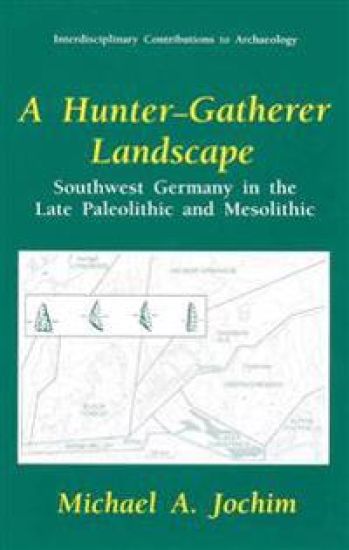
As an archaeologist with primary research and training experience in North American arid lands, I have always found the European Stone Age remote and impenetrable. My initial introduction, during a survey course on world prehis­ tory, established that (for me, at least) it consisted of more cultures, dates, and named tool types than any undergraduate ought to have to remember. I did not know much, but I knew there were better things I could be doing on a Saturday night. In any event, after that I never seriously entertained any notion of pur­ suing research on Stone Age Europe-that course was enough for me. That's a pity, too, because Paleolithic Europe-especially in the late Pleistocene and early Holocene-was the scene of revolutionary human adaptive change. Iron­ ically, all of it was amenable to investigation using precisely the same models and analytical tools I ended up spending the better part of two decades applying in the Great Basin of western North America. Back then, of course, few were thinking about the late Paleolithic or Me­ solithic in such terms. Typology, classification, and chronology were the order of the day, as the text for my undergraduate course reflected. Jochim evidently bridled less than I at the task of mastering these chronotaxonomic mysteries, yet he was keenly aware of their limitations-in particular, their silence on how individual assemblages might be connected as part of larger regional subsis­ tence-settlement systems.