
Kirjailija
Robert Lawrence
Kirjat ja teokset yhdessä paikassa: 32 kirjaa, julkaisuja vuosilta 1970–2026, suosituimpiin kuuluu Cleared for Departure. Vertaile teosten hintoja ja tarkista saatavuus suomalaisista kirjakaupoista.
32 kirjaa
Kirjojen julkaisuvuodet: 1970–2026.
Blue Collar Blues – Is Trade to Blame for Rising US Income Inequality?
Robert Lawrence
The Peterson Institute for International Economics
2008
nidottu
International trade accounts for only a small share of growing income inequality and labor-market displacement in the United States. Lawrence deconstructs the gap in real blue-collar wages and labor productivity growth between 1981 and 2006 and estimates how much higher these wages might have been had income growth been distributed proportionately and how much of the gap is due to measurement and technical factors about which little can be done. While increased trade with developing countries may have played some part in causing greater inequality in the 1980s, surprisingly, over the past decade the impact of such trade on inequality has been relatively small. Many imports are no longer produced in the United States, and US goods and services that do compete with imports are not particularly intensive in unskilled labor. Rising income inequality and slow real wage growth since 2000 reflect strong profit growth, much of which may be cyclical, and dramatic income gains for the top 1 percent of wage earners, a development that is more closely related to asset-market performance and technological and institutional innovations rather than conventional trade in goods and services. The minor role of trade, therefore, suggests that any policy that focuses narrowly on trade to deal with wage inequality and job loss is likely to be ineffective. Instead, policymakers should (a) use the tax system to improve income distribution and (b) implement adjustment policies to deal more generally with worker and community dislocation.

Gilbert and Sullivan's the Gondoliers or the King of Barataria
Robert Lawrence; Sheilah Beckett
Kessinger Pub
2007
pokkari
A US–Middle East Trade Agreement – A Circle of Opportunity?
Robert Lawrence
The Peterson Institute for International Economics
2006
nidottu
Would a free trade agreement (FTA) between the nations of the Middle East and the United States be beneficial to both sides? Robert Lawrence provides an analysis that incorporates both economic and political considerations. He documents the scope for enhancing the trade linkages, domestic governance and regional trade of Arab countries. He evaluates the US strategy in negotiating bilateral agreements and reviews in considerable detail the specific agreements that have been negotiated so far and the challenges still to meet if a single overarching arrangement is to be implemented. Lawrence also compares the US approach with the parallel initiative being undertaken by the European Union.
Case Studies in US Trade Negotiation – Resolving Disputes
Charan Devereaux; Robert Lawrence; Michael Watkins
The Peterson Institute for International Economics
2006
nidottu
Between 1992 and 2000, US exports rose by 55 percent. By the year 2000, trade summed to 26 percent of US GDP, and the United States imported almost two-thirds of its oil and was the world's largest host country for foreign investors. America's interest in a more open and prosperous foreign market is now squarely economic. These case studies in multilateral trade policymaking and dispute settlement explore the changing substance of trade agreements and also delve into the negotiation process-the who, how, and why of decision making. These books present a coherent description of the facts that will allow for discussion and independent conclusions about policies, politics, and processes. Volume 2 presents five cases on trade negotiations that have had important effects on trade policy rulemaking, as well as an analytic framework for evaluating these negotiations.
Case Studies in US Trade Negotiation – Resolving Disputes
Charan Devereaux; Robert Lawrence; Michael Watkins
The Peterson Institute for International Economics
2006
nidottu
Trade policy has moved from the wings onto center stage. Between 1992 and 2000, US exports rose by 55 percent. By the year 2000, trade summed to 26 percent of US GDP, and the United States imported almost two-thirds of its oil and was the world's largest host country for foreign investors. America's interest in a more open and prosperous foreign market is now squarely economic. This volume presents cases on five important trade negotiations, all focused on "making the rules," or the process of establishing how the trade system would operate. The cases not only explore the changing substance of trade agreements but also delve into the negotiation process. They explore not just the what of trade, but the who, how, and why of decision-making. By examining some of the most important recent negotiations, the reader can come to understand not just the larger issues surrounding trade, but how players seek to exert influence and how the system is evolving on a day-to-day basis. This book presents a coherent description of the facts that will allow for discussion and independent conclusions about policies, politics, and processes.
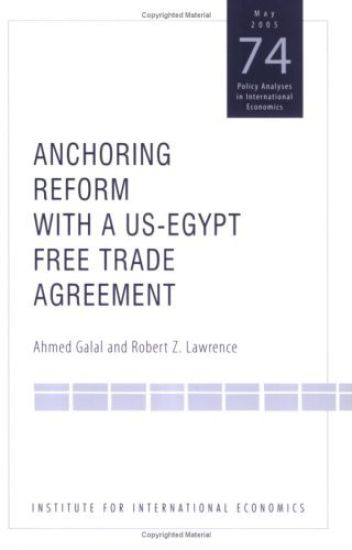
Anchoring Reform with a US–Egypt Free Trade Agreement
Ahmed Galal; Robert Lawrence
The Peterson Institute for International Economics
2005
nidottu
The relationship between the United States and the Muslim/Arab world has deteriorated since September 11, 2001. The United States is widely perceived as targeting Arab nations for their oil, especially in the wake of the war in Iraq. Measures are needed on both sides to build a more peaceful, prosperous Middle East. A free trade agreement with Egypt could be an instrument toward achieving this goal. If the United States were to select its FTA partners based on relative political importance in their regions, Egypt would top the list among Arab states. This study considers the key economic and political characteristics of Egypt as a potential FTA partner. It examines the benefits and challenges in pursuing bilateral negotiations with Egypt, examines the Bush proposal for a regional arrangement, and assesses the impact of a prospective FTA on other trading partners, on the Middle East/Arab world, and on the multilateral trading system. If an FTA with Egypt materializes, the gains can be substantial to all parties involved.
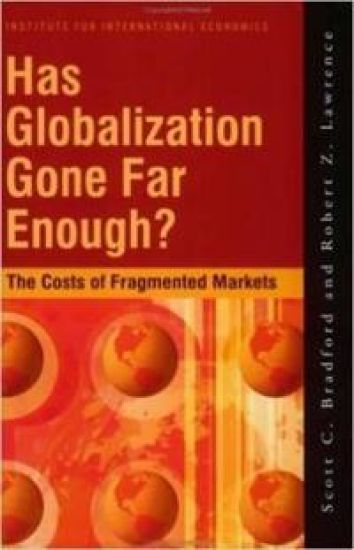
Has Globalization Gone Far Enough? – The Costs of Fragmented Markets
Scott Bradford; Robert Lawrence
The Peterson Institute for International Economics
2004
nidottu
Scott C. Bradford and Robert Z. Lawrence use the underlying data from purchasing power parity surveys to estimate the potential benefits from fully integrating goods markets among major OECD countries. These data are particularly useful because they are comprehensive, and every effort has been made to ensure that they are comparable. Input-output tables are used to eliminate distribution margins from final goods prices and thereby provide estimates of ex-factory prices. Price differentials have been taken as measures of barriers, and the welfare effects of eliminating these barriers have been estimated in a general equilibrium model. The study also provides insights into the relative openness of individual OECD countries to the world economy and the degree to which Europe has become a single market.
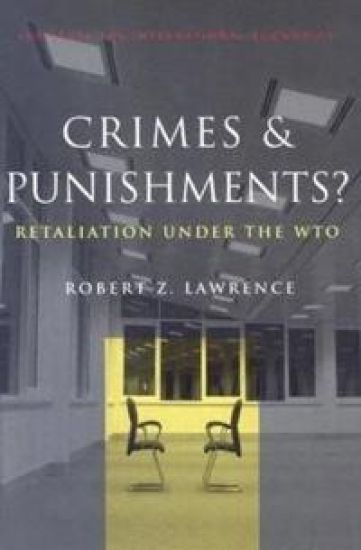
Crimes and Punishments? – Retaliation Under the WTO
Robert Lawrence
The Peterson Institute for International Economics
2003
nidottu
One of the unique aspects of the WTO as an international organization is that it authorizes members to retaliate against violations by raising tariffs. These authorizations have become increasingly common and increasingly controversial. In this analysis of the retaliation system, Robert Lawrence considers the guiding principles that govern responses to WTO violations, examines how these principles are implemented in practice, and considers options for reform.
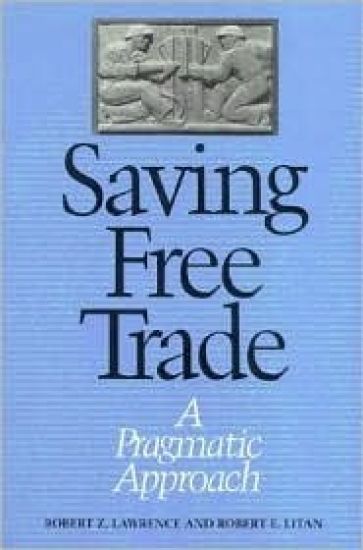
American Supporters of free trade are on the defensive. Record U. S. trade deficits are fueling demands from industry, Congress, and the public for tariffs, import quotas, and other protectionist measures that could reverse America’s long-standing commitment to open markets and sacrifice much of the economic progress experienced in recent years. In Saving Free Trade: A Pragmatic Approach, Robert Z. Lawrence and Robert E. Litan analyze both the allure of protectionism and the problems associated with free trade, proposing reasonable, cost-effective ways of helping industries, workers, and communities battered by intense import competition. The book focuses on the escape clause of the U. S. Trade Act of 1974, meant to provide domestic industries temporary shelter from severe import competition, and the trade adjustment assistance program, designed to provide direct aid to companies, workers, and communities injured by imports. The authors analyze the assumptions and implication of the many current congressional attempts to amend the provisions of the escape clause and the assistance program. They then set forth their own proposals, including new definitions of import injuries, modifications of provisions for providing relief for beleaguered companies, new standards for compensating and retaining displaced workers, and a plan for insuring communities against severe losses to their tax bases if local industries fail because they can no longer compete. Saving Free Trade provides a detailed but nontechnical introduction to the complex implications of amending trade policy and shrewd, innovative proposals for improving America’s ability to adapt to rapid changes in world markets.

An examination of the performance of U. S. manufacturing in historical and global perspective indicates that, contrary to recent fears, international trade competition has not induced the deindustrialization of America. During the 1970s the U. S. manufacturing sector fared relatively well compared to its counterparts in other industrual countries and its own post-war track record. Most of its problems in the early 1980s are linked to domestic recession and the strong U. S. dollar. A number of implicit assumptions in the current discussion about U. S. industrial performance are shown in this book to be inappropriate?changes in international trade are not the major reason for the declining share of manufacturing in U. S. employment: even though foreign productive capabilities are catching up with those of the United States, the U. S. comparative advantage in high-technology products has increased. The author looks at these and other issues and seeks to clarify some common misperceptions about U. S. manufacturing. He examines long-term trends and changes since 1973 in U. S. manufacturing?employment, capital formation, research and development expenditures, and output. He looks closely at manufacturing trade flows and their major determinants and at the role of trade in the U. S. manufacturing sector. The last part of the book addresses policy options for the United States, including laissez-faire, matching foreign subsidies, and new industrial policies. Changes in U. S. policies are suggested that might facilitate efficient structural trade adjustment, improve trade policy, and compensate for market failures.