Kirjojen hintavertailu – 12 903 725 kirjaa ja 27 kauppaa

Kirjailija

Robert Leroux

Kirjat ja teokset yhdessä paikassa: 10 kirjaa, julkaisuja vuosilta 2002–2019, suosituimpiin kuuluu Gabriel Tarde. Vie, ¿uvres, concepts. Vertaile teosten hintoja ja tarkista saatavuus suomalaisista kirjakaupoista.

10 kirjaa

Kirjojen julkaisuvuodet: 2002–2019.

History and Sociology in France

History and Sociology in France

Robert Leroux

Routledge
2019
nidottu
In the late 19th century and early part of the 20th, with the coming of age of sociology in France, the idea that there could be a “science” of history was the subject of much and varied debate. The methodological problems surrounding historical knowledge that were debated throughout this period concerned not only scientific history, but the social sciences as well, and sociology more specifically. Although sociology was from its origins in competition with the discipline of history, from the outset, it too was interested in history as a form of objective knowledge. Many of sociology's founders believed that by retracing historical processes, they could make a clean break with abstraction and metaphysics. For their part, historians generally remained hostile to any kind of systematization. And yet, at the end of the 19th century, the science of history would draw some valuable lessons from the emerging methodology of sociology. It was in large part under the impetus of the issues and problems raised by the philosopher Henri Berr and by the Durkheimian School, with the economist François Simiand as its lead protagonist, that the community of historians, increasingly aware of the limits of narrative history, turned so enthusiastically to social and economic history – just as Durkheim and his disciples consulted history in order to avoid the twin pitfalls of the philosophy of history and of introspective psychology. History and Sociology in France focuses on this dialogue of the two neighboring sciences.
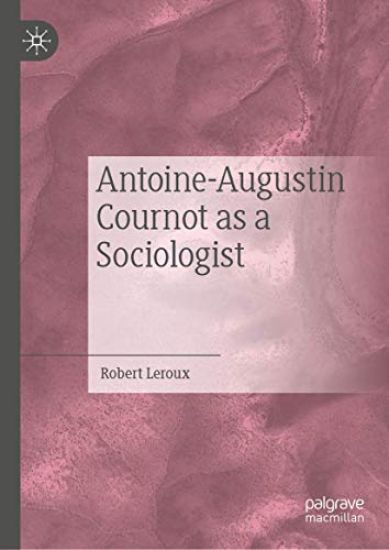
Antoine-Augustin Cournot as a Sociologist

Antoine-Augustin Cournot as a Sociologist

Robert Leroux

Springer Nature Switzerland AG
2019
sidottu
The thinking of Antoine-Augustin Cournot has inspired a growing literature in economy and epistemology, but as of yet, his sociological thought has not been explicitly discussed and contextualized within the discipline. From the 1850s to the end of the 1870s, Cournot contributed significantly to the history of French sociology, particularly in the development of one essential idea: that forms of knowledge are intimately linked to the progress of reason. Philosophy, therefore, becomes interested in the development of the sciences, evolving as they do from the process of rationalizing human societies. Cournot’s comparative-historical sociology, “rediscovered” especially by Gabriel Tarde in the 20th century, seeks to understand how a macro-sociological trend can depend on the aggregation of a host individual decisions and actions, or to discern a certain order out of apparent chaos.
History and Sociology in France

History and Sociology in France

Robert Leroux

Routledge
2017
sidottu
In the late 19th century and early part of the 20th, with the coming of age of sociology in France, the idea that there could be a “science” of history was the subject of much and varied debate. The methodological problems surrounding historical knowledge that were debated throughout this period concerned not only scientific history, but the social sciences as well, and sociology more specifically. Although sociology was from its origins in competition with the discipline of history, from the outset, it too was interested in history as a form of objective knowledge. Many of sociology's founders believed that by retracing historical processes, they could make a clean break with abstraction and metaphysics. For their part, historians generally remained hostile to any kind of systematization. And yet, at the end of the 19th century, the science of history would draw some valuable lessons from the emerging methodology of sociology. It was in large part under the impetus of the issues and problems raised by the philosopher Henri Berr and by the Durkheimian School, with the economist François Simiand as its lead protagonist, that the community of historians, increasingly aware of the limits of narrative history, turned so enthusiastically to social and economic history – just as Durkheim and his disciples consulted history in order to avoid the twin pitfalls of the philosophy of history and of introspective psychology. History and Sociology in France focuses on this dialogue of the two neighboring sciences.

Political Economy and Liberalism in France
The purpose of this book is to provide a comprehensive analysis of the work of Frédéric Bastiat (1801-1850), one of the towering intellectual figures of nineteenth century France. More than anyone else of his time, Bastiat personified the struggle of liberalism and science against socialism and utopia. Between 1844 in 1850, his campaign for the idea of liberty and his commitment to the discipline of political economy made him one of the most vigorous champions of economic liberalism in France. Bastiat put forth one of the most ambitious interpretations of the liberalism of his time, one that entailed both a critique of primitive socialism and a concern to provide political economy with a theoretical foundation. His thinking is far more sophisticated than would appear at first glance. Nor can it be confined, as so many commentators would have us believe, to its strictly economic dimension. The themes that Bastiat addressed – free trade, competition, labour, among others – certainly helped to reduce it to this dimension. Yet he did not limit himself to these issues, even if he dealt with them at length. He also paid close attention to the political, moral, social and religious dimensions. Coming, as Bastiat’s writing did, at a decisive moment in the history of French liberalism, the very existence of his work explodes the long-standing received idea to the effect that liberalism, and in particular economic liberalism, is the exclusive domain of Anglo-Saxon countries. Bastiat’s work thus offers a solid rebuttal to Hayek, who proclaimed "the total absence of a liberal tradition in France." This book should be of interest to students and researchers of many strands of economics, as well as those looking at French liberalism and the history of social science more generally.
The Foundations of Industrialism

The Foundations of Industrialism

Robert Leroux

Peter Lang Publishing Inc
2016
sidottu
From its beginnings, the doctrine of industrialism has inspired writers of varying persuasions. Saint-Simon is often closely associated with it, however, he represents only the socialist variant of the doctrine. By contrast, the variant that relates to liberalism has been virtually overlooked. Jean-Baptiste Say, Benjamin Constant and Joseph Droz, for example, provided crucial elements that would eventually lead two friends, Charles Comte (1782–1837) and Charles Dunoyer (1786–1862), to define industrialism in a more complete manner that was in fact radically opposed in many aspects to the notions of Saint-Simon. This shows that the term «industrialism» has many meanings. Mechanization, the production of wealth, the age of trades and specialization, the notion that progress is unstoppable, the question of liberty and individualism – these are the main themes that we find in the writings of the liberal proponents of industrialism. For Charles Comte and Charles Dunoyer, industrialism was a kind of philosophy of history, the purpose of which was to identify the tortuous stages through which the idea of liberty had developed. In doing this, as Robert Leroux explains, they shared a conviction, or perhaps a concern, based on clear historical evidence, that liberty is a fragile thing, and that its victory will never be final.
Political Economy and Liberalism in France
The purpose of this book is to provide a comprehensive analysis of the work of Frédéric Bastiat (1801-1850), one of the towering intellectual figures of nineteenth century France. More than anyone else of his time, Bastiat personified the struggle of liberalism and science against socialism and utopia. Between 1844 in 1850, his campaign for the idea of liberty and his commitment to the discipline of political economy made him one of the most vigorous champions of economic liberalism in France. Bastiat put forth one of the most ambitious interpretations of the liberalism of his time, one that entailed both a critique of primitive socialism and a concern to provide political economy with a theoretical foundation. His thinking is far more sophisticated than would appear at first glance. Nor can it be confined, as so many commentators would have us believe, to its strictly economic dimension. The themes that Bastiat addressed – free trade, competition, labour, among others – certainly helped to reduce it to this dimension. Yet he did not limit himself to these issues, even if he dealt with them at length. He also paid close attention to the political, moral, social and religious dimensions. Coming, as Bastiat’s writing did, at a decisive moment in the history of French liberalism, the very existence of his work explodes the long-standing received idea to the effect that liberalism, and in particular economic liberalism, is the exclusive domain of Anglo-Saxon countries. Bastiat’s work thus offers a solid rebuttal to Hayek, who proclaimed "the total absence of a liberal tradition in France." This book should be of interest to students and researchers of many strands of economics, as well as those looking at French liberalism and the history of social science more generally.