Kirjojen hintavertailu – 12 859 819 kirjaa ja 27 kauppaa

Kirjailija

Robert M. Price

Kirjat ja teokset yhdessä paikassa: 41 kirjaa, julkaisuja vuosilta 1999–2025, suosituimpiin kuuluu When Faith Meets Reason. Vertaile teosten hintoja ja tarkista saatavuus suomalaisista kirjakaupoista.

Nimi esiintyy myös muodoissa: Robert M Price

41 kirjaa

Kirjojen julkaisuvuodet: 1999–2025.

Killing History

Killing History

Robert M. Price

Prometheus Books
2014
pokkari
Killing Jesus, the bestselling blockbuster by Bill O'Reilly, claims to be a purely historical account of the events in the life of Jesus leading up to his crucifixion. New Testament scholar Robert M. Price (a member of the Jesus Seminar) shows how unfounded this claim is in this critical review of O'Reilly's work. In fact, he judges the book to be the number one source of misinformation on Jesus today. Ignoring over one hundred years of New Testament scholarship, O'Reilly and his coauthor, Martin Dugard, have produced what Price describes as a Christian historical thriller that plays fast and loose with the facts. Price goes through the key events of Jesus' later life as described in the gospels and retold in Killing Jesus, painstakingly showing in each case what scholars know and don't know. Using humor, down-to-earth analogies, and witty sarcasm-not unlike O'Reilly's own interview style-Price makes it clear that O'Reilly's book is more historical novel than a work of serious history. By cobbling together the four gospel stories, ignoring the contradictions, and adding plenty of quasi-historical background embellishments, O'Reilly and Dugard have created a good narrative that resonates with a lot of Christians. Entertaining reading this may be, but history it is not. Killing History provides lay readers with an accessible introduction to New Testament scholarship while showing the many problems in O'Reilly's book.
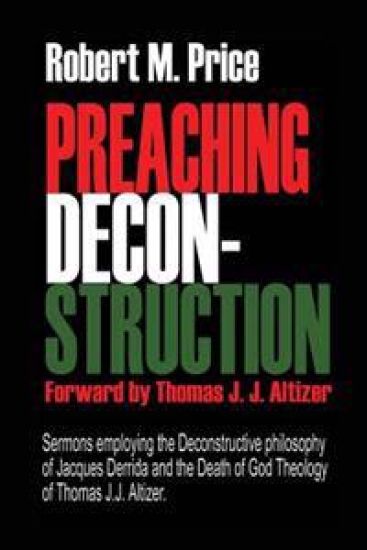
Preaching Deconstruction

Preaching Deconstruction

Thomas J. J. Altizer; Robert M. Price

Mindvendor
2014
nidottu
Deconstruction is usually denigrated (or praised ) for being esoteric, abstruse, a method and a language restricted to a self-appointed academic elite. Its critics object that Deconstruction is a mind-game with no connection or relation to the real world. Perhaps the very opposite kind of speech is pulpit preaching, a dispensing of comforting bromides and pious clich s aimed at reinforcing the prejudices of the pew potatoes. What could Deconstruction and Postmodernism possibly have to do with preaching? They seem alien even to social activist liberal Protestant cheer-leading. In this book Robert M. Price applies the philosophy of Jacques Derrida and the radical theology of Thomas J. J. Altizer to real questions of spirituality and biblical interpretation. Price preaches from both Old and New Testaments, as well as the Koran and the Gospel of Thomas. Other influences on these sermons, delivered in a Baptist church, include Paul Tillich, Paul de Man, Rudolf Bultmann, Robert W. Chambers, Ingmar Bergman, Malcolm Boyd, and Thomas Ligotti. The book features a foreword by Thomas Altizer, an important new essay in its own right, as well as Price's introductory discussion of Deconstruction, then a set of innovative sermons. The sermons are not about Deconstruction. They are about spirituality and the Bible. But Deconstruction is everywhere present as an atmosphere and a medium. It quickly becomes clear, not only that no theological orthodoxy is any longer possible, but also that it is not necessary for Postmodern man (and woman) to blaze a path on the new spiritual frontier. The radical theology that erupted in the 1960s has long been relegated to a pop cultural time capsule along with lava lamps and Nehru jackets. But it is not unusual for the majority to (nervously)laugh off what makes them uncomfortable. In the 1990s, Deconstruction revived the theology of the Death of God, providing a much-needed theoretical reformulation. The significance of Deconstruction can be measured by the amount of controversy, even hysteria, that it provoked. The publication of these unique sermons is an attempt to keep that witness alive. And to demonstrate that Deconstruction provides a new way forward in religious exploration.

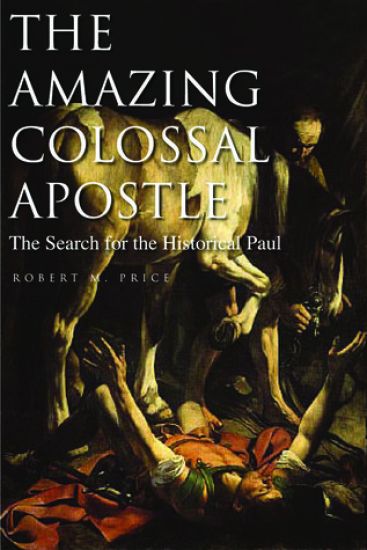
The Amazing Colossal Apostle: The Search for the Historical Paul Volume 1
The story of Paul is one of irony, the New Testament depicting him at the martyrdom of Stephen holding the assassins' cloaks. Then this same Paul is transformed into the biblical archetype for someone suffering for their faith. He becomes so entrenched, it would appear that he had walked with the Christians all his life, that he was the one who defined the faith, eventually being called the "second founder of Christianity." But much of what we think we "know" about Paul comes from Sunday school stories we heard as children. The stories were didactic tales meant to keep us reverent and obedient. As adults reading the New Testament, we catch glimpses of a very different kind of disciple--a wild ascetic whom Tertullian dubbed "the second apostle of Marcion and the apostle of the heretics." What does scholarship tell us about the enigmatic thirteenth apostle who looms larger than life in the New Testament? The epistles give evidence of having been written at the end of the first century or early in the second--too late to have been Paul's actual writings. So who wrote (and rewrote) them? F. C. Baur, a nineteenth-century theologian, pointed persuasively to Simon Magus as the secret identity of "Paul." Robert M. Price, in this exciting journey of discovery, gives readers the background for a story we thought we knew.
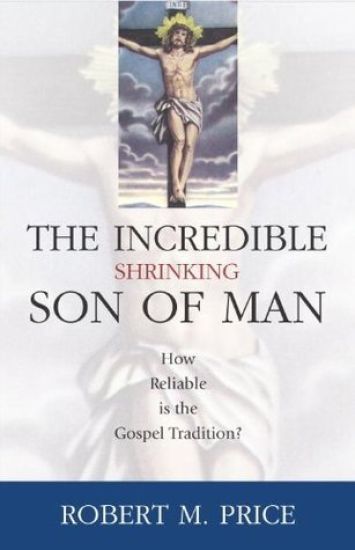
Incredible Shrinking Son of Man

Incredible Shrinking Son of Man

Robert M. Price

Prometheus Books
2004
sidottu
"This book should be mandatory reading for all scholars concerned with Christian origins ... nothing of comparable importance has been written for at least a decade." - Freethinker For more than a century scholars have been examining the Gospels and other traditions about the life of Jesus to determine their historical accuracy. Although the results of these scholarly efforts are sometimes controversial, the consensus among researchers today is that the four Evangelists' accounts cannot be taken at face value. In fact, a team of more than 100 scholars called the Jesus Seminar has come to the conclusion that on average only about 18 percent of the four Gospels is historically accurate. An active member of the Jesus Seminar, Dr. Robert M. Price presents the fruits of this important historical research in this fascinating discussion of early Christianity. As the title suggests, Price is none too optimistic about the reliability of the Gospel tradition as a source of accurate historical information about the life of Jesus. Indeed, he feels that his colleagues in the Jesus Seminar are much too optimistic in their estimate of authentic material in the Gospels. After an introduction to the historical-critical method for nonspecialists and a critique of the methods used by the Jesus Seminar, Price systematically discusses the narrative and teaching materials in the Gospel, clearly presenting what is known and not known about all of the major episodes of Jesus' life. He also examines the parables for authenticity as well as Jesus' teachings about the Kingdom of God, repentance, prayer, possessions and poverty, the Atonement, and many other features of the Gospels. Written for the general reading public in a lively and accessible style, Dr. Price's highly informative discussion will be of interest to anyone who has wondered about the origins of Christianity.
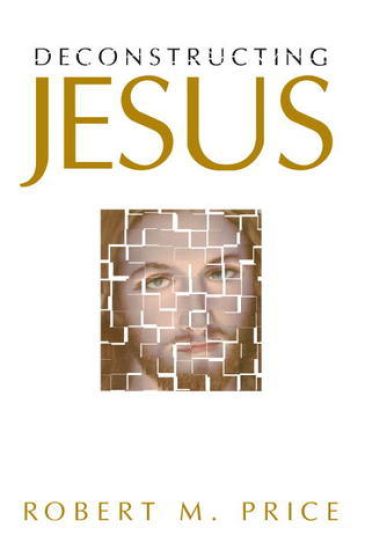
Deconstructing Jesus

Deconstructing Jesus

Robert M. Price

Prometheus Books
2000
sidottu
After more than a century of New Testament scholarship, it has become clear that the Jesus of the gospels is a fictive amalgam, reflecting the hopes and beliefs of the early Christian community and revealing very little about the historical Jesus. Over the millennia since the beginning of Christianity various congregations, from fundamentalist to liberal, have tended to produce a Jesus figurehead that functions as a symbolic cloak for their specific theological agendas. Through extensive research and fresh textual insights Robert M. Price paves the way for a new reconstruction of Christian origins. Moving beyond the work of Burton L. Mack and John Dominic Crossan on Jesus movements and Christ cults, which shows how the various Jesus figures may have amalgamated into the patchwork savior of Christian faith, Price takes an innovative approach. He links the work of F. C. Baur, Walter Bauer, Helmut Koester, and James M. Robinson with that of early Christ-myth theorists-two camps of biblical analysis that have never communicated. Arguing that perhaps Jesus never existed as a historical figure, Price maintains an agnostic stance, while putting many puzzles and scholarly debates in a new light. He also incorporates neglected parallels from Islam, the Baha'i Faith, and Buddhism. Deconstructing Jesus provides a valuable bridge between New Testament scholarship and early freethinkers in a refreshing cross-fertilization of perspectives.