Kirjojen hintavertailu – 12 903 725 kirjaa ja 27 kauppaa

Kirjailija

Robert Millward

Kirjat ja teokset yhdessä paikassa: 5 kirjaa, julkaisuja vuosilta 1994–2015, suosituimpiin kuuluu Public and Private Ownership of British Industry 1820-1990. Vertaile teosten hintoja ja tarkista saatavuus suomalaisista kirjakaupoista.

5 kirjaa

Kirjojen julkaisuvuodet: 1994–2015.

The State and Business in the Major Powers
In the 19th and early 20th centuries, the state emerged as a major player in the economies of the Western World. This important new volume provides an economic history for the period 1815-1939 of state/business relations in the major powers: France, Germany, Japan, Russia, UK and the USA. The book challenges the traditional story that the scale of state intervention reflected the degree to which each country was ideologically committed to laissez-faire, and which also tended to assume that governments were interested in economic growth and raising average living standards. Robert Millward gives a rather different perspective, arguing that the scale of state intervention and the differences across countries were motivated more by considerations of external defence and internal unification than by any notions of promoting economic growth or adherence to laissez-faire. This book provides, for the first time, an integrated economic history of these state /business relations in the major powers in the period 1815-1939, and offers a completely new perspective on the links between tariff policies, state enterprise in manufacturing, the treatment of the peasantry, regulation of railways, taxation of the business sector, policies on cartels, trusts and competition.
The State and Business in the Major Powers
In the 19th and early 20th centuries, the state emerged as a major player in the economies of the Western World. This important new volume provides an economic history for the period 1815-1939 of state/business relations in the major powers: France, Germany, Japan, Russia, UK and the USA. The book challenges the traditional story that the scale of state intervention reflected the degree to which each country was ideologically committed to laissez-faire, and which also tended to assume that governments were interested in economic growth and raising average living standards. Robert Millward gives a rather different perspective, arguing that the scale of state intervention and the differences across countries were motivated more by considerations of external defence and internal unification than by any notions of promoting economic growth or adherence to laissez-faire. This book provides, for the first time, an integrated economic history of these state /business relations in the major powers in the period 1815-1939, and offers a completely new perspective on the links between tariff policies, state enterprise in manufacturing, the treatment of the peasantry, regulation of railways, taxation of the business sector, policies on cartels, trusts and competition.
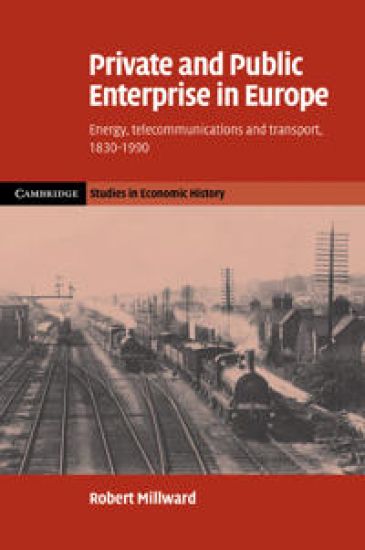
Private and Public Enterprise in Europe

Private and Public Enterprise in Europe

Robert Millward

Cambridge University Press
2008
pokkari
This 2005 book is a comparative history of the economic organisation of energy, telecommunications and transport in Europe in the nineteenth and twentieth centuries. It examines the role that private and public enterprise have played in the construction and operation of the railways, electricity, gas and water supply, tramways, coal, oil and natural gas industries, telegraph, telephone, computer networks and other modern telecommunications. The book begins with the arrival of the railways in the 1830s, charts the development of arms' length regulation, municipalisation and nationalisation, and ends on the eve of privatisation in the 1980s. Robert Millward argues that the role of ideology, especially in the form of debates about socialism and capitalism, has been exaggerated. Instead the driving forces in changes in economic organisation were economic and technological factors and the book traces their influence in shaping the pattern of regulation and ownership of these key sectors of modern economies.
Private and Public Enterprise in Europe

Private and Public Enterprise in Europe

Robert Millward

Cambridge University Press
2005
sidottu
This 2005 book is a comparative history of the economic organisation of energy, telecommunications and transport in Europe in the nineteenth and twentieth centuries. It examines the role that private and public enterprise have played in the construction and operation of the railways, electricity, gas and water supply, tramways, coal, oil and natural gas industries, telegraph, telephone, computer networks and other modern telecommunications. The book begins with the arrival of the railways in the 1830s, charts the development of arms' length regulation, municipalisation and nationalisation, and ends on the eve of privatisation in the 1980s. Robert Millward argues that the role of ideology, especially in the form of debates about socialism and capitalism, has been exaggerated. Instead the driving forces in changes in economic organisation were economic and technological factors and the book traces their influence in shaping the pattern of regulation and ownership of these key sectors of modern economies.
Public and Private Ownership of British Industry 1820-1990

Public and Private Ownership of British Industry 1820-1990

James Foreman-Peck; Robert Millward

Clarendon Press
1994
sidottu
Britain led the way for much of the world with industrial privatization during the 1980s. Yet the historical origins of the process that was being reversed have rarely been examined. This is a study of public and private ownership in industries such as railways, gas, water, electricity, and telecommunications. Industries such as these rely upon a substanial physical distribution network that `channels' their service from source to destination. They thus raise distinctive problems for government policy, as their requirement for some sort of unified system is incompatible with the coexistence of a number of competing service suppliers. Yet competition has been the traditional guarantee of `fair' and minimum prices in British industrial policy. This tension between experience and ideology provoked a variety of government policies over the last two centuries. Robert Millward and James Foreman-Peck provide a coherent and thorough economic history of the network industries, which continue to play an important role in the British economy. They trace the development of various institutional arrangements from the early nineteenth century until the end of the 1980s, and provide quantitative estimates of their performance. Their book offers a valuable historical approach to the contentious issue of privatization.