

Kirjailija
Robert Mitchell
Kirjat ja teokset yhdessä paikassa: 38 kirjaa, julkaisuja vuosilta 2002–2026, suosituimpiin kuuluu Jennifer. Vertaile teosten hintoja ja tarkista saatavuus suomalaisista kirjakaupoista.
38 kirjaa
Kirjojen julkaisuvuodet: 2002–2026.
Sympathy and the State in the Romantic Era explores a fascinating connection between two seemingly unrelated Romantic-era discourses, outlining the extent to which eighteenth and early nineteenth century theories of sympathy were generated by crises of state finance. Through readings of authors such as David Hume, Adam Smith, William Wordsworth, and P. B. Shelley, this volume establishes the ways in which crises of state finance encouraged the development of theories of sympathy capable of accounting for both the fact of "social systems" as well as the modes of emotional communication by means of which such systems bound citizens to one another. Employing a methodology that draws on the systems theory of Niklas Luhmann, Michel Serres, and Giovanni Arrighi, as well as Gilles Deleuze’s theories of time and affect, this book argues that eighteenth and early nineteenth century philosophies of sympathy emerged as responses to financial crises. Individual chapters focus on specific texts by David Hume, Adam Smith, Jean-Jacques Rousseau, Ann Yearsley, William Wordsworth, and P. B. Shelley, but Mitchell also draws on periodicals, pamphlets, and parliamentary hearings to make the argument that Romantic era theories of sympathy developed new discourses about social systems intended both to explain, as well as contain, the often disruptive effects of state finance and speculation.
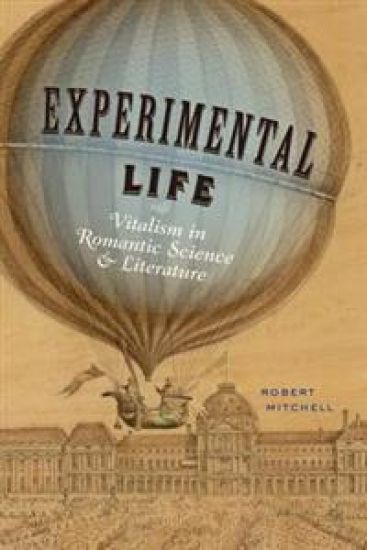
If the objective of the Romantic movement was nothing less than to redefine the meaning of life itself, what role did experiments play in this movement? While earlier scholarship has established both the importance of science generally and vitalism specifically, with regard to Romanticism no study has investigated what it meant for artists to experiment and how those experiments related to their interest in the concept of life. Experimental Life draws on approaches and ideas from contemporary science studies, proposing the concept of experimental vitalism to show both how Romantic authors appropriated the concept of experimentation from the sciences and the impact of their appropriation on post-Romantic concepts of literature and art. Robert Mitchell navigates complex conceptual arenas such as network theory, gift exchange, paranoia, and biomedia and introduces new concepts, such as cryptogamia, chylopoietic discourse, trance-plantation, and the poetics of suspension. As a result, Experimental Life is a wide-ranging summation and extension of the current state of literary studies, the history of science, cultural critique, and theory.

The Trials of the Initiate: Transforming the Warrior Spirit
Robert Mitchell
Createspace Independent Publishing Platform
2012
nidottu

Journey to Myrtos: Vietnam to Crete--Healing the Wounds of War
Robert Mitchell
Createspace Independent Publishing Platform
2011
nidottu


William Of Normandy, A Play In Five Acts; Echo, A Poem; Village Church And Churchyard Musings; Crimean Sonnets (1879)
Robert Mitchell
KESSINGER PUBLISHING, LLC
2010
pokkari

Sympathy and the State in the Romantic Era explores a fascinating connection between two seemingly unrelated Romantic-era discourses, outlining the extent to which eighteenth and early nineteenth century theories of sympathy were generated by crises of state finance. Through readings of authors such as David Hume, Adam Smith, William Wordsworth, and P. B. Shelley, this volume establishes the ways in which crises of state finance encouraged the development of theories of sympathy capable of accounting for both the fact of "social systems" as well as the modes of emotional communication by means of which such systems bound citizens to one another. Employing a methodology that draws on the systems theory of Niklas Luhmann, Michel Serres, and Giovanni Arrighi, as well as Gilles Deleuze’s theories of time and affect, this book argues that eighteenth and early nineteenth century philosophies of sympathy emerged as responses to financial crises. Individual chapters focus on specific texts by David Hume, Adam Smith, Jean-Jacques Rousseau, Ann Yearsley, William Wordsworth, and P. B. Shelley, but Mitchell also draws on periodicals, pamphlets, and parliamentary hearings to make the argument that Romantic era theories of sympathy developed new discourses about social systems intended both to explain, as well as contain, the often disruptive effects of state finance and speculation.
Tissue Economies
Robert Mitchell; Catherine Waldby
Duke University Press
2006
pokkari
Halvin toimitettuna 34,60 €
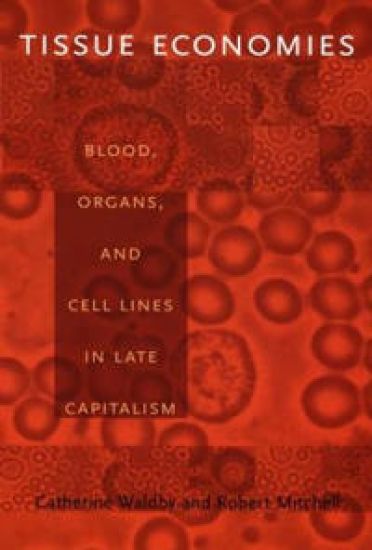
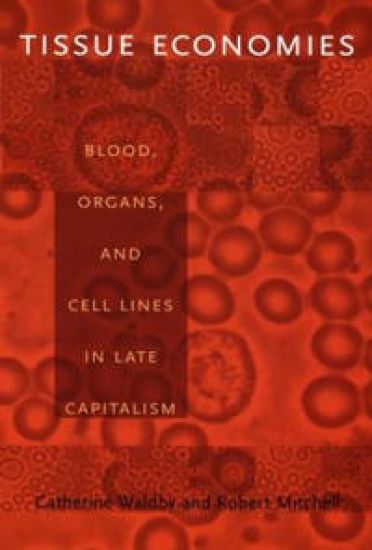
As new medical technologies are developed, more and more human tissues-such as skin, bones, heart valves, embryos, and stem cell lines-are stored and distributed for therapeutic and research purposes. The accelerating circulation of human tissue fragments raises profound social and ethical concerns related to who donates or sells bodily tissue, who receives it, and who profits-or does not-from the transaction. Catherine Waldby and Robert Mitchell survey the rapidly expanding economies of exchange in human tissue, explaining the complex questions raised and suggesting likely developments. Comparing contemporary tissue economies in the United Kingdom and United States, they explore and complicate the distinction that has dominated practice and policy for several decades: the distinction between tissue as a gift to be exchanged in a transaction separate from the commercial market and tissue as a commodity to be traded for profit. Waldby and Mitchell pull together a prodigious amount of research-involving policy reports and scientific papers, operating manuals, legal decisions, interviews, journalism, and Congressional testimony-to offer a series of case studies based on particular forms of tissue exchange. They examine the effect of threats of contamination-from HIV and other pathogens-on blood banks’ understandings of the gift/commodity relationship; the growth of autologous economies, in which individuals bank their tissues for their own use; the creation of the United Kingdom’s Stem Cell bank, which facilitates the donation of embryos for stem cell development; and the legal and financial repercussions of designating some tissues “hospital waste.” They also consider the impact of different models of biotechnology patents on tissue economies and the relationship between experimental therapies to regenerate damaged or degenerated tissues and calls for a legal, for-profit market in organs. Ultimately, Waldby and Mitchell conclude that scientific technologies, the globalization of tissue exchange, and recent anthropological, sociological, and legal thinking have blurred any strict line separating donations from the incursion of market values into tissue economies.
As new medical technologies are developed, more and more human tissues-such as skin, bones, heart valves, embryos, and stem cell lines-are stored and distributed for therapeutic and research purposes. The accelerating circulation of human tissue fragments raises profound social and ethical concerns related to who donates or sells bodily tissue, who receives it, and who profits-or does not-from the transaction. Catherine Waldby and Robert Mitchell survey the rapidly expanding economies of exchange in human tissue, explaining the complex questions raised and suggesting likely developments. Comparing contemporary tissue economies in the United Kingdom and United States, they explore and complicate the distinction that has dominated practice and policy for several decades: the distinction between tissue as a gift to be exchanged in a transaction separate from the commercial market and tissue as a commodity to be traded for profit. Waldby and Mitchell pull together a prodigious amount of research-involving policy reports and scientific papers, operating manuals, legal decisions, interviews, journalism, and Congressional testimony-to offer a series of case studies based on particular forms of tissue exchange. They examine the effect of threats of contamination-from HIV and other pathogens-on blood banks’ understandings of the gift/commodity relationship; the growth of autologous economies, in which individuals bank their tissues for their own use; the creation of the United Kingdom’s Stem Cell bank, which facilitates the donation of embryos for stem cell development; and the legal and financial repercussions of designating some tissues “hospital waste.” They also consider the impact of different models of biotechnology patents on tissue economies and the relationship between experimental therapies to regenerate damaged or degenerated tissues and calls for a legal, for-profit market in organs. Ultimately, Waldby and Mitchell conclude that scientific technologies, the globalization of tissue exchange, and recent anthropological, sociological, and legal thinking have blurred any strict line separating donations from the incursion of market values into tissue economies.
To devise a theory of education is to address the questions of culture, cultural values and cultural identity formation in the child. In this original study, Robert Mitchell gives us a scholarly overview of cultural education in America's schools. He demonstrates how the public trust of universal education fails our children and our democracy. He then advocates reframing our concept of education in terms of a sacred trust that teaches the culture of democracy. Turning to the question of the role of the teacher, Mr. Mitchell weaves together anecdotal evidence of a teacher archetype with advanced theories in archetypal psychology. This compelling work breaks new ground to provide us with a refreshingly new and visionary approach to K-12 education.
To devise a theory of education is to address the questions of culture, cultural values and cultural identity formation in the child. In this original study, Robert Mitchell gives us a scholarly overview of cultural education in America's schools. He demonstrates how the public trust of universal education fails our children and our democracy. He then advocates reframing our concept of education in terms of a sacred trust that teaches the culture of democracy. Turning to the question of the role of the teacher, Mr. Mitchell weaves together anecdotal evidence of a teacher archetype with advanced theories in archetypal psychology. This compelling work breaks new ground to provide us with a refreshingly new and visionary approach to K-12 education.

This major reference work details the story of London Underground’s award winning Jubilee Line Extension (JLE), how it came to being, how it was planned, how it was designed, built and commissioned, and how the millennium deadline imposed by the Dome was met. Always in the public eye and the political spotlight, the JLE has played a significant role in the success of the Canary Wharf development, improved public transport immeasurably in the areas of southeast and east London, and set new standards for London Underground and public transport. Despite the problems and the much publicised cost and time overruns, the project can still be considered to be a major construction achievement. The Jubilee Line Extension: From Concept to Completion describes in detail the history of the project, which goes back more than 50 years. The first concepts were defined in 1943, and the book traces developments to the East London Railway study that effectively defined the JLE Extension. Also presented is a detailed insight into the development of the Olympia & York funding contribution that was a key issue in achieving Government approval. With contributions from some of the major contractors personnel involved, the book offers a detailed and factual account of the completion of this ‘stunning’ new railway line. Much has been written about the construction work of the JLE, particularly the stations, however, this is the first book that provides a rounded view of how a major new underground railway line came to be built and presents key details of the JLE project activities relating to transport planning, the legal processes, comprehensive safety planning, procurement, contracting, engineering development, environmental issues, project management and commissioning. And all achieved under immense political and media scrutiny. The Jubilee Line Extension: From Concept to Completion will appeal to everyone who is interested in major transportation projects and in discovering how the JLE was able to deliver a major urban infrastructure project with the minimum of environmental disturbance and with an exemplary safety record. Project managers will find this detailed record of all that was involved an inspiration and an invaluable source of information, which they can apply to other projects they are working on now and in the future.
Boost your confidence for taking the GED test with help from "McGraw-Hill's GED" workbook series. The newly revised "McGraw-Hill's GED" workbook series helps you practice the skills you need to pass all five areas of the GED test. Designed to complement "McGraw-Hill's GED" test series and the complete "McGraw-Hill's GED", these books provide extra practice and reinforcement to ensure success. The series covers: language arts, reading; language arts, writing; mathematics; social studies; and, science. "McGraw-Hill's GED Science Workbook" begins with an introduction that explains the content of the Science exam. Multiple-choice questions provide thorough testing of all aspects of the exam, including life sciences, physical sciences, earth and space sciences, and interdisciplinary themes. Finally, a full-length Practice Test in official GED format will help you evaluate your readiness for the GED test. Complete solutions and explanations are provided in the Answer Key. "McGraw-Hill's GED Science Workbook" includes: graphs and diagrams so that you can become comfortable interpreting the visual elements of the GED; high-interest readings to increase your understanding of all areas of science; and, hundreds of practice questions to develop your understanding of scientific themes and concepts. With "McGraw-Hill's GED Science Workbook", you will have that extra confidence for taking the GED test.