Kirjojen hintavertailu – 12 903 742 kirjaa ja 27 kauppaa

Kirjailija

Robert N. McCauley

Kirjat ja teokset yhdessä paikassa: 8 kirjaa, julkaisuja vuosilta 1993–2023, suosituimpiin kuuluu Why Religion is Natural and Science is Not. Vertaile teosten hintoja ja tarkista saatavuus suomalaisista kirjakaupoista.

8 kirjaa

Kirjojen julkaisuvuodet: 1993–2023.

Manias, Panics, and Crashes

Manias, Panics, and Crashes

Robert Z. Aliber; Charles P. Kindleberger; Robert N. McCauley

Springer International Publishing AG
2023
nidottu

Halvin toimitettuna 31,90 €

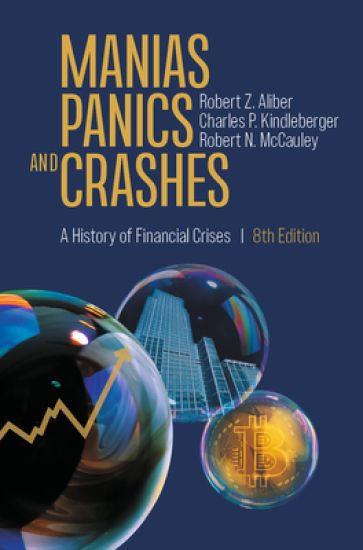
In the Eighth Edition of this classic text on the financial history of bubbles and crashes, Robert McCauley joins with Robert Aliber in building on Charles Kindleberger's renowned work. McCauley draws on his central banking experience to introduce new chapters on cryptocurrency and the United States as the 21st Century global lender of last resort. He also updates the book's coverage of the recent property bubble in China, as well as providing new perspectives on the US housing bubble of 2003-2006, and the Japanese bubble of the late 1980s. And he gives new attention to the social psychology that leads people to take the risk of investing in Ponzi schemes and asset price bubbles. For the first time in this revised and updated edition, figures highlight key points to ensure that today’s generation of finance and economic researchers, students, practitioners and policy-makers—as well as investors looking to avoid crashes—have access to this panoramic history of financial crisis.
Hearing Voices and Other Matters of the Mind

Hearing Voices and Other Matters of the Mind

Robert N. McCauley; George Graham

Oxford University Press Inc
2020
sidottu
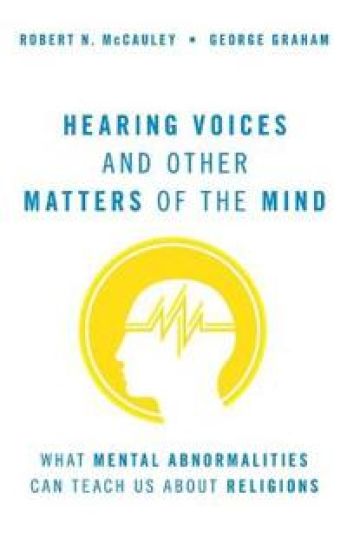
A man with schizophrenia believes that God is instructing him through the public address system in a bus station. A nun falls into a decades-long depression because she believes that God refuses to answer her prayers. A neighborhood parishioner is bedeviled with anxiety because he believes that a certain religious ritual must be repeated, repeated, and repeated lest God punish him. To what extent are such manifestations of religious thinking analogous to mental disorder? Does mental dysfunction bring an individual closer to religious experience or thought? Hearing Voices and Other Unusual Experiences explores these questions using the tools of the cognitive science of religion and the philosophy of psychopathology. Robert McCauley and George Graham emphasize underlying cognitive continuities between familiar features of religiosity, of mental disorders, and of everyday thinking and action. They contend that much religious thought and behavior can be explained as the cultural activation of our natural cognitive systems, which address matters that are essential to human survival: hazard precautions, agency detection, language processing, and theory of mind. Those systems produce responses to cultural stimuli that may mimic features of cognition and conduct associated with mental disorders, but which are sometimes coded as "religious" depending on the context. The authors examine hallucinations of the voice of God and of other supernatural agents, spiritual depression often described as a "dark night of the soul," religious scrupulosity and compulsiveness, and challenges to theistic cognition that Autistic Spectrum Disorder poses. Their approach promises to shed light on both mental abnormalities and religiosity.
Philosophical Foundations of the Cognitive Science  of Religion
Robert N. McCauley and E. Thomas Lawson are considered the founders of the field of the cognitive science of religion. Since its inception over twenty years ago, the cognitive science of religion has raised questions about the philosophical foundations and implications of such a scientific approach. This volume from McCauley, including chapters co-authored by Lawson, is the first book-length project to focus on such questions, resulting in a compelling volume that addresses fundamental questions that any scholar of religion should ask. The essays collected in this volume are those that initially defined this scientific field for the study of religion. These essays deal with issues of methodology, reductionism, resistance to the scientific study of religion, and other criticisms that have been lodged against the cognitive science of religion. The new final chapter sees McCauley reflect on developments in this field since its founding. Tackling these debates head on and in one place for the first time, this volume belongs on the shelf of every researcher interested in this now established approach to the study of religion within a range of disciplines, including religious studies, philosophy, anthropology and the psychology of religion.
Philosophical Foundations of the Cognitive Science  of Religion
Robert N. McCauley and E. Thomas Lawson are considered the founders of the field of the cognitive science of religion. Since its inception over twenty years ago, the cognitive science of religion has raised questions about the philosophical foundations and implications of such a scientific approach. This volume from McCauley, including chapters co-authored by Lawson, is the first book-length project to focus on such questions, resulting in a compelling volume that addresses fundamental questions that any scholar of religion should ask. The essays collected in this volume are those that initially defined this scientific field for the study of religion. These essays deal with issues of methodology, reductionism, resistance to the scientific study of religion, and other criticisms that have been lodged against the cognitive science of religion. The new final chapter sees McCauley reflect on developments in this field since its founding. Tackling these debates head on and in one place for the first time, this volume belongs on the shelf of every researcher interested in this now established approach to the study of religion within a range of disciplines, including religious studies, philosophy, anthropology and the psychology of religion.
Why Religion is Natural and Science is Not

Why Religion is Natural and Science is Not

Robert N. McCauley

Oxford University Press Inc
2013
nidottu

Halvin toimitettuna 41,70 €

"One of the pioneers of the cognitive science of religion, adds insight to the interdisciplinary discussion in this provocatively titled work .... McCauley's work is erudite, precise, well argued."-Library Journal The battle between religion and science, competing methods of knowing ourselves and our world, has been raging for many centuries. Now scientists themselves are looking at cognitive foundations of religion--and arriving at some surprising conclusions. Over the course of the past two decades, scholars have employed insights gleaned from cognitive science, evolutionary biology, and related disciplines to illuminate the study of religion. In Why Religion is Natural and Science Is Not, Robert N. McCauley, one of the founding fathers of the cognitive science of religion, argues that our minds are better suited to religious belief than to scientific inquiry. Drawing on the latest research and illustrating his argument with commonsense examples, McCauley argues that religion has existed for many thousands of years in every society because the kinds of explanations it provides are precisely the kinds that come naturally to human minds. Science, on the other hand, is a much more recent and rare development because it reaches radical conclusions and requires a kind of abstract thinking that only arises consistently under very specific social conditions. Religion makes intuitive sense to us, while science requires a lot of work. McCauley then draws out the larger implications of these findings. The naturalness of religion, he suggests, means that science poses no real threat to it, while the unnaturalness of science puts it in a surprisingly precarious position. Rigorously argued and elegantly written, this provocative book will appeal to anyone interested in the ongoing debate between religion and science, and in the nature and workings of the human mind.
Why Religion is Natural and Science is Not

Why Religion is Natural and Science is Not

Robert N. McCauley

Oxford University Press Inc
2012
sidottu
The battle between religion and science, competing methods of knowing ourselves and our world, has been raging for many centuries. Now scientists themselves are looking at cognitive foundations of religion--and arriving at some surprising conclusions. Over the course of the past two decades, scholars have employed insights gleaned from cognitive science, evolutionary biology, and related disciplines to illuminate the study of religion. In Why Religion is Natural and Science Is Not, Robert N. McCauley, one of the founding fathers of the cognitive science of religion, argues that our minds are better suited to religious belief than to scientific inquiry. Drawing on the latest research and illustrating his argument with commonsense examples, McCauley argues that religion has existed for many thousands of years in every society because the kinds of explanations it provides are precisely the kinds that come naturally to human minds. Science, on the other hand, is a much more recent and rare development because it reaches radical conclusions and requires a kind of abstract thinking that only arises consistently under very specific social conditions. Religion makes intuitive sense to us, while science requires a lot of work. McCauley then draws out the larger implications of these findings. The naturalness of religion, he suggests, means that science poses no real threat to it, while the unnaturalness of science puts it in a surprisingly precarious position. Rigorously argued and elegantly written, this provocative book will appeal to anyone interested in the ongoing debate between religion and science, and in the nature and workings of the human mind.
Bringing Ritual to Mind

Bringing Ritual to Mind

Robert N. McCauley; E. Thomas Lawson

Cambridge University Press
2002
pokkari
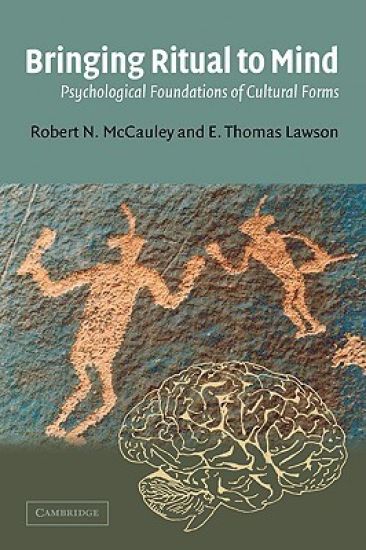
Bringing Ritual to Mind explores the cognitive and psychological foundations of religious ritual systems. Participants must recall their rituals well enough to ensure a sense of continuity across performances, and those rituals must motivate them to transmit and re-perform them. Most religious rituals the world over exploit either high performance frequency or extraordinary emotional stimulation (but not both) to enhance their recollection (the availability of literacy has little impact on this). But why do some rituals exploit the first of these variables while others exploit the second? McCauley and Lawson advance the ritual form hypothesis, arguing that participants’ cognitive representations of ritual form explain why. Reviewing evidence from cognitive, developmental and social psychology and from cultural anthropology and the history of religions, they utilize dynamical systems tools to explain the recurrent evolutionary trajectories religions exhibit.
Rethinking Religion

Rethinking Religion

E. Thomas Lawson; Robert N. McCauley

Cambridge University Press
1993
pokkari
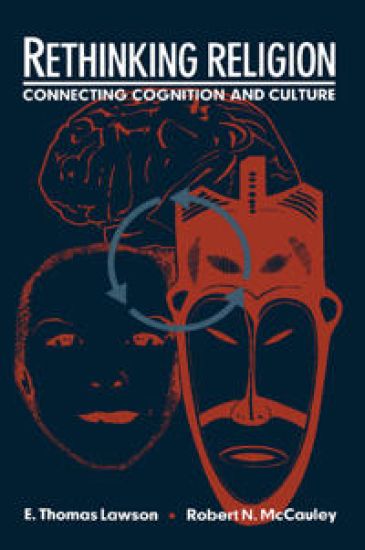
This book is an ambitious attempt to develop a cognitive approach to religion. Focusing particularly on ritual action, it borrows analytical methods from linguistics and other cognitive sciences. The authors, a philosopher of science and a scholar of comparative religion, provide a lucid critical review of established approaches to religion, and make a strong plea for the combination of interpretation and explanation. Often represented as competitive approaches, they are rather, complementary, equally vital to the study of symbolic systems.