Kirjojen hintavertailu – 12 859 828 kirjaa ja 27 kauppaa

Kirjailija

Robert Nisbet

Kirjat ja teokset yhdessä paikassa: 21 kirjaa, julkaisuja vuosilta 1983–2025, suosituimpiin kuuluu The Quest for Community. Vertaile teosten hintoja ja tarkista saatavuus suomalaisista kirjakaupoista.

21 kirjaa

Kirjojen julkaisuvuodet: 1983–2025.

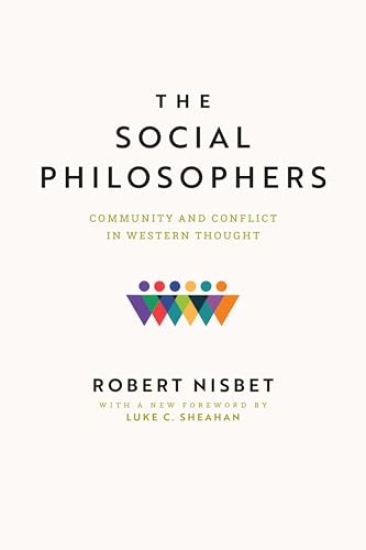
The Social Philosophers: Community and Conflict in Western Thought

The Social Philosophers: Community and Conflict in Western Thought

Robert Nisbet

American Philosophical Society Press
2025
nidottu
Western ideas of moral authority, freedom, consensus, and personality emerge from humankind's search for community In this provocative, absorbing essay in social and intellectual history, Robert Nisbet advances the idea that Western social philosophy arose during the disintegration of the ancient Greek and Roman communities, and has been preoccupied ever since with the problem of community lost and community to be gained. He further contends that Western ideas of moral authority, freedom, consensus, and personality take on their distinctive character when viewed through the lens of humankind's search for community. Much of the book's originality lies in its organization. Nisbet distinguishes six major types of community in Western life and thought: military, political, religious, revolutionary, ecological, and plural. Each of these is presented as a continuing current in Western history and as a vital context to the central ideas of social philosophy. From Plato and Aristotle down to such moderns as Marx, Tocqueville, Weber, Kropotkin, and Fanon, we are able to see the dominant ideas and perspectives of Western thought as responses to conflicts and crises--above all, to those affecting humankind's quest for community. Written by one of America's best-known historical sociologists, The Social Philosophers will be of interest to the student as well as the general reader.

Handbook of Statistical Analysis

Handbook of Statistical Analysis

Robert Nisbet; Gary D. Miner; Keith McCormick

ELSEVIER SCIENCE PUBLISHING CO INC
2024
nidottu
Handbook of Statistical Analysis: AI and ML Applications, third edition, is a comprehensive introduction to all stages of data analysis, data preparation, model building, and model evaluation. This valuable resource is useful to students and professionals across a variety of fields and settings: business analysts, scientists, engineers, and researchers in academia and industry. General descriptions of algorithms together with case studies help readers understand technical and business problems, weigh the strengths and weaknesses of modern data analysis algorithms, and employ the right analytical methods for practical application. This resource is an ideal guide for users who want to address massive and complex datasets with many standard analytical approaches and be able to evaluate analyses and solutions objectively. It includes clear, intuitive explanations of the principles and tools for solving problems using modern analytic techniques; offers accessible tutorials; and discusses their application to real-world problems.
Practical Data Analytics for Innovation in Medicine

Practical Data Analytics for Innovation in Medicine

Gary D. Miner; Linda A. Miner; Scott Burk; Mitchell Goldstein; Robert Nisbet; Nephi Walton; Thomas Hill

ELSEVIER SCIENCE TECHNOLOGY
2023
sidottu
Practical Data Analytics for Innovation in Medicine: Building Real Predictive and Prescriptive Models in Personalized Healthcare and Medical Research Using AI, ML, and Related Technologies, Second Edition discusses the needs of healthcare and medicine in the 21st century, explaining how data analytics play an important and revolutionary role. With healthcare effectiveness and economics facing growing challenges, there is a rapidly emerging movement to fortify medical treatment and administration by tapping the predictive power of big data, such as predictive analytics, which can bolster patient care, reduce costs, and deliver greater efficiencies across a wide range of operational functions. Sections bring a historical perspective, highlight the importance of using predictive analytics to help solve health crisis such as the COVID-19 pandemic, provide access to practical step-by-step tutorials and case studies online, and use exercises based on real-world examples of successful predictive and prescriptive tools and systems. The final part of the book focuses on specific technical operations related to quality, cost-effective medical and nursing care delivery and administration brought by practical predictive analytics.
Sociology as an Art Form

Sociology as an Art Form

Robert Nisbet

Routledge
2018
sidottu
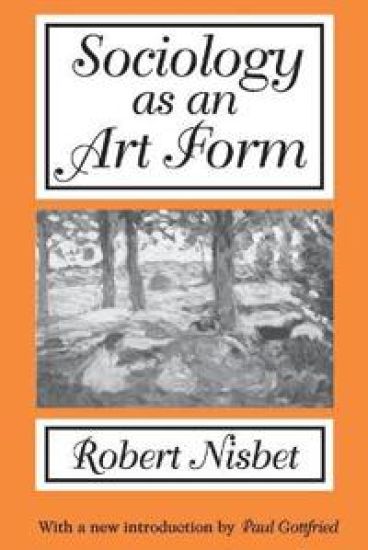
"One of our most original social thinkers," according to the New York Times, Robert Nisbet offers a new approach to sociology. He shows that sociology is indeed an art form, one that has a strong kinship with literature, painting, Romantic history, and philosophy in the nineteenth century, the age in which sociology came into full stature. Sociology as an Art Form is an introduction for the initiated and the uninitiated in so-ciology. Nisbet explains the degree to which sociology draws from the same creative impulses, themes and styles (rooted in history), and actual modes of representa-tion found in the arts. He shows how the founding sociologists such as Marx, Weber, Durkheim, and Simmel constructed portraits (of the bourgeois, the worker, and the intellectual) and landscapes (of the masses, the poor, the factory system), all reflecting and contribut-ing to identical portraits and landscapes found in the literature and art of the period. In addition to marking the similarities between sociologists' and artists' efforts to depict motion or movement, Nisbet emphasizes the relation of sociology to the fin de siecle in art and literature, with examples such as alienation, anomie, and degeneration. He creates an elegant, brilliantly reasoned appraisal of sociology's contribution to modern culture. This book will be of interest to sociologists, artists, and anyone interested in how the fields relate to one another.
The Degradation of the Academic Dogma

The Degradation of the Academic Dogma

Egon Friedell; Robert Nisbet

Routledge
2018
sidottu
This is one of the most important books ever published about the American university. Robert Nisbet accuses universities of having betrayed themselves. Over the centuries they earned the respect of society by attempting to remain faithful to what he terms "the academic dogma," the pursuit of knowledge for its own sake. The measure of a university's greatness and of the stature of an individual scholar was determined not by the immediate usefulness of the work done, but by how much it contributed to scholarship, learning, and teaching. American universities abandoned this ideal, Nisbet charges, after World War II, welcoming onto their campuses academic entrepreneurs engaged in the "higher capitalism," the highly profitable sale of knowledge. This "reformation," says Nisbet, has resulted in the greatest change in the structure and values of the university that has occurred since their founding as guilds in the Middle Ages. And it may be responsible, for reasons he spells out in convincing detail, for their eventual demise as centers of learning. In her introduction, Gertrude Himmelfarb pays tribute to Robert Nisbet for his prescience in analyzing the reformation of the university in the postwar period. A second reformation, she says, has further undermined the academic dogma, first by applying the principles of affirmative action and multiculturalism to the curriculum as well as to student admissions and faculty hiring, and then by "deconstructing" the disciplines, thus subverting the ideas of truth, reason, and objectivity. The Degradation of the Academic Dogma is even more pertinent today than when it was first published a quarter of a century ago. For those concerned with the integrity of the university and of intellectual life, Robert Nisbet has once again proved himself a prophet and a mentor.
The Sociological Tradition

The Sociological Tradition

Robert Nisbet

Routledge
2017
sidottu
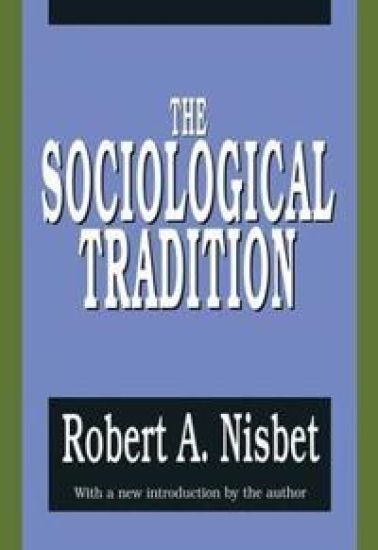
When first published, The Sociological Tradition had a profound and positive impact on sociology, providing a rich sense of intellectual background to a relatively new discipline in America. Robert Nisbet describes what he considers the golden age of sociology, 1830-1900, outlining five major themes of nineteenth-century sociologists: community, authority, status, the sacred, and alienation. Nisbet focuses on sociology's European heritage, delineating the arguments of Tocqueville, Marx, Durkheim, and Weber in new and revealing ways. When the book initially appeared, the Times Literary Supplement noted that "this thoughtful and lucid guide shows more clearly than any previous book on social thought the common threads in the sociological tradition and the reasons why so many of its central concepts have stood the test of time." And Lewis Coser, writing in the New York Times Book Review, claimed that "this lucidly written and elegantly argued volume should go a long way toward laying to rest the still prevalent idea that sociology is an upstart discipline, unconcerned with, and alien to, the major intellectual currents of the modern world." Its clear and comprehensive analysis of the origins of this discipline ensures The Sociological Tradition a permanent place in the literature on sociology and its origins. It will be of interest to those interested in sociological theory, the history of social thought, and the history of ideas. Indeed, as Alasdair Maclntyre observed: "We are unlikely to be given a better book to explain to us the inheritance of sociology from the conservative tradition."
History of the Idea of Progress

History of the Idea of Progress

Robert Nisbet

Routledge
2017
sidottu
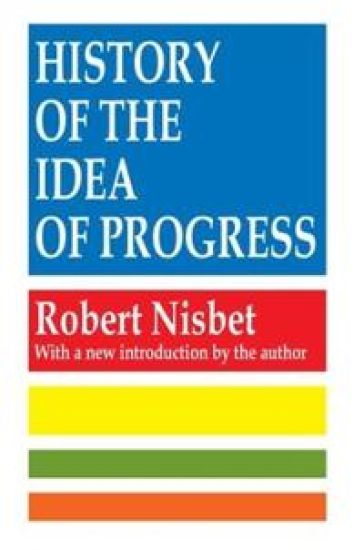
The idea of progress from the Enlightenment to postmodernism is still very much with us. In intellectual discourse, journals, popular magazines, and radio and talk shows, the debate between those who are "progressivists" and those who are "declinists" is as spirited as it was in the late seventeenth century. In History of the Idea of Progress, Robert Nisbet traces the idea of progress from its origins in Greek, Roman, and medieval civilizations to modern times. It is a masterful frame of reference for understanding the present world. Nisbet asserts there are two fundamental building blocks necessary to Western doctrines of human advancement: the idea of growth, and the idea of necessity. He sees Christianity as a key element in both secular and spiritual evolution, for it conveys all the ingredients of the modern idea of progress: the advancement of the human race in time, a single time frame for all the peoples and epochs of the past and present, the conception of time as linear, and the envisagement of the future as having a Utopian end. In his new introduction, Nisbet shows why the idea of progress remains of critical importance to studies of social evolution and natural history. He provides a contemporary basis for many disciplines, including sociology, economics, philosophy, religion, politics, and science. History of the Idea of Progress continues to be a major resource for scholars in all these areas.
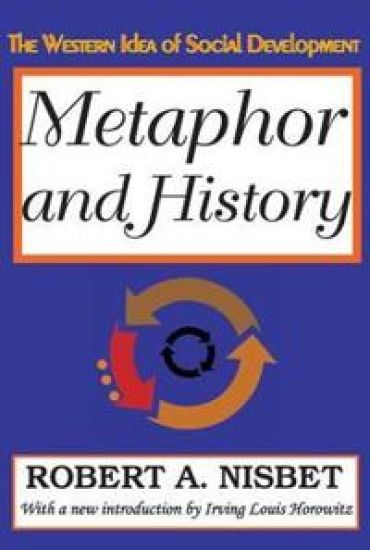
Metaphor and History

Metaphor and History

Robert Nisbet

Routledge
2017
sidottu
The primary purpose of Metaphor and History is to explain the sources and contexts of the Western idea of social development. Nisbet explores the concept of social change across the whole range of Western culture, from ancient Greece to the present day. He does not see the idea of social development as a nineteenth century phenomenon or a by-product of the idea of biological evolution. Instead, Nisbet finds the metaphor of organic growth and the analogy of the life cycle--among the oldest in the history of human thought--embedded in the pronouncements of sages, historians, and social scientists from Heraclitus and Aristotle to Comte, Marx, Spengler, Toynbee, Berdyaev, and Sorokin. He relates the classic Greek metaphor of growth, applied to society; the Christian epic, with its substance in the fusion of Hebrew and Greek ideas; and ideas of progress, natural history, evolution, and sociological functionalism. This book may be considered the "biography of a metaphor" of social development, one that has persisted through two and a half millennia of Western European history. A sociologist's view of history, this is a work at once of synthesis and of exploration of the premises and foundations of social evolution and social change.
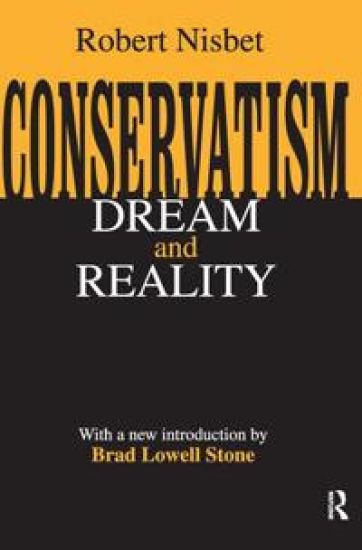
Conservatism

Conservatism

Robert Nisbet

Routledge
2017
sidottu
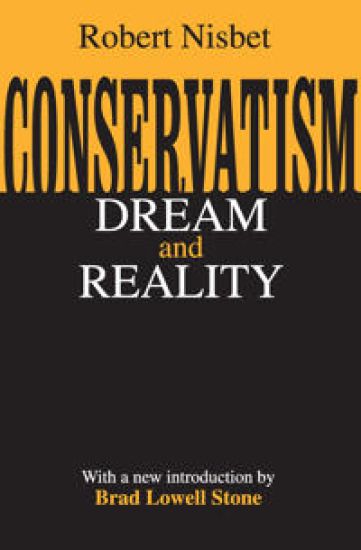
The essential concerns of conservatism are the same as those that motivated Nisbet's first and most influential book, The Quest for Community. In fact, Conservatism unites virtually all of Nisbet's work. In it, Nisbet deals with the political causes of the manifold forms of alienation that underwrite the human quest for community. The sovereign political state is more than a legal relationship of a superstructure of power, it is inseparable from its successive penetrations of man's economic, religious, kinship and local allegiances, and its revolutionary dislocations of established centers of power. Nisbet holds that although political philosophers are often conceived in terms of their views of the individual and the state, a more useful approach adds the factor of social groups or communities mediating between the individual and the state. Such groups comprise "society" the protection of which is the "sole object" of the conservative tradition, according to Nisbet. This conservative ideology arose in the West as a reaction to the French Revolution and its perceived impact upon traditional society. Edmund Burke was the first spokesman of the new ideology. In this book, Nisbet argues that modern conservatism throughout the West can be seen as a widening of Burke's indictment not only of the French Revolution, but of the larger revolution we have come to call modernity. From Edmund Burke and his contemporaries such as Bonald, de Maistre, Haller, and Savigny, down to T. S. Eliot, Christopher Dawson, Michael Oakeshott, Irving Babbit, Paul Elmer More, and Russell Kirk, the essential themes of political conservatism remained the same. They are centered upon history, tradition, property, authority, liberty and religion, and attack equally the political collectivism and radical individualism that have the same irrational outcomes. Nisbet makes the point that, at present, conservatism is also in a crisis, one created in large measure by mixing in the political arena economic liberalism and welfare state socialism - a lethal mix for conservative politics.
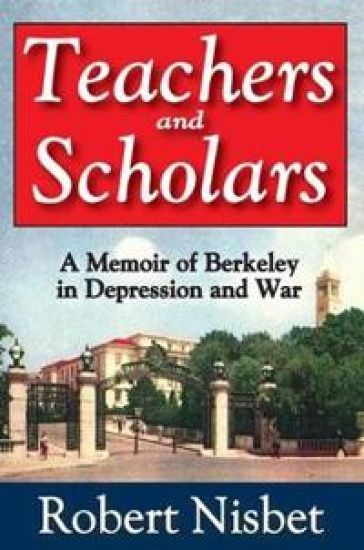
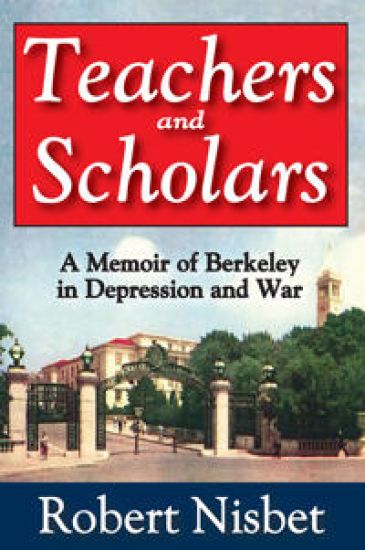
Teachers and Scholars

Teachers and Scholars

Robert Nisbet

AldineTransaction
2013
nidottu
The University of California at Berkeley is today best known as a great research center and popularly remembered as a locus of campus unrest in the 1960s. This memoir by the eminent sociologist and historian of ideas Robert Nisbet views Berkeley from a different perspective. Teachers and Scholars is a fascinating picture of Berkeley as it was a half a century ago in its move to become the most important center of learning west of the Mississippi. Nisbet recounts his years there as student and teacher, and offers vivid portraits of Berkeley's professors and personalities. Between the Great Depression and entry into World War II, Berkeley was a unique window on a Western world in turmoil. All the ideologies of the time—liberalism, socialism, populism, and fascism—impinged on the life of the campus. In Nisbet's view, the thirties was the last decade of "the old Berkeley"—a school that conceived its primary mission as that of teaching. Although research was expected of every faculty member, its chief importance was widely held to be in its elevating effect on undergraduate instruction. In the shift from teaching to research, some have argued that Berkeley has lost community and consensus while others claim that the university has only enriched itself. Nisbet finds much to respect and criticize in both views. His vision permits him to compare and contrast the Berkley experience with other schools such as Harvard, Chicago, and Stanford. Rich in intellectual and social history, Teachers and Scholars is vitally pertinent to the educational questions and controversies of our own time.
The Quest for Community

The Quest for Community

Robert Nisbet

ISI Books
2010
nidottu
One of the leading thinkers to emerge in the postwar conservative intellectual revival was the sociologist Robert Nisbet. His book The Quest for Community, published in 1953, stands as one of the most persuasive accounts of the dilemmas confronting modern society. Nearly a half century before Robert Putnam documented the atomization of society in Bowling Alone, Nisbet argued that the rise of the powerful modern state had eroded the sources of community—the family, the neighborhood, the church, the guild. Alienation and loneliness inevitably resulted. But as the traditional ties that bind fell away, the human impulse toward community led people to turn even more to the government itself, allowing statism—even totalitarianism—to flourish. ISI Books is proud to present this new edition of Nisbet’s magnum opus, featuring a brilliant introduction by New York Times columnist Ross Douthat and three critical essays. Published at a time when our communal life has only grown weaker and when many Americans display cultish enthusiasm for a charismatic president, this new edition of The Quest for Community shows that Nisbet’s insights are as relevant today as ever.
Metaphor and History

Metaphor and History

Robert Nisbet

AldineTransaction
2009
nidottu
The primary purpose of Metaphor and History is to explain the sources and contexts of the Western idea of social development. Nisbet explores the concept of social change across the whole range of Western culture, from ancient Greece to the present day. He does not see the idea of social development as a nineteenth century phenomenon or a by-product of the idea of biological evolution. Instead, Nisbet finds the metaphor of organic growth and the analogy of the life cycle--among the oldest in the history of human thought--embedded in the pronouncements of sages, historians, and social scientists from Heraclitus and Aristotle to Comte, Marx, Spengler, Toynbee, Berdyaev, and Sorokin. He relates the classic Greek metaphor of growth, applied to society; the Christian epic, with its substance in the fusion of Hebrew and Greek ideas; and ideas of progress, natural history, evolution, and sociological functionalism. This book may be considered the "biography of a metaphor" of social development, one that has persisted through two and a half millennia of Western European history. A sociologist's view of history, this is a work at once of synthesis and of exploration of the premises and foundations of social evolution and social change.
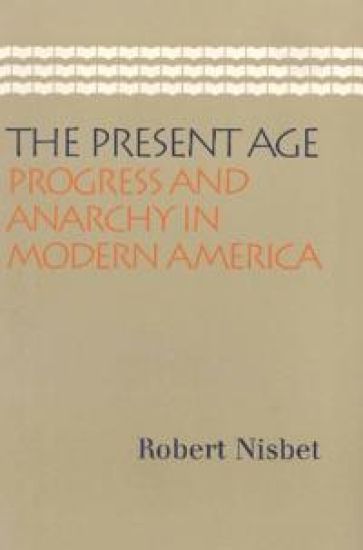
Present Age

Present Age

Robert Nisbet

Liberty Fund Inc
2003
nidottu
The Present Age challenges readers to re-examine the role of the United States in the world since World War I. Nisbet criticises Americans for isolationism at home, discusses the gutting of educational standards, the decay of education, the presence of government in all facets of life, the diminished connection to community, and the prominence of economic arrangements driving everyday life in America. This work is deeply indebted to the analyses of Tocqueville and Bryce regarding the threats that bureaucracy, centralisation, and creeping conformity pose to liberty and individual independence in the western world. The Present Age relates a tragedy -- the unprecedented militarisation of American life in the decades after 1914, as the result of the necessary resistance to National Socialist and Communist totalitarianism that fed into and reinforced the profound tendencies toward centralisation within modern society.
Sociology as an Art Form

Sociology as an Art Form

Robert Nisbet

Transaction Publishers
2001
nidottu

Halvin toimitettuna 65,10 €

"One of our most original social thinkers," according to the New York Times, Robert Nisbet offers a new approach to sociology. He shows that sociology is indeed an art form, one that has a strong kinship with literature, painting, Romantic history, and philosophy in the nineteenth century, the age in which sociology came into full stature. Sociology as an Art Form is an introduction for the initiated and the uninitiated in so-ciology. Nisbet explains the degree to which sociology draws from the same creative impulses, themes and styles (rooted in history), and actual modes of representa-tion found in the arts. He shows how the founding sociologists such as Marx, Weber, Durkheim, and Simmel constructed portraits (of the bourgeois, the worker, and the intellectual) and landscapes (of the masses, the poor, the factory system), all reflecting and contribut-ing to identical portraits and landscapes found in the literature and art of the period. In addition to marking the similarities between sociologists' and artists' efforts to depict motion or movement, Nisbet emphasizes the relation of sociology to the fin de siecle in art and literature, with examples such as alienation, anomie, and degeneration. He creates an elegant, brilliantly reasoned appraisal of sociology's contribution to modern culture. This book will be of interest to sociologists, artists, and anyone interested in how the fields relate to one another.
Conservatism

Conservatism

Robert Nisbet

Transaction Publishers
2001
nidottu
The essential concerns of conservatism are the same as those that motivated Nisbet's first and most influential book, The Quest for Community. In fact, Conservatism unites virtually all of Nisbet's work. In it, Nisbet deals with the political causes of the manifold forms of alienation that underwrite the human quest for community. The sovereign political state is more than a legal relationship of a superstructure of power, it is inseparable from its successive penetrations of man's economic, religious, kinship and local allegiances, and its revolutionary dislocations of established centers of power. Nisbet holds that although political philosophers are often conceived in terms of their views of the individual and the state, a more useful approach adds the factor of social groups or communities mediating between the individual and the state. Such groups comprise "society" the protection of which is the "sole object" of the conservative tradition, according to Nisbet. This conservative ideology arose in the West as a reaction to the French Revolution and its perceived impact upon traditional society. Edmund Burke was the first spokesman of the new ideology. In this book, Nisbet argues that modern conservatism throughout the West can be seen as a widening of Burke's indictment not only of the French Revolution, but of the larger revolution we have come to call modernity. From Edmund Burke and his contemporaries such as Bonald, de Maistre, Haller, and Savigny, down to T. S. Eliot, Christopher Dawson, Michael Oakeshott, Irving Babbit, Paul Elmer More, and Russell Kirk, the essential themes of political conservatism remained the same. They are centered upon history, tradition, property, authority, liberty and religion, and attack equally the political collectivism and radical individualism that have the same irrational outcomes. Nisbet makes the point that, at present, conservatism is also in a crisis, one created in large measure by mixing in the political arena economic liberalism and welfare state socialism - a lethal mix for conservative politics.
Twilight of Authority

Twilight of Authority

Robert Nisbet

Liberty Fund Inc
2000
nidottu
Nisbet argues that the political community in the West has broken down after two centuries of ascendancy. He believes that the West has entered 'a twilight age' that will be characterised by political and cultural crises similar to those that preceded the fall of Rome. He foresees the displacement of traditional, liberal society by centralised, collectivised power -- what he terms 'the war society', driven by the rising power and expense of a hugely scaled military. Nisbet offers no prophecy of inevitable decline; rather, he means to call attention to: the problem of finding the means of generating a social order within which the individual can live and derive a spirit of initiative.
The Degradation of the Academic Dogma

The Degradation of the Academic Dogma

Egon Friedell; Robert Nisbet

Transaction Publishers
1996
nidottu
This is one of the most important books ever published about the American university. Robert Nisbet accuses universities of having betrayed themselves. Over the centuries they earned the respect of society by attempting to remain faithful to what he terms "the academic dogma," the pursuit of knowledge for its own sake. The measure of a university's greatness and of the stature of an individual scholar was determined not by the immediate usefulness of the work done, but by how much it contributed to scholarship, learning, and teaching. American universities abandoned this ideal, Nisbet charges, after World War II, welcoming onto their campuses academic entrepreneurs engaged in the "higher capitalism," the highly profitable sale of knowledge. This "reformation," says Nisbet, has resulted in the greatest change in the structure and values of the university that has occurred since their founding as guilds in the Middle Ages. And it may be responsible, for reasons he spells out in convincing detail, for their eventual demise as centers of learning. In her introduction, Gertrude Himmelfarb pays tribute to Robert Nisbet for his prescience in analyzing the reformation of the university in the postwar period. A second reformation, she says, has further undermined the academic dogma, first by applying the principles of affirmative action and multiculturalism to the curriculum as well as to student admissions and faculty hiring, and then by "deconstructing" the disciplines, thus subverting the ideas of truth, reason, and objectivity. The Degradation of the Academic Dogma is even more pertinent today than when it was first published a quarter of a century ago. For those concerned with the integrity of the university and of intellectual life, Robert Nisbet has once again proved himself a prophet and a mentor.
History of the Idea of Progress

History of the Idea of Progress

Robert Nisbet

Transaction Publishers
1994
nidottu
The idea of progress from the Enlightenment to postmodernism is still very much with us. In intellectual discourse, journals, popular magazines, and radio and talk shows, the debate between those who are "progressivists" and those who are "declinists" is as spirited as it was in the late seventeenth century. In History of the Idea of Progress, Robert Nisbet traces the idea of progress from its origins in Greek, Roman, and medieval civilizations to modern times. It is a masterful frame of reference for understanding the present world. Nisbet asserts there are two fundamental building blocks necessary to Western doctrines of human advancement: the idea of growth, and the idea of necessity. He sees Christianity as a key element in both secular and spiritual evolution, for it conveys all the ingredients of the modern idea of progress: the advancement of the human race in time, a single time frame for all the peoples and epochs of the past and present, the conception of time as linear, and the envisagement of the future as having a Utopian end. In his new introduction, Nisbet shows why the idea of progress remains of critical importance to studies of social evolution and natural history. He provides a contemporary basis for many disciplines, including sociology, economics, philosophy, religion, politics, and science. History of the Idea of Progress continues to be a major resource for scholars in all these areas.
The Sociological Tradition

The Sociological Tradition

Robert Nisbet

Transaction Publishers
1993
nidottu
When first published, The Sociological Tradition had a profound and positive impact on sociology, providing a rich sense of intellectual background to a relatively new discipline in America. Robert Nisbet describes what he considers the golden age of sociology, 1830-1900, outlining five major themes of nineteenth-century sociologists: community, authority, status, the sacred, and alienation. Nisbet focuses on sociology's European heritage, delineating the arguments of Tocqueville, Marx, Durkheim, and Weber in new and revealing ways. When the book initially appeared, the Times Literary Supplement noted that "this thoughtful and lucid guide shows more clearly than any previous book on social thought the common threads in the sociological tradition and the reasons why so many of its central concepts have stood the test of time." And Lewis Coser, writing in the New York Times Book Review, claimed that "this lucidly written and elegantly argued volume should go a long way toward laying to rest the still prevalent idea that sociology is an upstart discipline, unconcerned with, and alien to, the major intellectual currents of the modern world." Its clear and comprehensive analysis of the origins of this discipline ensures The Sociological Tradition a permanent place in the literature on sociology and its origins. It will be of interest to those interested in sociological theory, the history of social thought, and the history of ideas. Indeed, as Alasdair Maclntyre observed: "We are unlikely to be given a better book to explain to us the inheritance of sociology from the conservative tradition."
Teachers and Scholars

Teachers and Scholars

Robert Nisbet

Transaction Publishers
1992
sidottu
The University of California at Berkeley is today best known as a great research center and popularly remembered as a locus of campus unrest in the 1960s. This memoir by the eminent sociologist and historian of ideas Robert Nisbet views Berkeley from a different perspective. Teachers and Scholars is a fascinating picture of Berkeley as it was a half a century ago in its move to become the most important center of learning west of the Mississippi. Nisbet recounts his years there as student and teacher, and offers vivid portraits of Berkeley's professors and personalities. Between the Great Depression and entry into World War II, Berkeley was a unique window on a Western world in turmoil. All the ideologies of the time—liberalism, socialism, populism, and fascism—impinged on the life of the campus. In Nisbet's view, the thirties was the last decade of "the old Berkeley"—a school that conceived its primary mission as that of teaching. Although research was expected of every faculty member, its chief importance was widely held to be in its elevating effect on undergraduate instruction. In the shift from teaching to research, some have argued that Berkeley has lost community and consensus while others claim that the university has only enriched itself. Nisbet finds much to respect and criticize in both views. His vision permits him to compare and contrast the Berkley experience with other schools such as Harvard, Chicago, and Stanford. Rich in intellectual and social history, Teachers and Scholars is vitally pertinent to the educational questions and controversies of our own time.