Kirjojen hintavertailu – 12 903 732 kirjaa ja 27 kauppaa

Kirjailija

Robert P. Stoker

Kirjat ja teokset yhdessä paikassa: 5 kirjaa, julkaisuja vuosilta 2005–2015, suosituimpiin kuuluu When Work Is Not Enough. Vertaile teosten hintoja ja tarkista saatavuus suomalaisista kirjakaupoista.

5 kirjaa

Kirjojen julkaisuvuodet: 2005–2015.

Urban Neighborhoods in a New Era

Urban Neighborhoods in a New Era

Clarence N. Stone; Robert P. Stoker; John Betancur; Susan E. Clarke; Marilyn Dantico; Martin Horak; Karen Mossberger; Juliet Musso; Jefferey M. Sellers; Ellen Shiau; Harold Wolman; Donn Worgs

University of Chicago Press
2015
nidottu
For decades, North American cities racked by deindustrialization and population loss have followed one primary path in their attempts at revitalization: a focus on economic growth in downtown and business areas. Neighborhoods, meanwhile, have often been left severely underserved. There are, however, signs of change. This collection of studies by a distinguished group of political scientists and urban planning scholars offers a rich analysis of the scope, potential, and ramifications of a shift still in progress. Focusing on neighborhoods in six cities-Baltimore, Chicago, Denver, Los Angeles, Phoenix, and Toronto-the authors show how key players, including politicians and philanthropic organizations, are beginning to see economic growth and neighborhood improvement as complementary goals. The heads of universities and hospitals in central locations also find themselves facing newly defined realities, adding to the fluidity of a new political landscape even as structural inequalities exert a continuing influence. While not denying the hurdles that community revitalization still faces, the contributors ultimately put forth a strong case that a more hospitable local milieu can be created for making neighborhood policy. In examining the course of experiences from an earlier period of redevelopment to the present postindustrial city, this book opens a window on a complex process of political change and possibility for reform.
Urban Neighborhoods in a New Era

Urban Neighborhoods in a New Era

Clarence N. Stone; Robert P. Stoker; John Betancur; Susan E. Clarke; Marilyn Dantico; Martin Horak; Karen Mossberger; Juliet Musso; Jefferey M. Sellers; Ellen Shiau; Harold Wolman; Donn Worgs

University of Chicago Press
2015
sidottu
For decades, North American cities racked by deindustrialization and population loss have followed one primary path in their attempts at revitalization: a focus on economic growth in downtown and business areas. Neighborhoods, meanwhile, have often been left severely underserved. There are, however, signs of change. This collection of studies by a distinguished group of political scientists and urban planning scholars offers a rich analysis of the scope, potential, and ramifications of a shift still in progress. Focusing on neighborhoods in six cities-Baltimore, Chicago, Denver, Los Angeles, Phoenix, and Toronto-the authors show how key players, including politicians and philanthropic organizations, are beginning to see economic growth and neighborhood improvement as complementary goals. The heads of universities and hospitals in central locations also find themselves facing newly defined realities, adding to the fluidity of a new political landscape even as structural inequalities exert a continuing influence. While not denying the hurdles that community revitalization still faces, the contributors ultimately put forth a strong case that a more hospitable local milieu can be created for making neighborhood policy. In examining the course of experiences from an earlier period of redevelopment to the present postindustrial city, this book opens a window on a complex process of political change and possibility for reform.
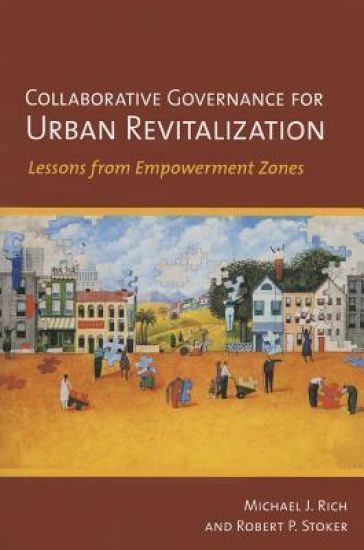
Collaborative Governance for Urban Revitalization

Collaborative Governance for Urban Revitalization

Michael J. Rich; Robert P. Stoker

Cornell University Press
2014
pokkari
For more than one hundred years, governments have grappled with the complex problem of how to revitalize distressed urban areas. In 1995, the original urban Empowerment Zones (Atlanta, Baltimore, Chicago, Detroit, New York, and Philadelphia) each received a $100 million federal block grant and access to a variety of market-oriented policy tools to support the implementation of a ten-year strategic plan to increase economic opportunities and promote sustainable community development in high-poverty neighborhoods. In Collaborative Governance for Urban Revitalization, Michael J. Rich and Robert P. Stoker confront the puzzle of why the outcomes achieved by the original Empowerment Zones varied so widely given that each city had the same set of federal policy tools and resources and comparable neighborhood characteristics. The authors' analysis, based on more than ten years of field research in Atlanta and Baltimore and extensive empirical analysis of EZ processes and outcomes in all six cities shows that revitalization outcomes are best explained by the quality of local governance. Good local governance makes positive contributions to revitalization efforts, while poor local governance retards progress. While policy design and contextual factors are important, how cities craft and carry out their strategies are critical determinants of successful revitalization. Rich and Stoker find that good governance is often founded on public-private cooperation, a stance that argues against both the strongest critics of neoliberalism (who see private enterprise as dangerous in principle) and the strongest opponents of liberalism (who would like to reduce the role of government).
Collaborative Governance for Urban Revitalization

Collaborative Governance for Urban Revitalization

Michael J. Rich; Robert P. Stoker

Cornell University Press
2014
sidottu
For more than one hundred years, governments have grappled with the complex problem of how to revitalize distressed urban areas. In 1995, the original urban Empowerment Zones (Atlanta, Baltimore, Chicago, Detroit, New York, and Philadelphia) each received a $100 million federal block grant and access to a variety of market-oriented policy tools to support the implementation of a ten-year strategic plan to increase economic opportunities and promote sustainable community development in high-poverty neighborhoods. In Collaborative Governance for Urban Revitalization, Michael J. Rich and Robert P. Stoker confront the puzzle of why the outcomes achieved by the original Empowerment Zones varied so widely given that each city had the same set of federal policy tools and resources and comparable neighborhood characteristics. The authors' analysis, based on more than ten years of field research in Atlanta and Baltimore and extensive empirical analysis of EZ processes and outcomes in all six cities shows that revitalization outcomes are best explained by the quality of local governance. Good local governance makes positive contributions to revitalization efforts, while poor local governance retards progress. While policy design and contextual factors are important, how cities craft and carry out their strategies are critical determinants of successful revitalization. Rich and Stoker find that good governance is often founded on public-private cooperation, a stance that argues against both the strongest critics of neoliberalism (who see private enterprise as dangerous in principle) and the strongest opponents of liberalism (who would like to reduce the role of government).
When Work Is Not Enough

When Work Is Not Enough

Robert P. Stoker; Laura A. Wilson

Brookings Institution
2005
nidottu
"Efforts to promote work have been the centerpiece of welfare reform over the past ten years. In signing the Personal Responsibility and Work Opportunity Reconciliation Act of 1996, President Bill Clinton pledged that the sweeping overhaul would ""end welfare as we know it"" by promoting work, responsibility, and family. To accomplish these goals, policymakers relied on two sets of tools: strict limits on eligibility for traditional benefits and a set of programs designed to make work pay. When Work Is Not Enough presents the first comprehensive analysis of the work support system. Drawing on both state and national data, Robert Stoker and Laura Wilson evaluate a broad range of policies that provide cash or in-kind benefits to low-wage workers, low-income working families, and families moving from welfare to work. These programs include minimum wage rates, Earned Income Tax Credit programs, medical assistance programs, food programs, Temporary Assistance for Needy Families earned income disregards, childcare grants, and rental assistance. Stoker and Wilson break new ground by examining the adequacy and coverage of the work support system in all fifty states and the District of Columbia. They address the prospects for reforming the system, as well as its impact on the politics of redistribution in the United States. Rich in analysis, Wh en Work Is Not Enough will be essential reading for anyone interested in the impact and future of welfare reform."