Kirjojen hintavertailu – 12 903 735 kirjaa ja 27 kauppaa
Kirjailija
Robert Reilly
Kirjat ja teokset yhdessä paikassa: 12 kirjaa, julkaisuja vuosilta 1985–2021, suosituimpiin kuuluu LANGE Instant Access Acid-Base, Fluids, and Electrolytes. Vertaile teosten hintoja ja tarkista saatavuus suomalaisista kirjakaupoista.
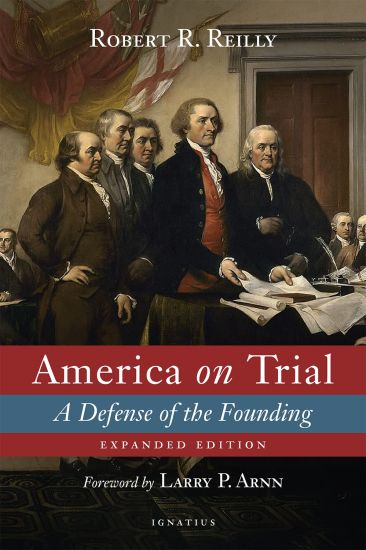
The Founding of the American Republic is on trial. Critics say it was a poison pill with a time-release formula; we are its victims. Its principles are responsible for the country's moral and social disintegration because they were based on the Enlightenment falsehood of radical individual autonomy. In this well-researched book, Robert Reilly declares: not guilty. To prove his case, he traces the lineage of the ideas that made the United States, and its ordered liberty, possible. These concepts were extraordinary when they first burst upon the ancient world: the Judaic oneness of God, who creates ex nihilo and imprints his image on man; the Greek rational order of the world based upon the Reason behind it; and the Christian arrival of that Reason (Logos) incarnate in Christ. These may seem a long way from the American Founding, but Reilly argues that they are, in fact, its bedrock. Combined, they mandated the exercise of both freedom and reason. These concepts were further developed by thinkers in the Middle Ages, who formulated the basic principles of constitutional rule. Why were they later rejected by those claiming the right to absolute rule, then reclaimed by the American Founders, only to be rejected again today? Reilly reveals the underlying drama: the conflict of might makes right versus right makes might. America's decline, he claims, is not to be discovered in the Founding principles, but in their disavowal. This expanded edition of America on Trial includes a new chapter on the American founding and slavery.
The Founding of the American Republic is on trial. Critics say it was a poison pill with a time-release formula; we are its victims. Its principles are responsible for the country's moral and social disintegration because they were based on the Enlightenment falsehood of radical individual autonomy. In this well-researched book, Robert Reilly declares: not guilty. To prove his case, he traces the lineage of the ideas that made the United States, and its ordered liberty, possible. These concepts were extraordinary when they first burst upon the ancient world: the Judaic oneness of God, who creates ex nihilo and imprints his image on man; the Greek rational order of the world based upon the Reason behind it; and the Christian arrival of that Reason (Logos) incarnate in Christ. These may seem a long way from the American Founding, but Reilly argues that they are, in fact, its bedrock. Combined, they mandated the exercise of both freedom and reason. These concepts were further developed by thinkers in the Middle Ages, who formulated the basic principles of constitutional rule. Why were they later rejected by those claiming the right to absolute rule, then reclaimed by the American Founders, only to be rejected again today? Reilly reveals the underlying drama: the conflict of might makes right versus right makes might. America's decline, he claims, is not to be discovered in the Founding principles, but in their disavowal.
After 13 years of struggling in the music business, Robert Reilly found himself broke and on the edge of despair. The specter of success in the music business had become a monster about to ruin his family life. Something had to change, or something was going to break beyond repair. A chance conversation with a neighbor led him to apply, somewhat half-heartedly, for a job at the county prison. Although he hated the thought of a “real job,” a regular salary of $40,000 with benefits, and paid time off seemed like a small fortune. “Amazingly, I somehow got hired. So, in an effort to do the right thing and put my family first, I left the madness of the music business and entered the insanity of the U. S. prison system.” Robert Reilly served a seven-year term as a prison guard in Pennsylvania and Maine. Entering America's industrial prison system in search of a way to support his young family, the struggling musician found himself in a looking-glass world where, often, only the uniforms distinguished guards from prisoners. Life in Prison chronicles the horrors of a place where justice is arbitrary, outcomes are preordained, and the private sector makes big money while the public looks away. This is Reilly's story of doing time. To call the experience sobering would be the ultimate understatement: “As time crawls by, I become jealous of the inmates leaving the prison. I start to slip; I start to feel like I'm losing my faith. Any trace of innocence that I thought I still had starts to evaporate. I begin to feel trapped, imprisoned, locked in a dark heartbreaking world, just like an inmate.”
Publisher's Note: Products purchased from Third Party sellers are not guaranteed by the publisher for quality, authenticity, or access to any online entitlements included with the product. A fast, innovative way to learn the core principles and clinical entities associated with nephrology at the point of careA Doody's Core Title for 2015! Nephrology in 30 Days enables you to quickly and easily attain a complete understanding of the basics of nephrology, allowing you to successfully diagnose and manage kidney disease and its associated complications. Designed to impart this knowledge in just thirty days, this unique self-instructional tool is perfect for medical students, physician assistants, medical residents, andnephrology fellows rotating on the clinical nephrology service elective. Now in full color, Nephrology in 30 Days is the most effective way to gain a solid understanding of acute and chronic kidney diseases, disturbances of fluid and electrolyte balance, and disorders of acid-base and mineral metabolism homeostasis--in the least amount of time possible. Updated to include the latest research and advances, including:New formulas for estimating glomerular filtration rateThe role of WNK kinases in distal tubular sodium and potassium handlingRevised hyponatremia guidelinesThe use of vaptans for clinical useNewly reported forms of metabolic acidosisThe role FGF-23 and Klotho play in phosphorus homeostasisConcerns about the use of erythropoietic stimulating agentsApproaches to and classification of both chronic kidney disease and acute kidney injuryDiscussion of urinalysis and urine microscopy in the evaluation of kidney diseaseNew forms of tubulointerstitial disease such as immunoglobulin G4 (IgG4)-related diseaseThe pathological classification of systemic lupus nephritis and other glomerular diseasesThe mechanisms and causes of essential and secondary forms of hypertension
Publisher's Note: Products purchased from Third Party sellers are not guaranteed by the publisher for quality, authenticity, or access to any online entitlements included with the product. Essential Evidence-Based Data for Common Clinical Encounters"This is very useful for providers who desire a fast review of fluid, electrolyte, and acid-base disorders without asking for in-depth information. Background information about pathophysiology and references are not included, but are not needed. This makes the book unique and quite different from other available resources on the topic. 3 Stars."--Doody's Review ServiceMake sense of acid-base and electrolytes with this compact, on-the-go guide--filled with clinical facts, figures, and data. In this ultra-convenient resource, the authors have distilled down the most relevant insights from their acclaimed text Nephrology in 30 Days, giving you a complete, yet concise overview of acid-based and electrolytes--supported by evidence-based findings. You'll find at-a-glance tables and a bulleted format that puts key diagnostic and clinical information right at your fingertips. This one-stop guide gets you up to speed on the major issues in acid-base and electrolyte disturbances, from metabolic acidosis to serum calcium disorders. It's the perfect clinical companion to more in-depth acid-base texts--one that goes beyond educational principles to focus on the real world of clinical medicine and patient management. The perfect portable brain for the wardsVital facts and figures everyone forgets to rememberPresented in easy-access tables
This authoritative title provides timely answers to controversial valuation, damages, and transfer price questions. Adam Smith's three sources of wealth creation - land, labor, and capital - have long been the factors that determine what a business is worth. Over the past few decades, however, a fourth factor, intellectual capital, has become increasingly important, yet difficult to quantify in the valuation equation. "The Handbook of Business Valuation and Intellectual Property Analysis" features the contributions of experts from leading valuation, accounting, investment banking, and law firms, and provides a comprehensive review of contemporary valuation issues related to businesses, securities, and intellectual property. Topics explored in this important book include: Business Valuation Technical Topics, Business Valuation Special Applications, Advanced Business Valuation Issues, Intellectual Property Valuation Issues, Intellectual Property Transfer Price Analysis Issues, Intellectual Property, and Economic Damages Issues. Accurate valuation, damages, and transfer price conclusions don't have to be a shot-in-the-dark proposition. "The Handbook of Business Valuation and Intellectual Property Analysis" presents valuation, damages, and transfer price analyses in a way that is clear, convincing, and cogent for practitioners at every level. Estimating business, security, and intellectual property values is increasingly difficult in today's transformed economy. From employee stock options to intellectual property license agreements, analysts, investors, accountants, lawyers, and regulators must understand complex new factors and confront important new challenges. In addition, governmental and regulatory changes combine with recent judicial precedent to impact both the theory and practice of valuation. "The Handbook of Business Valuation and Intellectual Property Analysis" provides practitioners with the latest information and knowledge on key aspects of business and intellectual property valuation, damages, and transfer price analyses. Contributions from today's leading experts, compiled and organized by valuation authorities Robert Reilly and Robert Schweihs, make this the essential volume for anyone looking for answers to transaction, financing, taxation, litigation, and corporate planning questions, such as: How should valuation discounts be applied in family limited partnerships, and what is the appropriate evidence for quantification of these discounts? And, what is the relevant regulatory framework for arriving at an arms-length transfer price in intercompany transactions? It also answers questions such as: What are the economic attributes and influences that create, destroy, and transfer value in intellectual property? How is the value of securities not traded on organized stock markets affected by their lack of liquidity? And, what three methods for valuing S corporations (and other pass-through entities) may now be more accurate than the traditional method, and why?" The Handbook of Business Valuation and Intellectual Property Analysis" updates and expands the professional literature related to business/intellectual property valuation, economic damages, and intercompany transfer price analyses. Controversial issues are demystified, and advanced topics are explained in ways that are illuminating for experienced practitioners while still remaining understandable for newer professionals. This latest Reilly/Schweihs anthology is certain to become a welcome and required addition to the libraries of valuation analysts, investment bankers, financial accountants, bankruptcy professionals, tax specialists, financial planners, and litigation attorneys.
This is the one-volume intangible valuation library - from trusted authorities Robert Reilly and Robert Schweihs. Seen as a science by some professionals - as an art by others - the accurate valuation of intangible assets can nonetheless be a daunting financial maze. In their latest comprehensive valuation resource, financial experts Robert F. Reilly and Robert P. Schweihs present in detail the theory and methodology associated with the identification, valuation, and economic analysis of intangible assets. "Valuing Intangible Assets" provides the necessary skills, judgment, and knowledge to truly understand the entire process of intangible valuation. Beginning with a general, fundamental overview of the topic, and building to more specific, advanced theories and practices, this essential book: clarifies the distinctions - and also the relationships - between tangible and intangible assets; works through each of the three basic valuation approaches - cost, market, and income - with guidelines to determine which is appropriate for a given situation; discusses remaining useful life analysis, transfer pricing analysis, and economic damages analysis; summarizes professional standards, including USPAP intangible asset valuation and reporting standards; introduces and describes specific types of intangibles - contract, copyright, goodwill, and more; and, provides entertaining and in-depth case studies to provide real-world application for concepts and activities.