Kirjojen hintavertailu – 12 903 725 kirjaa ja 27 kauppaa

Kirjailija

Robert S. Ridgely

Kirjat ja teokset yhdessä paikassa: 8 kirjaa, julkaisuja vuosilta 1989–2016, suosituimpiin kuuluu The Birds of Ecuador. Vertaile teosten hintoja ja tarkista saatavuus suomalaisista kirjakaupoista.

8 kirjaa

Kirjojen julkaisuvuodet: 1989–2016.

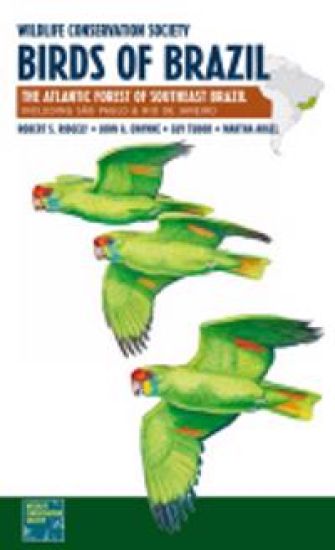
Wildlife Conservation Society Birds of Brazil

Wildlife Conservation Society Birds of Brazil

Robert S. Ridgely; John A. Gwynne; Guy Tudor; Martha Argel

Cornell University Press
2016
pokkari

Halvin toimitettuna 32,80 €

Brazil is the fifth largest country in the world and is one of the planet's richest places for bird diversity, especially when it comes to the number of endemic species. Brazil's Atlantic Forest region is one of the most dazzling of all. Immediately surrounding São Paulo and Rio de Janeiro, this area of Brazil is also a relatively accessible area to birders from around the world. Of these species, 140 are endemic and 105 near endemic to just this region; 83 of these are threatened. Modern and compact, this field guide provides illustrations of unparalleled quality, key field marks, and regional range maps to facilitate easy recognition of all species normally occurring in this vibrant and critically important area of Brazil.

Field Guide to the Songbirds of South America

Field Guide to the Songbirds of South America

Robert S. Ridgely; Guy Tudor

UNIVERSITY OF TEXAS PRESS
2009
pokkari
With the publication of the landmark volumes The Birds of South America: The Oscine Passerines and The Birds of South America: The Suboscine Passerines, Robert S. Ridgely and Guy Tudor established themselves as the leading authorities on the songbirds of South America. Reviewers hailed the volumes as the essential reference works for professional ornithologists and avocational birders alike, and they remain the only volumes that provide full scientific coverage of the continent's passerines. Recognizing the need for a more compact guide that birders can take into the field, Ridgely and Tudor have now extracted and updated the essential identification information from The Birds of South America to create the Field Guide to the Songbirds of South America. This definitive guide is filled with indispensable features: 121 color plates that present Guy Tudor's magnificently detailed paintings of more than 1,500 species of songbirds, including more than 400 that were not illustrated in BOSA 160 additional color illustrations of subspecies and females Extensively updated color range maps for all of the species in the field guide, prepared by Robert S. Ridgely with technical assistance from Maria Allen and Terry Clarke, appear opposite the plates for each bird family Robert S. Ridgely's authoritative accounts of nearly 2,000 species that cover each bird's abundance, habitat, and range; elevational preference; taxonomic or nomenclatural changes; plumage description; general behavior and voice; and range beyond South America, if applicable
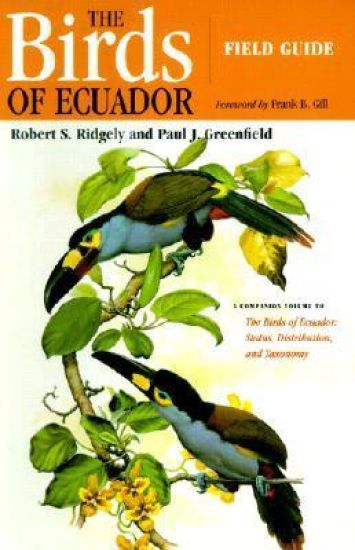
The Birds of Ecuador

The Birds of Ecuador

Robert S. Ridgely; Paul J. Greenfield; Frank Gill

Cornell University Press
2001
pokkari
The Birds of Ecuador comprehensively treats the nearly 1600 species of birds that can be found in mainland Ecuador. The authors describe Ecuador this way: "One of the wonders of the natural world. Nowhere else is such incredible avian diversity crammed into such a small country.... Birds are, happily, numerous in many parts of Ecuador: even the downtown parks of the big cities such as Quito and Guayaquil host their complement." Volume I, Status, Distribution, and Taxonomy, contains detailed information on the ecology, status, and distribution of all species. Introductory chapters deal with geography, climate, and vegetation; bird migration in Ecuador; Ecuadorian ornithology; endemic bird areas in Ecuador; and conservation. Individual species accounts treat habitat, distribution, and taxonomy. Volume II, Field Guide, contains 96 full-color plates and facing pages of descriptive text, a color map of Ecuador, 2 line drawings of bird anatomy, 115 silhouette outlines, and nearly 1600 distribution maps. All species are illustrated in full color, including migrants and vagrants and visually distinctive subspecies. The text focuses on the field identification aspects of each species, including their behavior, vocalizations, and nest appearance. The two volumes are available separately or may be purchased as a slipcased set.
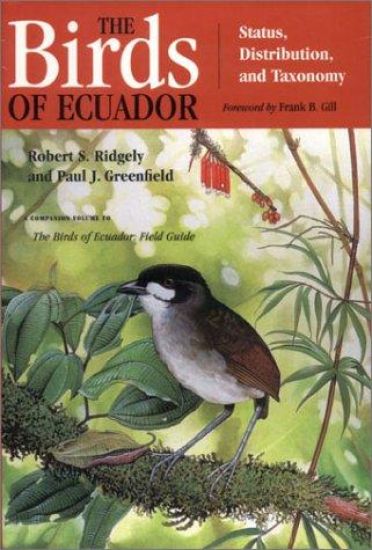
The Birds of Ecuador

The Birds of Ecuador

Robert S. Ridgely; Paul J. Greenfield; Frank Gill

Cornell University Press
2001
pokkari
Many of us can only long to travel to exotic birding places in South America,... but Ridgely and Greenfield live the dream and generously share it with us through their exquisite writings and paintings.... In summary, this is a thorough and thoughtful production that not only provides useful and complete information, but does so in a user-friendly manner.... The decades-long wait for these volumes has been worth it!- Birders Journal The Birds of Ecuador comprehensively treats the nearly 1600 species of birds that can be found in mainland Ecuador. The authors describe Ecuador this way: "One of the wonders of the natural world. Nowhere else is such incredible avian diversity crammed into such a small country.... Birds are, happily, numerous in many parts of Ecuador: even the downtown parks of the big cities such as Quito and Guayaquil host their complement." Volume I, Status, Distribution, and Taxonomy, contains: detailed information on the ecology, status, and distribution of all speciesintroductory chapters deal with geography, climate, and vegetationbird migration in EcuadorEcuadorian ornithologyendemic bird areas in Ecuadorand conservationIndividual species accounts treat habitat, distribution, and taxonomy. Volume II, Field Guide, contains: 96 full-color plates and facing pages of descriptive texta color map of Ecuador2 line drawings of bird anatomy115 silhouette outlinesand nearly 1600 distribution mapsAll species are illustrated in full color, including migrants and vagrants and visually distinctive subspecies. The text focuses on the field identification aspects of each species, including their behavior, vocalizations, and nest appearance. The two volumes are available separately or may be purchased as a slipcased set.
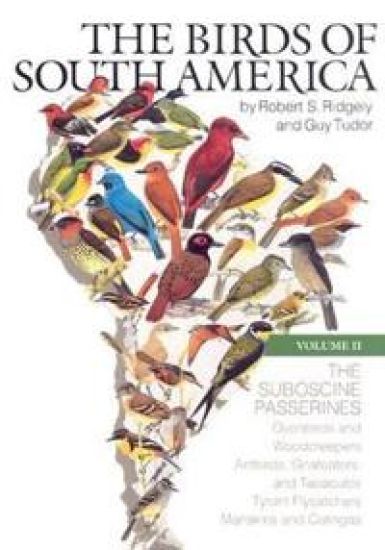
The Birds of South America

The Birds of South America

Robert S. Ridgely; Guy Tudor

University of Texas Press
1994
sidottu
A land of incredible natural resources, the South American continent is rich in plant and animal species. Among birds alone, over 3,100 species are either resident or migrant. Birds are some of South America's treasures and also one of its most endangered resources. Hence the need for a descriptive record of South American birds that will serve both professional and amateur bird students and encourage conservation of these magnificent species. Although South American birds elicit much popular and scientific interest, they have never been completely or satisfactorily described and cataloged in a single, published source. The Birds of South America thus fills a critical void. Starting from a museum approach, the authors have examined specimens of each subspecies, comparing them visually and trying to discern the patterns in their plumage variation, both intra- and inter-specifically. They take a new look at bird systematics, reassessing relationships in light of new information. Perhaps most important, they combine this review and analysis with extensive field observations to give an accurate, incisive portrait of the birds in nature. At a time when rapid development is devastating millions of acres of tropical habitat in South America, this record of an endangered resource becomes crucial. If the birds and other plants and animals of South America are to be saved, they must first be known and appreciated. The Birds of South America is a major step in that direction. Volume II includes the Ovenbirds and Woodcreepers, Antbirds, Gnatcatchers, and Tapaculos; Tyrant Flycatchers; and Manakins and Cotingas.
A Guide to the Birds of Panama

A Guide to the Birds of Panama

Robert S. Ridgely; John A Gwynne Jr.

Princeton University Press
1992
pokkari
This is the first paperback version of the second edition of the popular A Guide to the Birds of Panama. In the second edition, published in 1989, the authors expanded information on the birds of Costa Rica, Nicaragua, and Honduras: approximately 200 new species were added to the material in the 1976 edition. Over 300 additional species, some of them Panamanian, were illustrated. Sixteen new plates were added, and three of the original plates were replaced by improved versions. Throughout the book changes were made to accommodate the explosion in knowledge of the birds of Panama and nearby areas and of neotropical birds in general. The basic sequence and systematics of the AOU 1983 Check-list were adopted. Also included in the revised edition was expanded and updated information on birdfinding in Panama, prepared with the assistance of two of Panama's best resident birders. The book also contains a special section outlining developments in Panama ornithology and conservation. "A sophisticated treatment of one of the world's richest avifaunas."--The Quarterly Review of Biology
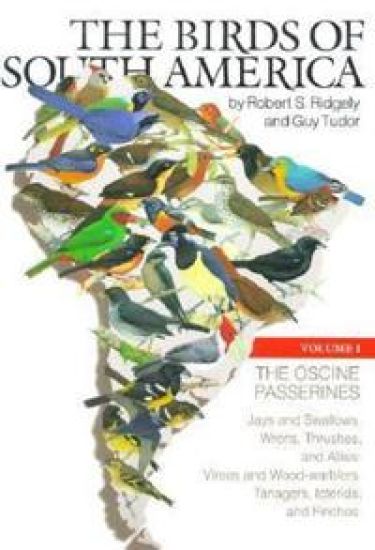
The Birds of South America

The Birds of South America

Robert S. Ridgely

University of Texas Press
1989
sidottu
Winner, Award of Merit in Design, Southern Books Competition, Southeastern Library Association A land of incredible natural resources, the South American continent is rich in plant and animal species. Among birds alone, over 3,100 species are either resident or migrant. Birds are some of South America's treasures and also one of its most endangered resources. Hence the need for a descriptive record of South American birds that will serve both professional and amateur bird students and encourage conservation of these magnificent species. Although South American birds elicit much popular and scientific interest, they have never been completely or satisfactorily described and cataloged in a single, published source. The Birds of South America, projected to be a four-volume work, thus fills a critical void. Starting from a museum approach, the authors have examined specimens of each subspecies, comparing them visually and trying to discern the patterns in their plumage variation, both intra- and inter-specifically. They take a new look at bird systematics, reassessing relationships in light of new information. Perhaps most important, they combine this review and analysis with extensive field observations to give an accurate, incisive portrait of the birds in nature. At a time when rapid development is devastating millions of acres of tropical habitat in South America, this record of an endangered resource becomes crucial. If the birds and other plants and animals of South America are to be saved, they must first be known and appreciated. The Birds of South America is a major step in that direction. Volume I includes the Jays and Swallows; Wrens, Thrushes, and Allies; Vireos and Wood-warblers; Tanagers, Icterids, and Finches. The remaining volumes of The Birds of South America will be: Volume III: The Nonpasserines (Landbirds) Volume IV: The Nonpasserines (Waterbirds) No release date has been set for the remaining volumes.