Kirjojen hintavertailu – 12 903 725 kirjaa ja 27 kauppaa

Kirjailija

Robert S. Weiss

Kirjat ja teokset yhdessä paikassa: 5 kirjaa, julkaisuja vuosilta 1995–2018, suosituimpiin kuuluu Institutions and the Person. Vertaile teosten hintoja ja tarkista saatavuus suomalaisista kirjakaupoista.

5 kirjaa

Kirjojen julkaisuvuodet: 1995–2018.

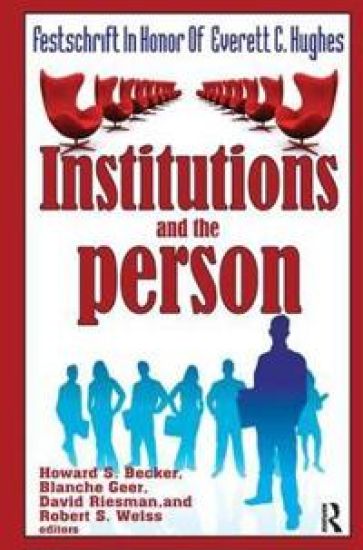
Institutions and the Person

Institutions and the Person

Howard Saul Becker; Blanche Geer; David Riesman; Robert S. Weiss

Routledge
2018
sidottu
Everett C. Hughes had a great impact on the field of sociology as a whole and on an entire generation of sociologists. Some of Hughes' former students and colleagues honor him in this book. The essays address the main themes in his work over the years, and illustrate as well Hughes' impact on the contributors, many of whom are themselves senior figures in the field. The book as a whole provides a distinguished and representative sampling of a major stream of contemporary sociological thought. Each of the five main divisions in the book covers one aspect of Hughes' work. The first deals with the study of occupations and professions-a field in which Hughes was a leader. The second section deals with race relations and other situations in which peoples of differing cultures meet. Beginning with his own work in French Canada many years ago, Hughes interests spread, and the breadth of this interest is seen in chapters on India, Peru, and race relations in the United States. Problems of organizations-how they are put together and how they work-are contained in a third section. A fourth section reflects Hughes' interest in the impact of institutional experience on the people who participate in social institutions, and includes chapters on occupational socialization, status passage, and the use of drugs. A final section develops still another of Hughes' interests-social science method. Presenting some of the most important topics of contemporary theory and research, this book remains profitable reading for every member of the discipline
Institutions and the Person

Institutions and the Person

Howard Saul Becker; Blanche Geer; David Riesman; Robert S. Weiss

AldineTransaction
2009
nidottu
Everett C. Hughes had a great impact on the field of sociology as a whole and on an entire generation of sociologists. Some of Hughes' former students and colleagues honor him in this book. The essays address the main themes in his work over the years, and illustrate as well Hughes' impact on the contributors, many of whom are themselves senior figures in the field. The book as a whole provides a distinguished and representative sampling of a major stream of contemporary sociological thought. Each of the five main divisions in the book covers one aspect of Hughes' work. The first deals with the study of occupations and professions-a field in which Hughes was a leader. The second section deals with race relations and other situations in which peoples of differing cultures meet. Beginning with his own work in French Canada many years ago, Hughes interests spread, and the breadth of this interest is seen in chapters on India, Peru, and race relations in the United States. Problems of organizations-how they are put together and how they work-are contained in a third section. A fourth section reflects Hughes' interest in the impact of institutional experience on the people who participate in social institutions, and includes chapters on occupational socialization, status passage, and the use of drugs. A final section develops still another of Hughes' interests-social science method. Presenting some of the most important topics of contemporary theory and research, this book remains profitable reading for every member of the discipline

The Experience of Retirement

The Experience of Retirement

Robert S. Weiss; David J. Ekerdt

ILR Press
2005
pokkari
Retirement brings with it the promises of leisure and freedom as well as the risks of boredom and isolation. When retirees rid their schedules of anything resembling the kinds of obligations that once had been imposed by work, they will experience a sometimes-uncomfortable absence of structure. In The Experience of Retirement, the distinguished sociologist Robert S. Weiss provides a detailed description of how some people plan their retirement, what life in retirement is like, and what makes for a fulfilling retirement. His engaging book can thus serve as a most useful guide. Weiss shows us both retirement's benefits and its possible costs, both the relief retirees can feel once free of work's stresses and constraints and the discomfort that can be caused by loss of the positive aspects of working life. The book is based on extensive interviews with eighty-nine men and women before and after their retirement from middle-income careers. Weiss makes vivid their experiences by presenting, in their own words, their descriptions of leaving their careers, considering what to do with their time, confronting issues of income in retirement, dealing, sometimes, with social isolation, and reorganizing their lives. The interviews reveal the way in which retirement affects marriages and other familial relationships. Weiss concludes by presenting advice about retirement based on the actual experiences of retirees. For anyone approaching the age of retirement or already retired and looking for a more satisfying post-career life, for personnel managers, health care professionals, and all those who provide services for the retired, The Experience of Retirement will be an illuminating guidebook to this phase of life.
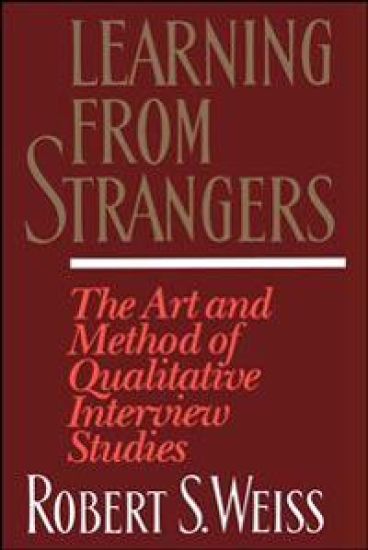
Learning From Strangers

Learning From Strangers

Robert S. Weiss

Simon Schuster
1995
pokkari

Halvin toimitettuna 25,20 €

Learning From Strangers is the definitive work on qualitative research interviewing. It draws on Robert Weiss's thirty years of experience in interviewing and teaching others how to do it. The most effective interviews, says Weiss, rely on creating cooperation -- an open and trusting alliance between interviewer and respondent, dedicated to specific and honest accounts of both internal and external events. Against the eclectic background of his work in national sample surveys, studies based on semi-structured interviewing, and participant observation, Weiss walks the reader through the method of qualitative interview studies: sample selection, development of an interview guide, the conduct of the interview, analysis, and preparation of the data. Weiss gives examples of successful and less successful interviews and offers specific techniques and guidelines for the practitioner.