Kirjojen hintavertailu – 12 859 818 kirjaa ja 27 kauppaa

Kirjailija

Robert Southey

Kirjat ja teokset yhdessä paikassa: 461 kirjaa, julkaisuja vuosilta 1813–2026, suosituimpiin kuuluu A Memoir of the Life and Writings of the Late William Taylor of Norwich. Vertaile teosten hintoja ja tarkista saatavuus suomalaisista kirjakaupoista.

461 kirjaa

Kirjojen julkaisuvuodet: 1813–2026.

Fairy Tales Every Child Should Know

Fairy Tales Every Child Should Know

Gabrielle De Villeneuve; Hans Christian Andersen; Robert Southey

Createspace Independent Publishing Platform
2016
nidottu
The fairy tale is a poetic recording of the facts of life, an interpretation by the imagination of its hard conditions, an effort to reconcile the spirit which loves freedom and goodness and beauty with its harsh, bare and disappointing conditions. It is, in its earliest form, a spontaneous and instinctive endeavor to shape the facts of the world to meet the needs of the imagination, the cravings of the heart. It involves a free, poetic dealing with realities in accordance with the law of mental growth; it is the na ve activity of the young imagination of the race, untrammelled by the necessity of rigid adherence to the fact. This collection of tales, gathered from the rich literature of the childhood of the world, or from the books of the few modern men who have found the key of that wonderful world, is put forth not only without apology, but with the hope that it may widen the demand for these charming reports of a world in which the truths of our working world are loyally upheld, while its hard facts are quietly but authoritatively dismissed from attention. The modern child passes through the same stages as did the children of four thousand years ago. He, too, is a poet. He believes that the world about him throbs with life and is peopled with all manner of strange, beautiful, powerful folk, who live just outside the range of his sight; he, too, personifies light and heat and storm and wind and cold as his remote ancestors did. He, too, lives in and through his imagination; and if, in later life, he grows in power and becomes a creative man, his achievements are the fruits of the free and vigorous life of his imagination. The fairy tale belongs to the child and ought always to be within his reach, not only because it is his special literary form and his nature craves it, but because it is one of the most vital of the textbooks offered to him in the school of life. In ultimate importance it outranks the arithmetic, the grammar, the geography, the manuals of science; for without the aid of the imagination none of these books is really comprehensible. Classics included in this volume include: One Eye, Two Eyes, Three Eyes, The Magic Mirror, The Enchanted Stag, Hansel and Grethel, The Story of Aladdin, This Story of Ali Baba, The Second Voyage of Sinbad the Sailor, The White Cat, The Golden Goose, The Twelve Brothers, The Fair One With the Golden Locks, Tom Thumb, Blue Beard, Cinderella, Puss In Boots, The Sleeping Beauty In the Wood, Jack and The Bean-Stalk
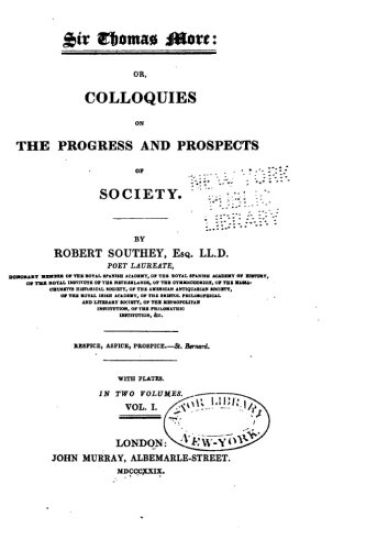
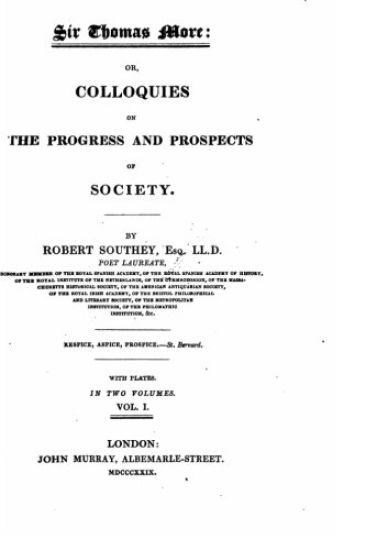
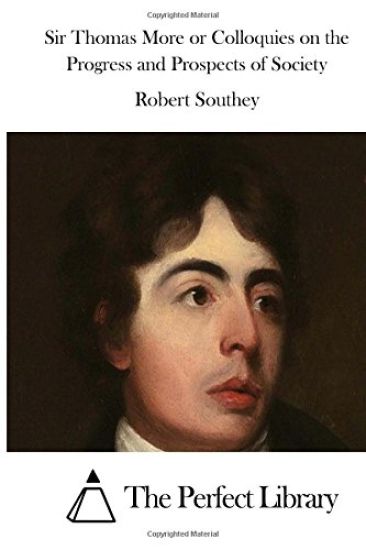
Colloquies on Society

Colloquies on Society

Robert Southey

Createspace Independent Publishing Platform
2016
nidottu
Robert Southey (August 12, 1774 in Bristol - March 21, 1843 in London) was an English poet of the Romantic school, one of the so-called "Lake Poets", and Poet Laureate for 30 years from 1813 to his death in 1843. Although his fame has long been eclipsed by that of his contemporaries and friends William Wordsworth and Samuel Taylor Coleridge, Southey's verse still enjoys some popularity. Southey was also a prolific letter writer, literary scholar, essay writer, historian and biographer. His biographies include the life and works of John Bunyan, John Wesley, William Cowper, Oliver Cromwell and Horatio Nelson. The last has rarely been out of print since its publication in 1813 and was adapted for the screen in the 1926 British film, Nelson. He was also a renowned scholar of Portuguese and Spanish literature and history, translating a number of works from those two languages into English and writing a History of Brazil (part of his planned History of Portugal, which he never completed) and a History of the Peninsular War. Perhaps his most enduring contribution to literary history is the children's classic The Story of the Three Bears, the original Goldilocks story, first published in Southey's prose collection The Doctor. He also wrote on political issues which led to a brief, non-sitting, spell as a Tory Member of Parliament.
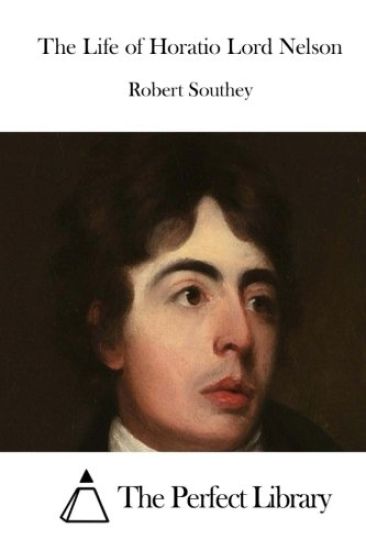
The Life of Horatio Lord Nelson

The Life of Horatio Lord Nelson

Robert Southey

Createspace Independent Publishing Platform
2016
nidottu

Halvin toimitettuna 15,00 €

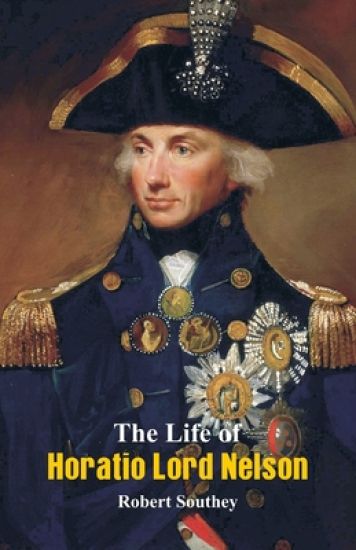
Many Lives of Nelson have been written; one is yet wanting, clear and concise enough to become a manual for the young sailor, which he may carry about with him till he has treasured it up for example in his memory and in his heart. In attempting such a work I shall write the eulogy of our great national hero, for the best eulogy of NELSON is the faithful history of his actions, and the best history must be that which shall relate them most perspicuously. Vice-Admiral Horatio Nelson, 1st Viscount Nelson, 1st Duke of Bront , KB (29 September 1758 - 21 October 1805) was a British flag officer in the Royal Navy. He was noted for his inspirational leadership, superb grasp of strategy, and unconventional tactics, which together resulted in a number of decisive British naval victories, particularly during the Napoleonic Wars. He was wounded several times in combat, losing the sight in one eye in Corsica and most of one arm in the unsuccessful attempt to conquer Santa Cruz de Tenerife. He was shot and killed during his final victory at the Battle of Trafalgar near the port city of C diz in 1805. Lord Nelson was born into a moderately prosperous Norfolk family and joined the navy through the influence of his uncle, Maurice Suckling, a high-ranking naval officer himself. He rose rapidly through the ranks and served with leading naval commanders of the period before obtaining his own command in 1778. He developed a reputation in the service through his personal valour and firm grasp of tactics but suffered periods of illness and unemployment after the end of the American War of Independence. The outbreak of the French Revolutionary Wars allowed Lord Nelson to return to service, where he was particularly active in the Mediterranean. He fought in several minor engagements off Toulon and was important in the capture of Corsica and subsequent diplomatic duties with the Italian states. In 1797, he distinguished himself while in command of HMS Captain at the Battle of Cape St Vincent. Shortly after the battle, Lord Nelson took part in the Battle of Santa Cruz de Tenerife, where his attack was defeated and he was badly wounded, losing his right arm, and was forced to return to England to recuperate. The following year, he won a decisive victory over the French at the Battle of the Nile and remained in the Mediterranean to support the Kingdom of Naples against a French invasion. In 1801, he was dispatched to the Baltic and won another victory, this time over the Danes at the Battle of Copenhagen. He subsequently commanded the blockade of the French and Spanish fleets at Toulon and, after their escape, chased them to the West Indies and back but failed to bring them to battle. After a brief return to England, he took over the C diz blockade in 1805. On 21 October 1805, the Franco-Spanish fleet came out of port, and Lord Nelson's fleet engaged them at the Battle of Trafalgar. The battle was Britain's greatest naval victory, but during the action Nelson, aboard HMS Victory, was fatally wounded by a French sharpshooter. His body was brought back to England where he was accorded a state funeral. Lord Nelson's death at Trafalgar secured his position as one of Britain's most heroic figures. The significance of the victory and his death during the battle led to his signal, "England expects that every man will do his duty", being regularly quoted, paraphrased and referenced up to the modern day. Numerous monuments, including Nelson's Column in Trafalgar Square, London, and the Nelson Monument in Edinburgh, have been created in his memory and his legacy remains highly influential.
Chronicle of the Cid

Chronicle of the Cid

Robert Southey

Createspace Independent Publishing Platform
2015
pokkari
El Cid Campeador (Chronicle of the Cid), English version. "Chronicle of the Cid" is an epic narrative poem that tells the story of the legendary hero, Rodrigo D az de Vivar or El Cid, a warrior who fought for both Christian and Muslim rulers in medieval Spain. Written in the 12th century, the poem is a seminal work of Spanish literature, and Robert Southey's translation captures its essence beautifully. Southey's translation is a remarkable achievement. Not only did he translate the poem into English, but he also made it accessible to a wider audience. The poem's original language, Old Castilian, is difficult to understand for modern readers, and Southey's translation makes the story more approachable. The poem is divided into three parts: the first part introduces El Cid and his exploits serving the Castilian king, the second part covers his exile and his battles against the Moors, and the final part describes his triumphs and eventual death. Southey's translation captures the epic scope of the poem, with its battles, betrayals, and heroic deeds. What makes "Chronicle of the Cid" such a compelling read is its portrayal of El Cid as a complex and flawed hero. He is a man who is both violent and compassionate, loyal and opportunistic, and his story is a testament to the human condition. Southey's translation captures this complexity, and his prose brings to life the vivid characters and settings of this epic tale. Overall, "Chronicle of the Cid" is a must-read for anyone interested in historical fiction, classic literature, or just a good old-fashioned adventure story. Southey's translation is an excellent introduction to this seminal work of Spanish literature, and it offers a window into a fascinating era of European history. Don't miss out on this timeless tale of courage, loyalty, and honor.