Kirjojen hintavertailu – 12 859 819 kirjaa ja 27 kauppaa

Kirjailija

Robert Stern

Kirjat ja teokset yhdessä paikassa: 25 kirjaa, julkaisuja vuosilta 1900–2021, suosituimpiin kuuluu Deutsche Handelskorrespondenz. Vertaile teosten hintoja ja tarkista saatavuus suomalaisista kirjakaupoista.

25 kirjaa

Kirjojen julkaisuvuodet: 1900–2021.

Bark-Lee

Bark-Lee

Robert Stern

Authorhouse
2021
pokkari
This story really happened as told to the author by Bark-Lee's breeder. And Bark-Lee (I just call him "BARK") is a real champion show dog, now retired. He still loves to go on hikes in the woods where he is constantly on the lookout for squirrels and rabbits which he loves to chase. Has not caught one yet but hope lives eternal. Kids love to play with Bark-Lee when they meet him on his daily walks. He shows his appreciation by wagging his tail in a "blur of fur". Bark-Lee is looking forward to becoming a best selling canine co-author.
Kantian Ethics

Kantian Ethics

Robert Stern

Oxford University Press
2020
nidottu
This volume presents a selection of Robert Stern's work on the theme of Kantian ethics. It begins by focusing on the relation between Kant's account of obligation and his view of autonomy, arguing that this leaves room for Kant to be a realist about value. Stern then considers where this places Kant in relation to the question of moral scepticism, and in relation to the principle of 'ought implies can', and examines this principle in its own right. The papers then move beyond Kant himself to his wider influence and to critics of his work, including Hegel, the British Idealists, and the Danish philosopher and theologian K. E. Løgstrup, while also offering a comparison with William James's arguments for freedom. The collection concludes with a consideration of a broadly Kantian critique of divine command ethics offered by Stephen Darwall, arguing that the critique does not succeed. General themes considered in this volume therefore include value, perfectionism, agency, autonomy, moral motivation, moral scepticism, and obligation, as well as the historical place of Kant's ethics and its influence on thinkers up to the present day.
The Radical Demand in Løgstrup's Ethics

The Radical Demand in Løgstrup's Ethics

Robert Stern

Oxford University Press
2019
sidottu
How much does ethics demand of us? On what authority does it demand it? How does what ethics demand relate to other requirements, such as those of prudence, law, and social convention? Does ethics really demand anything at all? Questions of this sort lie at the heart of the work of the Danish philosopher and theologian K. E. Løgstrup (1905-1981), and in particular his key text The Ethical Demand (1956). In The Radical Demand in Løgstrup's Ethics, Robert Stern offers a full account of that text, and situates Løgstrup's distinctive position in relation to Kant, Kierkegaard, Levinas, Darwall and Luther. For Løgstrup, the ethical situation is primarily one in which the fate of the other person is placed in your hands, where it is then your responsibility to do what is best for them. The demand therefore does not come from the other person as such, as what they ask you to do may be different from what you should do. It is also not laid down by social rules, nor by God or by any formal principle of practical reason, such as Kant's principle of universalizability. Rather, it comes from what is required to care for the other, and the directive power of their needs in the situation. Løgstrup therefore rejects accounts of ethical obligation based on the commands of God, or on abstract principles governing practical reason, or on social norms; instead he develops a different picture, at the basis of which is our interdependence, which he argues gives his ethics a grounding in the nature of life itself.

Balance of Payments

Balance of Payments

Robert Stern

Routledge
2017
sidottu
An original and systematic synthesis of the major postwar developments in theory and policy of balance-of-payments adjustment, this book focuses on the present-day system of pegged-but-adjustable exchange rates and the problems that policy authorities must face if they are to attain full employment, price stability, balance-of-payments equilibrium, and a satisfactory rate of economic growth. The dominate theme of this book is that any system of exchange rates carries with it assumptions about the way it works and how effective the automatic and policy-motivated forces operate to bring about equilibrium in a country's balance of payments. By analyzing balance-of-payments adjustment and policies under alternative exchange-rate systems, and with different assumptions concerning the level of employment and prices, it is possible to embrace a wide variety of contemporary and historical circumstances experienced by individual countries and the world as a whole. In this way the author assesses the economic consequences of the different exchange-rate systems and of the policies that countries may follow to attain their national objectives. In particular it appears to Professor Stern that the international monetary turmoil of the past ten years can be traced to the exchange-rate inflexibilities of the adjustable-peg system and to the creation of excessive reserves under the dollar standard. He demonstrates that the international monetary system must be redesigned to permit greater exchange-rate inflexibility and control over the creation of new international reserve assets.
Kantian Ethics

Kantian Ethics

Robert Stern

Oxford University Press
2015
sidottu
This volume presents a selection of Robert Stern's work on the theme of Kantian ethics. It begins by focusing on the relation between Kant's account of obligation and his view of autonomy, arguing that this leaves room for Kant to be a realist about value. Stern then considers where this places Kant in relation to the question of moral scepticism, and in relation to the principle of 'ought implies can', and examines this principle in its own right. The papers then move beyond Kant himself to his wider influence and to critics of his work, including Hegel, the British Idealists, and the Danish philosopher and theologian K. E. Løgstrup, while also offering a comparison with William James's arguments for freedom. The collection concludes with a consideration of a broadly Kantian critique of divine command ethics offered by Stephen Darwall, arguing that the critique does not succeed. General themes considered in this volume therefore include value, perfectionism, agency, autonomy, moral motivation, moral scepticism, and obligation, as well as the historical place of Kant's ethics and its influence on thinkers up to the present day.
The Routledge Guidebook to Hegel's Phenomenology of Spirit
The Phenomenology of Spirit is arguably Hegel’s most influential and important work, and is considered to be essential in understanding Hegel’s philosophical system and his contribution to western philosophy. The Routledge Guidebook to Hegel’s Phenomenology of Spirit introduces the major themes in Hegel’s great book and aids the reader in understanding this key work, examining:The context of Hegel’s thought and the background to his writing Each separate part of the text in relation to its goals, meaning and significance The reception the book has received since its publication The relevance of Hegel’s ideas to modern philosophy With a helpful introductory overview of the text, end of chapter summaries and further reading included throughout, this text is essential reading for all students of philosophy, and all those wishing to get to grips with Hegel’s contribution to our intellectual world.
Understanding Moral Obligation

Understanding Moral Obligation

Robert Stern

Cambridge University Press
2011
sidottu
In many histories of modern ethics, Kant is supposed to have ushered in an anti-realist or constructivist turn by holding that unless we ourselves 'author' or lay down moral norms and values for ourselves, our autonomy as agents will be threatened. In this book, Robert Stern challenges the cogency of this 'argument from autonomy', and claims that Kant never subscribed to it. Rather, it is not value realism but the apparent obligatoriness of morality that really poses a challenge to our autonomy: how can this be accounted for without taking away our freedom? The debate the book focuses on therefore concerns whether this obligatoriness should be located in ourselves (Kant), in others (Hegel) or in God (Kierkegaard). Stern traces the historical dialectic that drove the development of these respective theories, and clearly and sympathetically considers their merits and disadvantages; he concludes by arguing that the choice between them remains open.
Hegelian Metaphysics

Hegelian Metaphysics

Robert Stern

Oxford University Press
2011
nidottu
The great German idealist philosopher G. W. F. Hegel has exerted an immense influence on the development of philosophy from the early 19th century to the present. But the metaphysical aspects of his thought are still under-appreciated. In a series of essays Robert Stern traces the development of a distinctively Hegelian approach to metaphysics and certain central metaphysical issues. The book begins with an introduction that considers this theme as a whole, followed by a section of essays on Hegel himself. Stern then focuses on the way in which certain key metaphysical ideas in Hegel's system, such as his doctrine of the 'concrete universal' and his conception of truth, relate to the thinking of the British Idealists on the one hand, and the American Pragmatists on the other. The volume concludes by examining a critique of Hegel's metaphysical position from the perspective of the 'continental' tradition, and in particular Gilles Deleuze.
Hegelian Metaphysics

Hegelian Metaphysics

Robert Stern

Oxford University Press
2009
sidottu
The great German idealist philosopher G. W. F. Hegel has exerted an immense influence on the development of philosophy from the early 19th century to the present. But the metaphysical aspects of his thought are still under-appreciated. In a series of essays Robert Stern traces the development of a distinctively Hegelian approach to metaphysics and certain central metaphysical issues. The book begins with an introduction that considers this theme as a whole, followed by a section of essays on Hegel himself. Stern then focuses on the way in which certain key metaphysical ideas in Hegel's system, such as his doctrine of the 'concrete universal' and his conception of truth, relate to the thinking of the British Idealists on the one hand, and the American Pragmatists on the other. The volume concludes by examining a critique of Hegel's metaphysical position from the perspective of the 'continental' tradition, and in particular Gilles Deleuze.
The Hunter Hunted

The Hunter Hunted

Robert Stern

Naval Institute Press
2007
sidottu
Today the submarine itself is regarded as the most potent anti-submarine weapon, but it was not always so. This book traces the growing effectiveness of the submarine as a hunter of its own kind, using a carefully selected series of dramatic incident from the earliest days to some nuclear "near misses" during the Cold War. Here are some fifteen dramatic accounts, including the sinking in 1915 of Germany's U-7 by U-22; the sinking of a Spanish Republican submarine by the German U-34 in 1936; the only U. S. submarine lost to an enemy submarine--the USS Corvina, sunk by the Japanese I-176 in 1943; and the last German and Japanese submarines sunk in World War II--both taken down by U. S. submarines.
Balance of Payments

Balance of Payments

Robert Stern

AldineTransaction
2007
nidottu
An original and systematic synthesis of the major postwar developments in theory and policy of balance-of-payments adjustment, this book focuses on the present-day system of pegged-but-adjustable exchange rates and the problems that policy authorities must face if they are to attain full employment, price stability, balance-of-payments equilibrium, and a satisfactory rate of economic growth. The dominate theme of this book is that any system of exchange rates carries with it assumptions about the way it works and how effective the automatic and policy-motivated forces operate to bring about equilibrium in a country's balance of payments. By analyzing balance-of-payments adjustment and policies under alternative exchange-rate systems, and with different assumptions concerning the level of employment and prices, it is possible to embrace a wide variety of contemporary and historical circumstances experienced by individual countries and the world as a whole. In this way the author assesses the economic consequences of the different exchange-rate systems and of the policies that countries may follow to attain their national objectives. In particular it appears to Professor Stern that the international monetary turmoil of the past ten years can be traced to the exchange-rate inflexibilities of the adjustable-peg system and to the creation of excessive reserves under the dollar standard. He demonstrates that the international monetary system must be redesigned to permit greater exchange-rate inflexibility and control over the creation of new international reserve assets.
Transcendental Arguments and Scepticism

Transcendental Arguments and Scepticism

Robert Stern

Clarendon Press
2004
nidottu
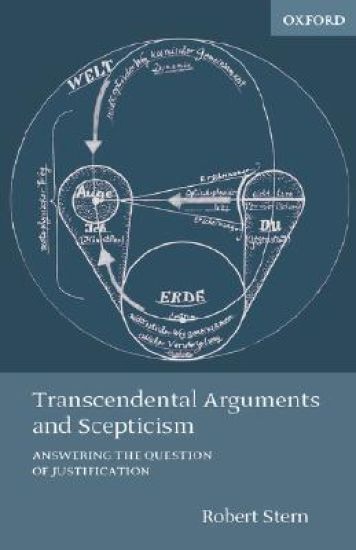
Robert Stern investigates how scepticism can be countered by using transcendental arguments concerning the necessary conditions for the possibility of experience, language, or thought. He shows that the most damaging sceptical questions concern neither the certainty of our beliefs, nor the reliability of our belief-forming methods, but rather whether we can justify our beliefs in the light of our doxastic norms. He concludes that although transcendental arguments cannot be used to resolve the first two issues, they can help to address the issue of normative justification as raised by our belief in the existence of the external world, causal necessity, and other minds. Stern then reassesses transcendental arguments of the sort proposed by Kant in the Refutation of Idealism and the Second Analogy, by Hegel in his treatment of perception in the Phenomenology, and by Strawson in Individuals. Readable, well-informed, and original, Stern's discussion will provide a positive stimulus for further discussion of the philosophical and interpretative issues raised by this influential approach to the problem of scepticism.
Transcendental Arguments and Scepticism

Transcendental Arguments and Scepticism

Robert Stern

Clarendon Press
2000
sidottu
Robert Stern investigates how scepticism can be countered by using transcendental arguments concerning the necessary conditions for the possibility of experience, language, or thought. He shows that the most damaging sceptical questions concern neither the certainty of our beliefs, nor the reliability of our belief-forming methods, but rather whether we can justify our beliefs in the light of our doxastic norms. He concludes that although transcendental arguments cannot be used to resolve the first two issues, they can help us to address the issue of normative justification as raised by our belief in the existence of the external world, causal necessity, and other minds. Stern then reassesses transcendental arguments of the sort proposed by Kant in the Refutation of Idealism and the Second Analogy, by Hegel in his treatment of perception in the Phenomenology, and by Strawson in Individuals. Readable, well-informed, and original, Stern's discussion will provide a positive stimulus for further discussion of the philosophical and interpretative issues raised by this influential approach to the problem of scepticism.