Kirjojen hintavertailu – 12 870 671 kirjaa ja 27 kauppaa

Kirjailija

Robert W. Tucker

Kirjat ja teokset yhdessä paikassa: 10 kirjaa, julkaisuja vuosilta 1979–2022, suosituimpiin kuuluu The Just War. Vertaile teosten hintoja ja tarkista saatavuus suomalaisista kirjakaupoista.

Nimi esiintyy myös muodoissa: Robert W Tucker

10 kirjaa

Kirjojen julkaisuvuodet: 1979–2022.

The Law of War and Neutrality at Sea [1957]

The Law of War and Neutrality at Sea [1957]

Robert W Tucker

Lawbook Exchange, Ltd.
2022
sidottu
Published at a time when international law was processing the challenges introduced during World War II and the Korean Conflict, and when the United Nations, the World Court and other new international bodies were exerting influence as judicial bodies, Tucker's analysis was a timely guide to a legal field in the midst of unprecedented change. Tucker is professor emeritus of American foreign policy at the Nitze School of Advanced International Studies, Johns Hopkins University. A graduate of the U. S. Naval Academy and UC-Berkeley, where he earned a Ph. D. in political science, he is the author of several notable books including The Just War (1960), The Inequality of Nations (1977) and, with David C. Hendrickson, The Imperial Temptation: The New World Order and America's Purpose (1992). xiii, 448 pp.
Sdi And U.S. Foreign Policy

Sdi And U.S. Foreign Policy

Robert W. Tucker; George Liska; Robert E. Osgood; David P Calleo

Routledge
2021
nidottu
Showing how the development of space technology could affect the present system of deterrence, the authors consider the consequences for U. S. foreign policy, alliance relations, and strategic stability. In the first essay, Dr. Tucker argues that a greater commitment to defensive systems would not substantially affect deterrence or extended deterren
Immigration And U.s. Foreign Policy

Immigration And U.s. Foreign Policy

Robert W. Tucker

Routledge
2020
nidottu
This book focuses on the consequences of immigration for U. S. foreign policy, in particular, to those consequences that affect, or appear to affect, the nation's view of its role and the definition of its vital interest in the world. It discusses the impact of ethnic groups on foreign policy. .
Sdi And U.s. Foreign Policy

Sdi And U.s. Foreign Policy

Robert W. Tucker; George Liska; Robert E. Osgood; David P Calleo

Routledge
2019
sidottu
Showing how the development of space technology could affect the present system of deterrence, the authors consider the consequences for U. S. foreign policy, alliance relations, and strategic stability. In the first essay, Dr. Tucker argues that a greater commitment to defensive systems would not substantially affect deterrence or extended deterren
Immigration And U.s. Foreign Policy

Immigration And U.s. Foreign Policy

Robert W. Tucker

Routledge
2019
sidottu
In this inter disciplinary study, a distinguished group of demographers, historians, and political scientists assess the relationship between immigration and foreign policy in the United States. First re-examining the consequences of the 19th-century and inter-war migrations, the authors then explore the origins of US refugee policy and refugee mi
Woodrow Wilson and the Great War

Woodrow Wilson and the Great War

Robert W. Tucker

University of Virginia Press
2015
nidottu
In recent years, and in light of U. S. attempts to project power in the world, the presidency of Woodrow Wilson has been more commonly invoked than ever before. Yet ""Wilsonianism"" has often been distorted by a concentration on American involvement in the First World War. In Woodrow Wilson and the Great War: Reconsidering America’s Neutrality, 1914-1917, prominent scholar Robert Tucker turns the focus to the years of neutrality. Arguing that our neglect of this prewar period has reduced the complexity of the historical Wilson to a caricature or stereotype, Tucker reveals the importance that the law of neutrality played in Wilson’s foreign policy during the fateful years from 1914 to 1917, and in doing so he provides a more complete portrait of our nation’s twenty-eighth president. By focusing on the years leading up to America’s involvement in the Great War, Tucker reveals that Wilson’s internationalism was always highly qualified, dependent from the start upon the advent of an international order that would forever remove the specter of another major war. World War I was the last conflict in which the law of neutrality played an important role in the calculations of belligerents and neutrals, and it is scarcely an exaggeration to say that this law?or rather Woodrow Wilson’s version of it?constituted almost the whole of his foreign policy with regard to the war. Wilson’s refusal to find any significance, moral or otherwise, in the conflict beyond the law and its violation led him to see the war as meaningless, save for the immense suffering and sense of utter futility it fostered. Treating issues of enduring interest, such as the advisability and effectiveness of U. S. interventions in, or initiation of, conflicts beyond its borders, Woodrow Wilson and the Great War will appeal to anyone interested in the president’s power to determine foreign policy, and in constitutional history in general.
Revisions in Need of Revising: What Went Wrong in the Iraq War

Revisions in Need of Revising: What Went Wrong in the Iraq War

David C. Hendrickson; Robert W. Tucker; Strategic Studies Institute

Lulu.com
2014
nidottu
David C. Hendrickson and Robert W. Tucker examine the contentious debate over the Iraq war and occupation, focusing on the critique that the Bush administration squandered an historic opportunity to reconstruct the Iraqi state because of various critical blunders in planning. Though they conclude that critics have made a number of telling points against the Bush administration's conduct of the Iraq war, they argue that the most serious problems facing Iraq and its American occupiers-criminal anarchy and lawlessness, a raging insurgency, and a society divided into rival and antagonistic groups-were virtually inevitable consequences that flowed from the act of war itself. Military and civilian planners were culpable in failing to plan for certain tasks, but the most serious problems had no good solution. The authors draw attention to a variety of lessons, including the danger that the imperatives of "force protection" may sacrifice the broader political mission of U. S. forces...
Woodrow Wilson and the Great War

Woodrow Wilson and the Great War

Robert W. Tucker

University of Virginia Press
2007
sidottu
In recent years, and in light of U. S. attempts to project power in the world, the presidency of Woodrow Wilson has been more commonly invoked than ever before. Yet ""Wilsonianism"" has often been distorted by a concentration on American involvement in the First World War. In ""Woodrow Wilson and the Great War: Reconsidering America's Neutrality, 1914-1917"", prominent scholar Robert Tucker turns the focus to the years of neutrality. Arguing that our neglect of this prewar period has reduced the complexity of the historical Wilson to a caricature or stereotype, Tucker reveals the importance that the law of neutrality played in Wilson's foreign policy during the fateful years from 1914 to 1917, and in doing so he provides a more complete portrait of our nation's twenty-eighth president. By focusing on the years leading up to America's involvement in the Great War, Tucker reveals that Wilson's internationalism was always highly qualified, dependent from the start upon the advent of an international order that would forever remove the specter of another major war. World War I was the last conflict in which the law of neutrality played an important role in the calculations of belligerents and neutrals, and it is scarcely an exaggeration to say that this law - or rather Woodrow Wilson's version of it - constituted almost the whole of his foreign policy with regard to the war. Wilson's refusal to find any significance, moral or otherwise, in the conflict beyond the law and its violation led him to see the war as meaningless, save for the immense suffering and sense of utter futility it fostered. Treating issues of enduring interest, such as the advisability and effectiveness of U. S. interventions in, or initiation of, conflicts beyond its borders, ""Woodrow Wilson and the Great War"" will appeal to anyone interested in the president's power to determine foreign policy, and in constitutional history in general.

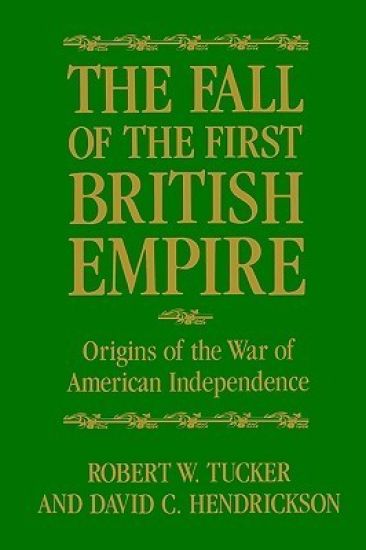
The Fall of the First British Empire

The Fall of the First British Empire

Robert W. Tucker; David Hendrickson

Johns Hopkins University Press
2002
pokkari
The Fall of the First British Empire takes an often controversial view of British imperial policy in the age of the American Revolution, one that challenges long-held assumptions about the causes of America's war for independence. In dealing with the origins of the conflict that led to Britain's loss of America, Robert W. Tucker and David C. Hendrickson place considerable emphasis on the relationship between the Seven Years' War and the difficulties between Britain and America in its immediate aftermath. They also examine the nature of the imperial-colonial relationship as it existed in 1763, challenging the widespread view that there was a well-defined status quo and that a new view of empire led the British to oppose it. In addition, they similarly question conventional accounts of British policy from the Stamp Act crisis to the decision for war in 1775.