Kirjailija
Roberto Esposito
Kirjat ja teokset yhdessä paikassa: 39 kirjaa, julkaisuja vuosilta 1999–2026, suosituimpiin kuuluu Al diavolo il target!. Vertaile teosten hintoja ja tarkista saatavuus suomalaisista kirjakaupoista.
39 kirjaa
Kirjojen julkaisuvuodet: 1999–2026.
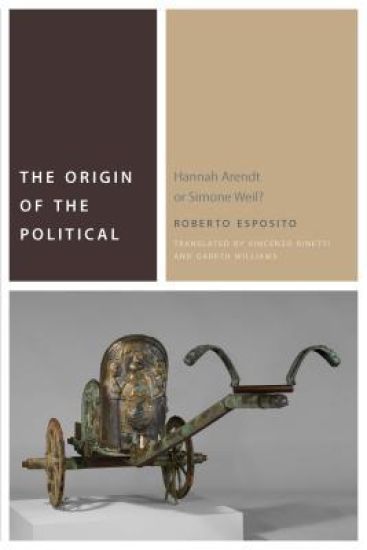
In this book Roberto Esposito explores the conceptual trajectories of two of the twentieth century's most vital thinkers of the political: Hannah Arendt and Simone Weil. Taking Homer's Iliad—that "great prism through which every gesture has the possibility of becoming public, precisely by being observed by others"— as the common origin and point of departure for our understanding of Western philosophical and political traditions, Esposito examines the foundational relation between war and the political. Drawing actively and extensively on Arendt's and Weil's voluminous writings, but also sparring with thinkers from Marx to Heidegger, The Origin of the Political traverses the relation between polemos and polis, between Greece, Rome, God, force, technicity, evil, and the extension of the Christian imperial tradition, while at the same time delineating the conceptual and hermeneutic ground for the development of Esposito's notion and practice of "the impolitical." In Esposito's account Arendt and Weil emerge "in the inverse of the other's thought, in the shadow of the other's light," to "think what the thought of the other excludes not as something that is foreign, but rather as something that appears unthinkable and, for that very reason, remains to be thought." Moving slowly toward their conceptualizations of love and heroism, Esposito unravels the West's illusory metaphysical dream of peace, obliging us to reevaluate ceaselessly what it means to be responsible in the wake of past and contemporary forms of war.
The Debt of the Living
Elettra Stimilli; Roberto Esposito
State University of New York Press
2017
sidottu
Halvin toimitettuna 102,70 €
An analysis of theological and philosophical understandings of debt and its role in contemporary capitalism. Max Weber's account of the rise of capitalism focused on his concept of a Protestant ethic, valuing diligence in earning and saving money but restraint in spending it. However, such individual restraint is foreign to contemporary understandings of finance, which treat ever-increasing consumption and debt as natural, almost essential, for maintaining the economic cycle of buying and selling. In The Debt of the Living, Elettra Stimilli returns to this idea of restraint as ascesis, by analyzing theological and philosophical understandings of debt drawn from a range of figures, including Saint Paul, Schmitt and Agamben, Benjamin and Marx, Nietzsche and Freud, and Foucault. Central to this analysis is the logic of "profit for profit's sake"-an aspect of Weber's work that Stimilli believes has been given insufficient attention. Following Foucault, she identifies this as the original mechanism of a capitalist dispositif that feeds not on a goal-directed rationality, but on the self-determining character of human agency. Ascesis is fundamental not because it is characterized by renunciation, but because the self-discipline it imposes converts the properly human quality of action without a predetermined goal into a lack, a fault, or a state of guilt: a debt that cannot be settled. Stimilli argues that this lack, which is impossible to fill, should be seen as the basis of the economy of hedonism and consumption that has governed global economies in recent years and as the premise of the current economy of debt.
The debate on "political theology" that ran throughout the twentieth century has reached its end, but the ultimate meaning of the notion continues to evade us. Despite all the attempts to resolve the issue, we still speak its language—we remain in its horizon. The reason for this, says Roberto Esposito, lies in the fact that political theology is neither a concept nor an event; rather, it is the pivot around which the machine of Western civilization has revolved for more than 2,000 years. At its heart stands the juncture between universalism and exclusion, unity and separation: the tendency of the Two to make itself into One by subordinating one part to the domination of the other. All the philosophical and political categories that we use, starting with the Roman and Christian notion of "the person," continue to reproduce this exclusionary dispositif. To take our departure from political theology, then—the task of contemporary philosophy—we must radically revise our conceptual lexicon. Only when thought has been returned to its rightful "place"—connected to the human species as a whole rather than to individuals—will we be able to escape from the machine that has imprisoned our lives for far too long.
The notion of the "impolitical" developed in this volume draws its meaning from the exhaustion of modernity's political categories, which have become incapable of giving voice to any genuinely radical perspective. The impolitical is not the opposite of the political but rather its outer limit: the border from which we might glimpse a trajectory away from all forms of political theology and the depoliticizing tendencies of a completed modernity. The book's reconstruction of the impolitical lineage—which is anything but uniform—begins with the extreme conclusions reached by Carl Schmitt and Romano Guardini in their reflections on the political and then moves through a series of encounters between several great twentieth-century texts: from Hannah Arendt's On Revolution to Hermann Broch's The Death of Virgil, to Elias Canetti's Crowds and Power; from Simone Weil's The Need for Roots to Georges Bataille's Sovereignty to Ernst Junger's An der Zeitmauer. The trail forged by this analysis offers a defiant counterpoint to the modern political lexicon, but at the same time a contribution to our understanding of its categories.
What is the relationship between persons and things? And how does the body transform this relationship? In this highly original new book, Roberto Esposito - one of Italy’s leading political philosophers - considers these questions and shows that starting from the body, rather than from the thing or the person, can help us to reconsider the status of both. Ever since its beginnings, our civilization has been based on a strict, unequivocal distinction between persons and things, founded on the instrumental domination of persons over things. This opposition arose out of ancient Roman law and persisted throughout modernity, to take its place in our current global market, where it continues to generate growing contradictions. Although the distinction seems to appear clear and necessary to us, what we are continually witnessing in legal, economic, and technological practice is a reversal of perspectives: some categories of persons are becoming assimilated with things, while some types of things are taking on a personal profile. With his customary rigour, Roberto Esposito argues that there exists an escape route out of this paradox, constituted by a new point of view founded in the body. Neither a person nor a thing, the human body becomes the decisive element in rethinking the concepts and values that govern our philosophical, legal, and political lexicons.
The work of contemporary Italian thinkers, what Roberto Esposito refers to as Italian Theory, is attracting increasing attention around the world. This book explores the reasons for its growing popularity, its distinguishing traits, and why people are turning to these authors for answers to real-world issues and problems. The approach he takes, in line with the keen historical consciousness of Italian thinkers themselves, is a historical one. He offers insights into the great "unphilosophical" philosophers of life—poets, painters, politicians and revolutionaries, film-makers and literary critics—who have made Italian thought, from its beginnings, an "impure" thought. People like Machiavelli, Croce, Gentile, and Gramsci were all compelled to fulfill important political roles in the societies of their times. No wonder they felt that the abstract vocabulary and concepts of pure philosophy were inadequate to express themselves. Similarly, artists such as Dante, Leonardo Da Vinci, Leopardi, or Pasolini all had to turn to other disciplines outside philosophy in order to discuss and grapple with the messy, constantly changing realities of their lives. For this very reason, says Esposito, because Italian thinkers have always been deeply engaged with the concrete reality of life (rather than closed up in the introspective pursuits of traditional continental philosophy) and because they have looked for the answers of today in the origins of their own historical roots, Italian theory is a "living thought." Hence the relevance or actuality that it holds for us today. Continuing in this tradition, the work of Roberto Esposito is distinguished by its interdisciplinary breadth. In this book, he passes effortlessly from literary criticism to art history, through political history and philosophy, in an expository style that welcomes non-philosophers to engage in the most pressing problems of our times. As in all his works, Esposito is inclusive rather than exclusive; in being so, he celebrates the affirmative potency of life.
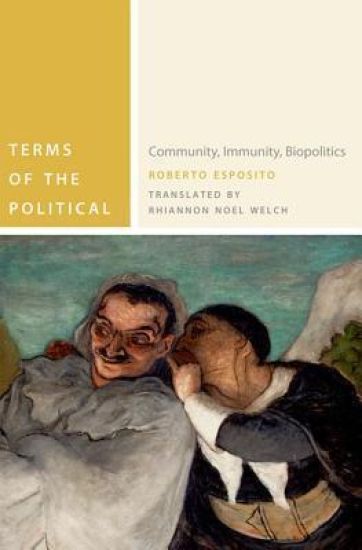
Terms of the Political: Community, Immunity, Biopolitics presents a decade of thought about the origins and possibilities of political theory from one of contemporary Italy's most prolific and engaging political theorists, Roberto Esposito. He has coined a number of critical concepts in current debates about the past, present, and future of biopolitics—from his work on the implications of the etymological and philosophical kinship of community (communitas) and immunity (immunitas) to his theorizations of the impolitical and the impersonal. Taking on interlocutors from throughout the Western philosophical tradition, from Aristotle and Augustine to Weil, Arendt, Nancy, Foucault, and Agamben, Esposito announces the eclipse of a modern political lexicon—"freedom," "democracy," "sovereignty," and "law"—that, in its attempt to protect human life, has so often produced its opposite (violence, melancholy, and death). Terms of the Political calls for the opening of political thought toward a resignification of these and other operative terms—such as "community," "immunity," "biopolitics," and "the impersonal"—in ways that affirm rather than negate life. An invaluable introduction to the breadth and rigor of Esposito's thought, the book will also welcome readers already familiar with Esposito's characteristic skill in overturning and breaking open the language of politics.
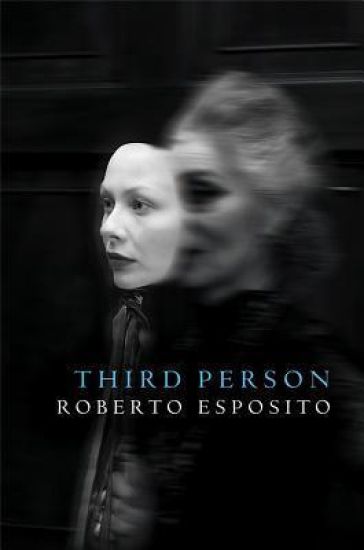
All discourses aimed at asserting the value of human life as such—whether philosophical, ethical, or political—assume the notion of personhood as their indispensable point of departure. This is all the more true today. In bioethics, for example, Catholic and secular thinkers may disagree on what constitutes a person and its genesis, but they certainly agree on its decisive importance: human life is considered to be untouchable only when based on personhood. In the legal sphere as well the enjoyment of subjective rights continues to be increasingly linked to the qualification of personhood, which appears to be the only one capable of bridging the gap between human being and citizen, right and life, and soul and body opened up at the very origins of Western civilization. The radical and alarming thesis put forward in this book is that the notion of person is unable to bridge this gap because it is precisely what creates this breach. Its primary effect is to create a separation in both the human race and the individual between a rational, voluntary part endowed with particular value and another, purely biological part that is thrust by the first into the inferior dimension of the animal or the thing. In opposition to the performative power of the person, whose dual origins can be traced back to ancient Rome and Christianity, Esposito pursues his strikingly original and innovative philosophical inquiry by inviting reflection on the category of the impersonal: the third person, in removing itself from the exclusionary mechanism of the person, points toward the orginary unity of the living being.
This book by Roberto Esposito - a leading Italian political philosopher - is a highly original exploration of the relationship between human bodies and societies. The original function of law, even before it was codified, was to preserve peaceful cohabitation between people who were exposed to the risk of destructive conflict. Just as the human body's immune system protects the organism from deadly incursions by viruses and other threats, law also ensures the survival of the community in a life-threatening situation. It protects and prolongs life. But the function of law as a form of immunization points to a more disturbing consideration. Like the individual body, the collective body can be immunized from the perceived danger only by allowing a little of what threatens it to enter its protective boundaries. This means that in order to escape the clutches of death, life is forced to incorporate within itself the lethal principle. Starting from this reflection on the nature of immunization, Esposito offers a wide-ranging analysis of contemporary biopolitics. Never more than at present has the demand for immunization come to characterize all aspects of our existence. The more we feel at risk of being infiltrated and infected by foreign elements, the more the life of the individual and society closes off within its protective boundaries, forcing us to choose between a self-destructive outcome and a more radical alternative based on a new conception of community.
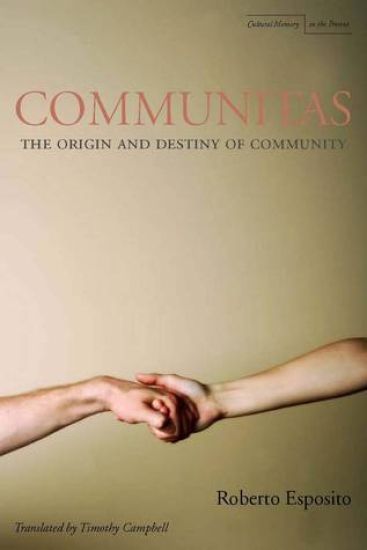
No theme has been more central to international philosophical debates than that of community: from American communitarianism to Habermas's ethic of communication to the French deconstruction of community in the work of Derrida and Nancy. Nevertheless, in none of these cases has the concept been examined from the perspective of community's original etymological meaning: cum munus. In Communitas: The Origin and Destiny of Community, Roberto Esposito does just that through an original counter-history of political philosophy that takes up not only readings of community by Hobbes, Rousseau, Kant, Heidegger and Bataille, but also by Hölderlin, Nietzsche, Canetti, Arendt, and Sartre. The result of his extraordinary conceptual and lexical analysis is a radical overturning of contemporary interpretations of community. Community isn't a property, nor is it a territory to be separated and defended against those who do not belong to it. Rather, it is a void, a debt, a gift to the other that also reminds us of our constitutive alterity with respect to ourselves.
Roberto Esposito is one of the most prolific and important exponents of contemporary Italian political theory. Bíos-his first book to be translated into English-builds on two decades of highly regarded thought, including his thesis that the modern individual-with all of its civil and political rights as well as its moral powers-is an attempt to attain immunity from the contagion of the extraindividual, namely, the community. In Bíos, Esposito applies such a paradigm of immunization to the analysis of the radical transformation of the political into biopolitics. Bíos discusses the origins and meanings of biopolitical discourse, demonstrates why none of the categories of modern political thought is useful for completely grasping the essence of biopolitics, and reconstructs the negative biopolitical core of Nazism. Esposito suggests that the best contemporary response to the current deadly version of biopolitics is to understand what could make up the elements of a positive biopolitics-a politics of life rather than a politics of mastery and negation of life. In his introduction, Timothy Campbell situates Esposito’s arguments within American and European thinking on biopolitics. A comprehensive, illuminating, and highly original treatment of a critically important topic, Bíos introduces an English-reading public to a philosophy that will critically impact such wide-ranging current debates as stem cell research, euthanasia, and the war on terrorism. Roberto Esposito teaches contemporary philosophy at the Italian Institute for the Human Sciences in Naples. His books include Categorie dell impolitico, Nove pensieri sulla politica, Communitas: orgine e destino della comunità, and Immunitas: protezione e negazione della vita. Timothy Campbell is associate professor of Italian studies in the Department of Romance Studies at Cornell University and the author of Wireless Writing in the Age of Marconi (Minnesota, 2006).