
Kirjailija
Roberto Scaramuzzino
Kirjat ja teokset yhdessä paikassa: 37 kirjaa, julkaisuja vuosilta 2016–2026, suosituimpiin kuuluu Mänskliga rättigheter i det lokala Sverige. Vertaile teosten hintoja ja tarkista saatavuus suomalaisista kirjakaupoista.
37 kirjaa
Kirjojen julkaisuvuodet: 2016–2026.






Le Scritture di Assestamento e la Chiusura dei Conti
Roberto Scaramuzzino
Independently Published
2026
pokkari


Elites in Civil Society
Niklas Altermark; Malin Arvidson; Jayeon Lee; Roberto Scaramuzzino
MANCHESTER UNIVERSITY PRESS
2026
sidottu
Where civil society is often seen as a driving force for equality, this book addresses a challenging topic: civil society elites. Drawing on a comprehensive study of Italy, Poland, Sweden, and the UK, this ground-breaking research investigates the often-overlooked power structures within civil society. By combining elite studies with civil society research, the book uncovers how a distinct civil society elite emerges and how it interacts with leaders in politics and business. The findings reveal a fascinating paradox. While this elite may be a powerful engine for social change, its integration into wider power circles risks reproducing the very inequalities it seeks to dismantle. By exploring how this elite can become disconnected from its grassroots, the book provides essential insights into the future of civil society and its democratic promise.


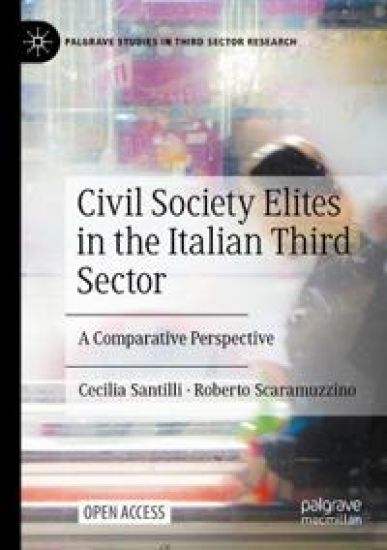
Civil Society Elites in the Italian Third Sector
Cecilia Santilli; Roberto Scaramuzzino
Palgrave Studies in Third Sector Research
2025
pokkari
Etsitkö jännitystä, uusia näkökulmia tai rentouttavaa lukuelämystä? Tutustu kirjakategorioihimme ja löydä seuraava suosikkikirjasi.
Civil Society Elites in the Italian Third Sector
Cecilia Santilli; Roberto Scaramuzzino
Springer International Publishing AG
2024
sidottu
This open access book unveils the hidden elite of Italy's third sector, offering a rare glimpse into the lives and minds of civil society's most influential leaders. Bridging elite and civil society studies, it presents pioneering research on these powerful yet understudied figures. Through in-depth analysis, the chapters reveal surprising insights about the elite's composition, attitudes, career trajectories, and views on power. Essential reading for scholars of democracy, civil society, and social policy, this volume challenges conventional wisdom about leadership in the nonprofit world. By illuminating the dynamics of Italy's third sector elite, it reshapes our understanding of civil society's role in modern democracies.
Equal opportunities? : a cross-national comparison of immigrant organisations in Sweden and Italy
Roberto Scaramuzzino
Malmö högskola
2018
nidottu
English abstract Abstract This thesis concerns the role played by immigrant organisations today. It focuses on the way in which the national context and especially the corporative, social welfare, and integration systems affect such roles. The thesis is structured around the hypothesis that immigrant organisations are shaped by their interaction with political opportunity structures which function as links between the broader institutional setting and the organisations. Examples of such structures are consultation bodies, systems of public funding, rules and routines for public-private partnerships in service provision, access to media and public debate and fiscal facilitations. Such structures can be used by immigrant organisations to, for example, advocate for the interest of the groups they represent, to strengthen their own organisation, as well as its position in society, and to influence policy. However, the usage of such structures always implies a certain amount of control and regulation, as it might require that the organisations assume certain internal rules, adhere to certain principles, or work with certain issues. To highlight the role of the national institutional setting, and especially of the corporative, social welfare, and integration systems in shaping the function of immigrant organisations, this thesis adopts a cross-national comparative approach with Sweden and Italy chosen as national contexts. The cross-national comparison follows a so- called “most-different” logic as these two countries’ civil societies, welfare systems, migration patterns and integration systems show salient differences that make them interesting to compare. Political opportunity structures are, however, spread on different levels from the local to the international in a so-called “multi-level system”. To reflect such complexity, the thesis is designed as three sub-studies focusing on the interaction between immigrant organisations and political opportunity structures connected to different levels: European Union (EU), local and national/regional. Each one of the three sub-studies therefore presents a comparison of immigrant organisations’ interaction with political opportunity structures in Sweden and in Italy. The empirical data consists mostly of interviews with representatives of immigrant organisations and other key-informants from other civil society organisations, public authorities and experts. The results of the thesis show that Swedish immigrant organisations seem to have been able to rely on relatively strong resources and administrative capacity as a consequence of the national and local systems of public grants. In Italy, the results show major differences between ethnic organisations, inter-ethnic and hybrid organisations (connected to trade unions). Ethnic organisations seem to be more marginalised in relation to both public funding and networks of organisations while inter-ethnic and hybrid organisations seem to have been able to access and use such opportunity structures and strengthen their position especially as service producers. The thesis also shows that the corporative, social welfare and integration systems seem to have played a crucial role in shaping the functions of immigrant organisations through the political opportunity structures. The most relevant opportunity structure for the Swedish immigrant organisations was the national and local systems of public grants, while for the Italian organisations the most relevant was the constellation of actors that had access to resources as service providers in the welfare-mix model. The results show also trends of convergence as the importance of immigrant organisations as service providers, often working in network with other organisations, was also evident in Sweden. Also the importance of the EU both as a channel for influencing policy through participation in European networks of organisations and as source of resources for activities at national and local level is evident in the results. Furthermore, the results show that immigrant organisations in Sweden were more often addressed by public authorities and other organisations as civil society organisations with knowledge and expertise on integration issues, while in Italy their role as representatives of immigrant communities was more often highlighted (at least for the ethnic organisations). This reflects the way in which the channelling of ethnic-based collective interests is structured in both countries. The results suggest that immigrant organisations in both countries are much embedded in the national and local context while tendencies of trans-nationalisation, for example, through trans-national ethnic networks only concerned a few organisations which in their turn tended to interact less with local and national political opportunity structures. The nation-state, in fact, seems not to have lost its importance for immigrant organisations as a frame for influencing policy-making and for collective identity formation.
I statens tjänst : så påverkas invandrarorganisationer av politiska krav och förväntningar
Roberto Scaramuzzino
Forum Idéburna organisationer med social inriktning
2016
nidottu
Politikens förväntningar på det civila samhället har under de senaste åren förändrats kraftigt. Idag efterfrågas etniska föreningar av det offentliga allt mer på grund av sin expertis i sakfrågor, inte för vem eller hur många man representerar. Organisationer som skapats för identitetsbyggande och intresserepresentation ses istället ofta som ideella konsulter i integration och välfärd. Samtidigt är det en roll som föreningar och organisationer inte verkar vilja axla. Med den här rapporten vill vi öppna upp för en diskussion om det offentligas nya syn på civila samhället och effekterna dessa ändrade förväntningar kan få för samhället i stort.