Kirjojen hintavertailu – 12 903 725 kirjaa ja 27 kauppaa

Kirjailija

Robin Pearson

Kirjat ja teokset yhdessä paikassa: 16 kirjaa, julkaisuja vuosilta 1988–2022, suosituimpiin kuuluu Delusions of Competence. Vertaile teosten hintoja ja tarkista saatavuus suomalaisista kirjakaupoista.

16 kirjaa

Kirjojen julkaisuvuodet: 1988–2022.

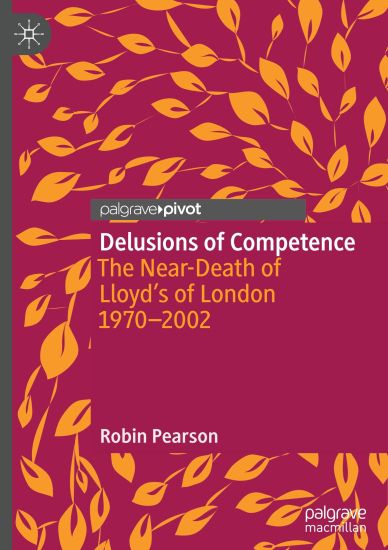
Delusions of Competence

Delusions of Competence

Robin Pearson

Springer Nature Switzerland AG
2022
sidottu
This book examines the crisis at the famous insurance market, Lloyd's of London, during the late twentieth century, which nearly destroyed the 300-year-old institution. While rapid structural change resulting from system collapse is less common in insurance than in the history of other financial services, one exception was the Lloyd’s crisis. Hitherto, explanations of the crisis have focused on the effects of catastrophic losses and poor governance. By drawing on contemporary accounts of the crisis, the author constructs the first comprehensive scholarly analysis of the public and political response. The book applies theoretical concepts from behavioural economics and economic psychology to argue that multiple delusions of competence were at work both within and outside the Lloyd’s market. Arrogance, elitism and defence of vested interests comprised endogenous elements of the crisis. Entrenched ideas about the virtues of self-regulation and faith in insider experts also played a role. The result was a misdiagnosis by both insiders and politicians of what ailed Lloyd’s and a series of reforms that failed to address the underlying causes of its disease. This book offers a salutary lesson from recent history about the importance of the transparency, accountability and effective monitoring of financial institutions. It is of interest to academics and students of economic and financial history, business, insurance, political economy and history.

Insuring the Industrial Revolution

Insuring the Industrial Revolution

Robin Pearson

Routledge
2017
nidottu
Fire had always been one of the greatest threats to an early modern British society that relied on the naked flame as the prime source of heating, lighting and cooking. Yet whilst the danger of fire had always been taken seriously, it was not until the start of the eighteenth century that a sophisticated system of insurance became widely available. Whilst a number of high profile fires during the seventeenth century had drawn attention to the economic havoc a major conflagration could wreak, it was not until the effects of sustained industrialization began to alter the economic and social balance of the nation, that fire insurance really took off as a concept. The culmination of ten years of research, this book is the definitive work on early British fire insurance. It also provides a foundation for future comparative international studies of this important financial service, and for a greater level of theorising by historians about the relationship between insurance, perceptions of risk, economic development and social change. Through a detailed study of the archives of nearly 50 English and Scottish insurance companies founded between 1696 and 1850 - virtually all the records currently available - together with the construction of many new datasets on output, performance and markets, this book presents one of the most comprehensive histories ever written of a financial service. As well as measuring the size, market structure and growth rate of insurance, and the extent to which the first industrial revolution was insured, it also demonstrates ways in which insurance can be linked into wider issues of economic and social change in Britain. These range from an examination of the joint-stock company form of organization - to an analysis of changing attitudes towards fire hazard during the course of the eighteenth century. The book concludes by emphasising the ambivalent character of fire insurance in eighteenth and early nineteenth century Britain, contrasting the industry's dynamic long-run rate of growth with its more conservative attitude to product design and diversification.
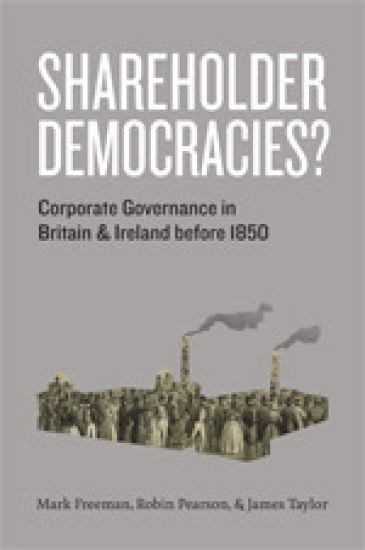
Shareholder Democracies?

Shareholder Democracies?

Mark Freeman; Robin Pearson; James Taylor

University of Chicago Press
2011
sidottu
Understanding the challenges of corporate governance is central to our comprehension of the economic dynamics driving corporations today. Among the most important institutions in capitalism, corporations and joint-stock companies had their origins in Europe during the seventeenth and eighteenth centuries. And as they became more prevalent, the issue of internal governance became more pressing. At stake - and very much contested - were the allocation of rights and obligations among shareholders, directors, and managers. This comprehensive account of the development of corporate governance in Britain and Ireland during its earliest stages highlights the role of political factors in shaping the evolution of corporate governance as well as the important debates that arose about the division of authority and responsibility. Political and economic institutions confronted similar issues, including the need for transparency and accountability in decision making and the roles of electors and the elected, and this book emphasizes how political institutions - from election procedures to assemblies to annual reporting - therefore provided apt models upon which companies drew readily. Filling a gap in the literature on early corporate economy, this book provides insight into the origins of many ongoing modern debates.
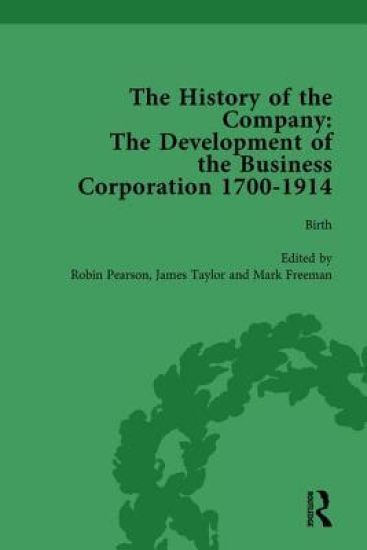
The History of the Company, Part II vol 8

The History of the Company, Part II vol 8

Robin Pearson; James Taylor; Mark Freeman

Routledge
2006
sidottu
Explores the changing economic, social and political role of the Anglo-American firm. Focusing on its formative development between the later 17th and the early 20th centuries, the editors bring together a collection which employs selected documents and analytical commentary to illustrate the external role of the firm and public perceptions of it.
The History of the Company, Part II vol 7

The History of the Company, Part II vol 7

Robin Pearson; James Taylor; Mark Freeman

Routledge
2006
sidottu
Explores the changing economic, social and political role of the Anglo-American firm. Focusing on its formative development between the later 17th and the early 20th centuries, the editors bring together a collection which employs selected documents and analytical commentary to illustrate the external role of the firm and public perceptions of it.
The History of the Company, Part II vol 6

The History of the Company, Part II vol 6

Robin Pearson; James Taylor; Mark Freeman

Routledge
2006
sidottu
Explores the changing economic, social and political role of the Anglo-American firm. Focusing on its formative development between the later 17th and the early 20th centuries, the editors bring together a collection which employs selected documents and analytical commentary to illustrate the external role of the firm and public perceptions of it.
The History of the Company, Part II vol 5

The History of the Company, Part II vol 5

Robin Pearson; James Taylor; Mark Freeman

Routledge
2006
sidottu
Explores the changing economic, social and political role of the Anglo-American firm. Focusing on its formative development between the later 17th and the early 20th centuries, the editors bring together a collection which employs selected documents and analytical commentary to illustrate the external role of the firm and public perceptions of it.
The History of the Company, Part I Vol 4

The History of the Company, Part I Vol 4

Robin Pearson; James Taylor; Mark Freeman

Routledge
2006
sidottu
Exploring the changing economic, social and political role of the Anglo-American firm, this two-part collection of rare texts covers the period 1700-1850. Each part features an introduction which provides an overview of the development of the British and American business corporation in their respective periods and places it in its wider contexts.
The History of the Company, Part I Vol 3

The History of the Company, Part I Vol 3

Robin Pearson; James Taylor; Mark Freeman

Routledge
2006
sidottu
Exploring the changing economic, social and political role of the Anglo-American firm, this two-part collection of rare texts covers the period 1700-1850. Each part features an introduction which provides an overview of the development of the British and American business corporation in their respective periods and places it in its wider contexts.
The History of the Company, Part I Vol 2

The History of the Company, Part I Vol 2

Robin Pearson; James Taylor; Mark Freeman

Routledge
2006
sidottu
Exploring the changing economic, social and political role of the Anglo-American firm, this two-part collection of rare texts covers the period 1700-1850. Each part features an introduction which provides an overview of the development of the British and American business corporation in their respective periods and places it in its wider contexts.
The History of the Company, Part I Vol 1

The History of the Company, Part I Vol 1

Robin Pearson; James Taylor; Mark Freeman

Routledge
2006
sidottu
Exploring the changing economic, social and political role of the Anglo-American firm, this two-part collection of rare texts covers the period 1700-1850. Each part features an introduction which provides an overview of the development of the British and American business corporation in their respective periods and places it in its wider contexts.
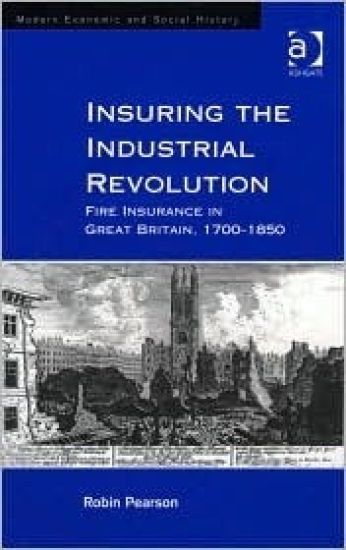
Insuring the Industrial Revolution

Insuring the Industrial Revolution

Robin Pearson

Ashgate Publishing Limited
2004
sidottu
Fire had always been one of the greatest threats to an early modern British society that relied on the naked flame as the prime source of heating, lighting and cooking. Yet whilst the danger of fire had always been taken seriously, it was not until the start of the eighteenth century that a sophisticated system of insurance became widely available. Whilst a number of high profile fires during the seventeenth century had drawn attention to the economic havoc a major conflagration could wreak, it was not until the effects of sustained industrialization began to alter the economic and social balance of the nation, that fire insurance really took off as a concept. The culmination of ten years of research, this book is the definitive work on early British fire insurance. It also provides a foundation for future comparative international studies of this important financial service, and for a greater level of theorising by historians about the relationship between insurance, perceptions of risk, economic development and social change. Through a detailed study of the archives of nearly 50 English and Scottish insurance companies founded between 1696 and 1850 - virtually all the records currently available - together with the construction of many new datasets on output, performance and markets, this book presents one of the most comprehensive histories ever written of a financial service. As well as measuring the size, market structure and growth rate of insurance, and the extent to which the first industrial revolution was insured, it also demonstrates ways in which insurance can be linked into wider issues of economic and social change in Britain. These range from an examination of the joint-stock company form of organization - to an analysis of changing attitudes towards fire hazard during the course of the eighteenth century. The book concludes by emphasising the ambivalent character of fire insurance in eighteenth and early nineteenth century Britain, contrasting the industry's dynamic long-run rate of growth with its more conservative attitude to product design and diversification.