Kirjojen hintavertailu – 12 859 828 kirjaa ja 27 kauppaa

Kirjailija

Roger Bakeman

Kirjat ja teokset yhdessä paikassa: 5 kirjaa, julkaisuja vuosilta 1997–2011, suosituimpiin kuuluu Observing Interaction. Vertaile teosten hintoja ja tarkista saatavuus suomalaisista kirjakaupoista.

5 kirjaa

Kirjojen julkaisuvuodet: 1997–2011.

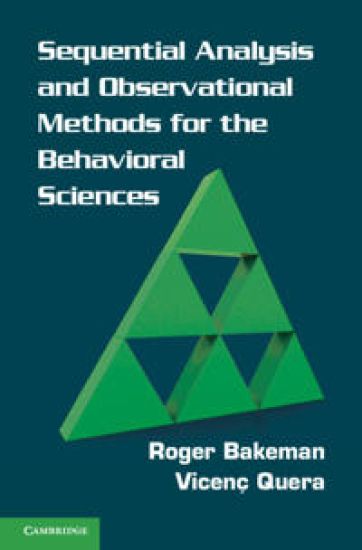
Sequential Analysis and Observational Methods for the Behavioral Sciences

Sequential Analysis and Observational Methods for the Behavioral Sciences

Roger Bakeman; Vicenç Quera

Cambridge University Press
2011
sidottu
Behavioral scientists – including those in psychology, infant and child development, education, animal behavior, marketing and usability studies – use many methods to measure behavior. Systematic observation is used to study relatively natural, spontaneous behavior as it unfolds sequentially in time. This book emphasizes digital means to record and code such behavior; while observational methods do not require them, they work better with them. Key topics include devising coding schemes, training observers and assessing reliability, as well as recording, representing and analyzing observational data. In clear and straightforward language, this book provides a thorough grounding in observational methods along with considerable practical advice. It describes standard conventions for sequential data and details how to perform sequential analysis with a computer program developed by the authors. The book is rich with examples of coding schemes and different approaches to sequential analysis, including both statistical and graphical means.
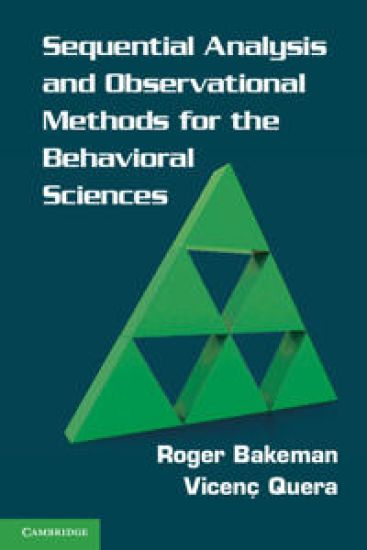
Sequential Analysis and Observational Methods for the Behavioral Sciences

Sequential Analysis and Observational Methods for the Behavioral Sciences

Roger Bakeman; Vicenç Quera

Cambridge University Press
2011
pokkari
Behavioral scientists – including those in psychology, infant and child development, education, animal behavior, marketing and usability studies – use many methods to measure behavior. Systematic observation is used to study relatively natural, spontaneous behavior as it unfolds sequentially in time. This book emphasizes digital means to record and code such behavior; while observational methods do not require them, they work better with them. Key topics include devising coding schemes, training observers and assessing reliability, as well as recording, representing and analyzing observational data. In clear and straightforward language, this book provides a thorough grounding in observational methods along with considerable practical advice. It describes standard conventions for sequential data and details how to perform sequential analysis with a computer program developed by the authors. The book is rich with examples of coding schemes and different approaches to sequential analysis, including both statistical and graphical means.
Understanding Statistics in the Behavioral Sciences

Understanding Statistics in the Behavioral Sciences

Roger Bakeman; Byron F. Robinson

Psychology Press
2005
sidottu
Understanding Statistics in the Behavioral Sciences is designed to help readers understand research reports, analyze data, and familiarize themselves with the conceptual underpinnings of statistical analyses used in behavioral science literature. The authors review statistics in a way that is intended to reduce anxiety for students who feel intimidated by statistics. Conceptual underpinnings and practical applications are stressed, whereas algebraic derivations and complex formulas are reduced. New ideas are presented in the context of a few recurring examples, which allows readers to focus more on the new statistical concepts than on the details of different studies. The authors' selection and organization of topics is slightly different from the ordinary introductory textbook. It is motivated by the needs of a behavioral science student, or someone in clinical practice, rather than by formal, mathematical properties. The book begins with hypothesis testing and then considers how hypothesis testing is used in conjunction with statistical designs and tests to answer research questions. In addition, this book treats analysis of variance as another application of multiple regression. With this integrated, unified approach, students simultaneously learn about multiple regression and how to analyze data associated with basic analysis of variance and covariance designs. Students confront fewer topics but those they do encounter possess considerable more power, generality, and practical importance. This integrated approach helps to simplify topics that often cause confusion. Understanding Statistics in the Behavioral Sciences features:*Computer-based exercises, many of which rely on spreadsheets, help the reader perform statistical analyses and compare and verify the results using either SPSS or SAS. These exercises also provide an opportunity to explore definitional formulas by altering raw data or terms within a formula and immediately see the consequences thus providing a deeper understanding of the basic concepts.*Key terms and symbols are boxed when first introduced and repeated in a glossary to make them easier to find at review time.*Numerous tables and graphs, including spreadsheet printouts and figures, help students visualize the most critical concepts. This book is intended as a text for introductory behavioral science statistics. It will appeal to instructors who want a relatively brief text. The book's active approach to learning, works well both in the classroom and for individual self-study.
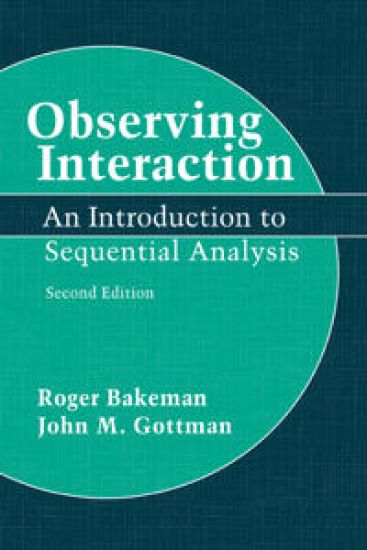
Observing Interaction

Observing Interaction

Roger Bakeman; John M. Gottman

Cambridge University Press
1997
pokkari
Mothers and infants exchanging gleeful vocalizations, married couples discussing their problems, children playing, birds courting and monkeys fighting have this in common: their interactions with others unfold over time. Almost anyone who is interested can observe and describe such phenomena. But usually scientists demand more. They want observations that are replicable and amenable to scientific analysis, while still faithful to the dynamics of the phenomena studied. This book provides a straightforward introduction to scientific methods for observing social behavior. Because of the importance of time in the dynamics of social interaction, sequential approaches to analyzing and understanding social behavior are emphasized. An advanced knowledge of statistical analysis is not required. Instead, the authors present fundamental concepts and offer practical advice. 30 line diagrams, 13 tables
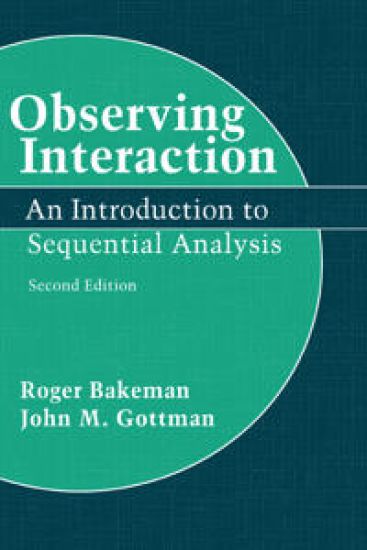
Observing Interaction

Observing Interaction

Roger Bakeman; John M. Gottman

Cambridge University Press
1997
sidottu
Mothers and infants exchanging gleeful vocalizations, married couples discussing their problems, children playing, birds courting and monkeys fighting have this in common: their interactions with others unfold over time. Almost anyone who is interested can observe and describe such phenomena. But usually scientists demand more. They want observations that are replicable and amenable to scientific analysis, while still faithful to the dynamics of the phenomena studied. This book provides a straightforward introduction to scientific methods for observing social behavior. Because of the importance of time in the dynamics of social interaction, sequential approaches to analyzing and understanding social behavior are emphasized. An advanced knowledge of statistical analysis is not required. Instead, the authors present fundamental concepts and offer practical advice.