Kirjailija
Roger Brownsword
Kirjat ja teokset yhdessä paikassa: 22 kirjaa, julkaisuja vuosilta 1994–2026, suosituimpiin kuuluu The Evolution of Law, Regulation and Technology. Vertaile teosten hintoja ja tarkista saatavuus suomalaisista kirjakaupoista.
22 kirjaa
Kirjojen julkaisuvuodet: 1994–2026.
Outlining three phases in the history of ‘Law, Regulation and Technology’ as a scholarly discipline, this book anticipates its next phase through the elaboration of a new jurisprudence centred on governance, and the aspiration for good governance. In the first phase, it is advances in genetics and the development of the internet that attract legal interest. In the second phase, and in the context of a raft of emerging technologies, the book identifies three recognisable lines of inquiry. One focuses on the juridical application of traditional legal rules, principles, concepts, and classifications to these technologies. Another explores the political challenges of regulating new technologies. And a third line of inquiry focuses on the ways in which new tools might be applied for the more effective and efficient performance of legal and regulatory functions. In the context of an extensive and expanding reliance on new technologies being applied for the purposes of governance, the third phase of Law, Regulation and Technology, the book argues, demands a new approach. It is time to treat law and regulation as particular modalities of governance – according to which it must be asked, for example, whether governance must be by rules, whether the rule of law is fit for purpose, and whether the separation of powers is conducive to good governance. In short, the book argues, this third – and emerging – phase of Law, Regulation and Technology demands nothing less than a new jurisprudence of governance in general, hybrid (rule and tool) governance in particular, and always the aspiration for good governance. This book will appeal to legal researchers and postgraduates in the burgeoning field of law, regulation and technology; as well as to jurists who are interested in the challenge new technologies present to traditional debates about the nature of law.
This book argues that law, regulation, and technology can be understood as particular kinds of governance projects, and their credentials assessed according to an overarching concept of good governance. The book introduces the ideas of ‘governance by law’ and ‘governance by regulation’ as particular types of projects within a constellation of governance projects – some normative, some non-normative, and some hybrid. As such, legal and regulatory projects can be differentiated from each other as well as from other normative governance projects, such as ethics; they can also be contrasted with various kinds of non-normative technological projects; and, importantly, they can be compared with governance projects that are hybrids, such as rule-and-tool projects. Based on this account of governance, the limitations and imperfections of legal and regulatory governance – relative to an overarching concept of good governance – become readily apparent. Focusing on governance projects, governance problems, and governance prospects, the book thereby offers an insightful and original analysis of the current – and future – intersection of law, technology and governance. This book will be of interest to legal researchers and postgraduates in the burgeoning field of law, regulation and technology; as well as others with more general interests in issues of law and governance.
This book offers a radically different introduction to law, one that reflects the challenges and opportunities presented by the rapid technological developments of our time. Traditionally, law has been about historic principles and rules and their application to a particular set of facts; and courts, judges, and disputes have been central to the legal enterprise. Against this approach, this book highlights four radical and revisionist ideas: by bringing modern technologies into the foreground; by presenting law as one particular mode of governance in a larger picture of governance that now includes technological modalities; by insisting that we have to think outside the traditional doctrinal box to engage with a broad range of governance questions; and by emphasising that human communities cannot flourish without good governance to which both lawyers and law are central. These four radical threads are woven into a discussion of the modern landscape of law, and together they offer a distinctly contemporary contribution to the quest for good governance. The challenge for lawyers now, the book maintains, is to contribute to thinking, both locally and globally, about how we take advantage of the opportunities presented by the newest technology, without compromising the essential conditions for human life and co-existence, and without losing what we value in law’s governance. This book is aimed at students who are studying law at university and legal academics, and others, interested in the current and future impact of technology on law.
This book analyses discontent with law and assesses the prospect of better governance by technology. In the first part of the book, where the context is ‘low tech’, the range of discontent with law is examined; the underlying reasons for such discontent are identified (namely, the human nature of the legal enterprise, its reliance on rules, and the pluralistic nature of human communities); and the reasonableness of such discontent is assessed. In the second part of the book, where the context is ‘high-tech’ (with new tools becoming available to undertake governance functions), the question is whether discontent with law is further provoked or, to the contrary, is eased. While new technologies provoke further discontent with law’s claimed authority, its ineffectiveness, and its principles, positions, and policies, they also promise more effective and efficient ways of achieving order. The book closes with some reflections on the ambivalence that humans might experience when faced with the choice between law’s governance and apparently better performing governance by technology. That law’s governance is imperfect is undeniable; that humans should quest after better governance is right; but, the shape of our technological futures is unclear. This accessibly written book will appeal to scholars and students who are working in the broad and burgeoning field of law, regulation, and technology, as well as to legal theorists, political scientists, and sociologists with interests in the impact of new technology.
In the context of the technological disruption of law and, in particular, the prospect of governance by machines, this book reconsiders the demand that we should respect the law, simply because it is the law. What does ‘the law’ need to look like to justify our respect? Responding to this question, the book takes the form of a dialectic between, on the one side, the promise of the prospectus for law and, on the other, the discontent provoked by the performance of law in practice; this is followed by a synthesis. Four pictures of law are considered: two are traditional pictures – law as order and law as just order; and two are prompted by the technological disruption of law – law as governance by machines and law as self-governance by humans. These pictures are tested in five performance areas: contract law, criminal law, biolaw, information law, and constitutional law. The synthesis, revealing the complexity of the demand for respect, highlights three particular points. First, the only prospectus for law that clearly commands respect is one that is committed to protecting the global commons (the preconditions for humans to form their own communities with their own forms of governance); second, any form of governance by humans will invite reservations and push-back against the demand for respect; and, third, governance by machines is not so much a superior form of governance as a radically different form in which questions about respect are redundant. This book will appeal to scholars and students with interests in the broad and burgeoning field of law, regulation and technology, as well as to legal theorists, practitioners, and others interested in the impact of new technology on law.
Putting technology front and centre in our thinking about law, this book introduces Law 3.0: the future of the legal landscape. Technology not only disrupts the traditional idea of what it is ‘to think like a lawyer,’ as per Law 1.0; it presents major challenges to regulators who are reasoning in a Law 2.0 mode. As this book demonstrates, the latest developments in technology offer regulators the possibility of employing a technical fix rather than just relying on rules – thus, we are introducing Law 3.0. Law 3.0 represents, so to speak, the state we are in and the conversation that we now need to have, and this book identifies some of the key points for discussion in that conversation. Thinking like a lawyer might continue to be associated with Law 1.0, but from 2020 onward, Law 3.0 is the conversation that we all need to join. And, as this book argues, law and the evolution of legal reasoning cannot be adequately understood unless we grasp the significance of technology in shaping both legal doctrine and our regulatory thinking. This is a book for those studying, or about to study, law – as well as others with interests in the legal, political, and social impact of technology.
This book considers the implications of the regulatory burden being borne increasingly by technological management rather than by rules of law. If crime is controlled, if human health and safety are secured, if the environment is protected, not by rules but by measures of technological management—designed into products, processes, places and so on—what should we make of this transformation? In an era of smart regulatory technologies, how should we understand the ‘regulatory environment’, and the ‘complexion’ of its regulatory signals? How does technological management sit with the Rule of Law and with the traditional ideals of legality, legal coherence, and respect for liberty, human rights and human dignity? What is the future for the rules of criminal law, torts and contract law—are they likely to be rendered redundant? How are human informational interests to be specified and protected? Can traditional rules of law survive not only the emergent use of technological management but also a risk management mentality that pervades the collective engagement with new technologies? Even if technological management is effective, is it acceptable? Are we ready for rule by technology? Undertaking a radical examination of the disruptive effects of technology on the law and the legal mind-set, Roger Brownsword calls for a triple act of re-imagination: first, re-imagining legal rules as one element of a larger regulatory environment of which technological management is also a part; secondly, re-imagining the Rule of Law as a constraint on the arbitrary exercise of power (whether exercised through rules or through technological measures); and, thirdly, re-imagining the future of traditional rules of criminal law, tort law, and contract law.
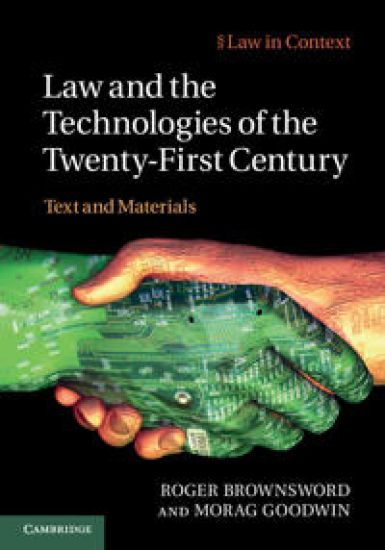
Law and the Technologies of the Twenty-First Century
Roger Brownsword; Morag Goodwin
Cambridge University Press
2012
pokkari
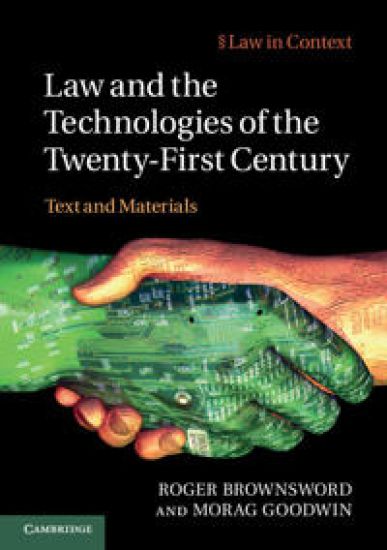
Law and the Technologies of the Twenty-First Century provides a contextual account of the way in which law functions in a broader regulatory environment across different jurisdictions. It identifies and clearly structures the four key challenges that technology poses to regulatory efforts, distinguishing between technology as a regulatory target and tool, and guiding the reader through an emerging field that is subject to rapid change. By extensive use of examples and extracts from the texts and materials that form and shape the scholarly and public debates over technology regulation, it presents complex material in a stimulating and engaging manner. Co-authored by a leading scholar in the field with a scholar new to the area, it combines comprehensive knowledge of the field with a fresh approach. This is essential reading for students of law and technology, risk regulation, policy studies, and science and technology studies.
Law and the Technologies of the Twenty-First Century
Roger Brownsword; Morag Goodwin
Cambridge University Press
2012
sidottu
Law and the Technologies of the Twenty-First Century provides a contextual account of the way in which law functions in a broader regulatory environment across different jurisdictions. It identifies and clearly structures the four key challenges that technology poses to regulatory efforts, distinguishing between technology as a regulatory target and tool, and guiding the reader through an emerging field that is subject to rapid change. By extensive use of examples and extracts from the texts and materials that form and shape the scholarly and public debates over technology regulation, it presents complex material in a stimulating and engaging manner. Co-authored by a leading scholar in the field with a scholar new to the area, it combines comprehensive knowledge of the field with a fresh approach. This is essential reading for students of law and technology, risk regulation, policy studies, and science and technology studies.
Rights, Regulation, and the Technological Revolution
Roger Brownsword
Oxford University Press
2008
sidottu
Rights, Regulation, and the Technological Revolution confronts a central question facing modern government - how can regulators respond to both the challenges and opportunities presented by a technologically driven society without sacrificing legitimacy for effectiveness, or weakening the essential conditions of a stable, aspirant moral community? Analysing developments across biotechnology, information and communications technology, nanotechnology and neurotechnology, the book explores the difficulties facing the public control of rapid technological change, focusing on the problems of regulatory effectiveness, connection, legitimacy, and compliance. The book argues that as regulators struggle to find adequate frameworks to limit, license and support new technologies, they will increasingly rely on a technological approach to complement, enhance, and even replace traditional legal strategies. The book breaks new ground by offering the first overarching commentary on the relationship between regulators, industry, and wider society as the new technologies of the twenty-first century achieve an ever-greater penetration in our daily lives.
In a community that takes rights seriously, consent features pervasively in both moral and legal discourse as a justifying reason: stated simply, where there is consent, there can be no complaint. However, without a clear appreciation of the nature of a consent-based justification, its integrity, both in principle and in practice, is liable to be compromised. This book examines the role of consent as a procedural justification, discussing the prerequisites for an adequate consent -- in particular, that an agent with the relevant capacity has made an unforced and informed choice, that the consent has been clearly signalled, and that the scope of the authorisation covers the act in question. It goes on to highlight both the Fallacy of Necessity (where there is no consent, there must be a wrong) and the Fallacy of Sufficiency (where there is consent, there cannot be a wrong). Finally, the extent to which the authority of law itself rests on consent is considered. If the familiarity of consent-based justification engenders confusion and contempt, the analysis in this book acts as a corrective, identifying a range of abusive or misguided practices that variously under-value or over-value consent, that fictionalise it or that are fixated by it, and that treat it too casually or too cautiously. In short, the analysis in Consent in the Law points the way towards recognising an important procedural justification for precisely what it is as well as giving it a more coherent application.
In this unique volume, Roger Brownsword provides a thoughtful overview of the principal themes of the law of contract. He explores the context of the recent development of contract law, and considers the many changes the law has undergone given the ever-evolving nature of English law. This accessible text brings Brownsword's expert commentary to a wider readership, and has been fully updated and revised to include recent issues and cases, including the Europeanization of contract law and the Great Peace Shipping case.
Human Dignity in Bioethics and Biolaw
Deryck Beyleveld; Roger Brownsword
Oxford University Press
2001
sidottu
The concept of human dignity is increasingly invoked in bioethical debate and, indeed, in international instruments concerned with biotechnology and biomedicine. While some commentators consider appeals to human dignity to be little more than rhetoric and not worthy of serious consideration, the authors of this groundbreaking new study give such appeals distinct and defensible meaning through an application of the moral theory of Alan Gewirth. In Part One, the book seeks to bring human dignity more clearly into focus. It sketches two opposed conceptions, 'human dignity as empowerment', which treats human rights as based on the intrinsic dignity of humans, identified with individual autonomy, and 'human dignity as constraint', which acts as an umbrella for a number of duty-driven approaches. While viewing human dignity primarily as empowerment, the authors argue that it is not autonomy as such, but vulnerable agency around which dignity as the basis of human rights is to be analyzed. Alongside this, they develop the idea of dignity as a virtue, specifically as a practical attitude to be cultivated in the face of human finitude and vulnerability. At its sharpest, dignity as a virtue indicates the aspirational path of responsible and rational agency in the context of the existential anxiety that is part and parcel of the human condition. During this analysis they pay particular attention to the similarities and differences between Kantian and Gewirthian theory. In Part Two, the authors apply their analysis of dignity as generating rights and responsibilities to a range of activities (such as pre-natal selection, commodification of the human body, cloning, and euthanasia) running from birth with dignity through to death with dignity, and subject the use of 'human dignity' in existing regulatory frameworks to critical scrutiny.