Kirjojen hintavertailu – 12 903 725 kirjaa ja 27 kauppaa

Kirjailija

Roger D. Congleton

Kirjat ja teokset yhdessä paikassa: 7 kirjaa, julkaisuja vuosilta 1998–2022, suosituimpiin kuuluu Improving Democracy Through Constitutional Reform. Vertaile teosten hintoja ja tarkista saatavuus suomalaisista kirjakaupoista.

7 kirjaa

Kirjojen julkaisuvuodet: 1998–2022.

Solving Social Dilemmas

Solving Social Dilemmas

Roger D. Congleton

OXFORD UNIVERSITY PRESS INC
2022
sidottu
An original account of the role of ethical dispositions in the development of prosperous commercial societies In Solving Social Dilemmas, Roger Congleton provides an explanation for the rise of prosperous commercial societies. Congleton argues that an endless series of social, economic, and political dilemmas have to be solved or ameliorated to sustain social and economic progress and suggests that the most plausible solutions involve internalized rules of conduct. Previous foundational texts suggest that institutions often emerge to address social dilemmas, but Congleton focuses on a solution that is arguably prior to formal institutions: the internalization of principles and rules of conduct that directly affect individual behavior and thereby group outcomes. Supported by an intellectual and analytical history of the emergence of commercial societies in the West, the book uses elementary game theory to review a few dozen social, economic, and political dilemmas that need to be solved if prosperous societies are to emerge. It shows that ethical dispositions are likely to play important roles in solutions to all the problems examined-and arguably many more. Congleton does not claim that commercial networks result from ethical as opposed to unethical behavior, but that some ethical systems include rules that support the development of extended market networks, specialization, and innovation. As evidence the book traces how the increasing support of commerce in ethical theories in the seventeenth, eighteenth, and nineteenth centuries helped launch "the great acceleration" and the emergence of the first truly commercial societies. By combining substantive theoretical work with analysis of centuries of ethical writings, Solving Social Dilemmas reveals that commercial societies have moral foundations.
Improving Democracy Through Constitutional Reform

Improving Democracy Through Constitutional Reform

Roger D. Congleton

Springer-Verlag New York Inc.
2012
nidottu
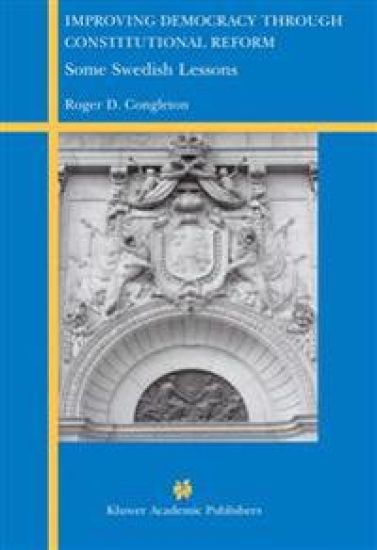
Do constitutions matter? Are constitutions simply symbols of the political times at which they were adopted, or do they systematically affect the course of public policy? Are the policy crises of failing democracies the result of bad luck or of fundamental problems associated with the major and minor constitutional reforms adopted during their recent histories? The purpose of the present study is to address these questions using a blend of theory, history, and statistical analysis. The Swedish experience provides a nearly perfect laboratory in which to study the effects of constitutional reform. During the past 200 years, Swedish governance has shifted from a king-dominated system with an unelected four-chamber parliament to a bicameral legislature elected with wealth-weighted voting in 1866, and then to a new electoral system based on proportional representation and universal suffrage in 1920, and finally to a unicameral parliamentary system in 1970. All these radical reorganizations of Swedish governance were accomplished peacefully using formal amendment procedures established by previous constitutions. By focusing on constitutional issues rather than Sweden's political history, this book extends our understanding of constitutional reform and parliamentary democracy in general.
Perfecting Parliament

Perfecting Parliament

Roger D. Congleton

Cambridge University Press
2010
sidottu
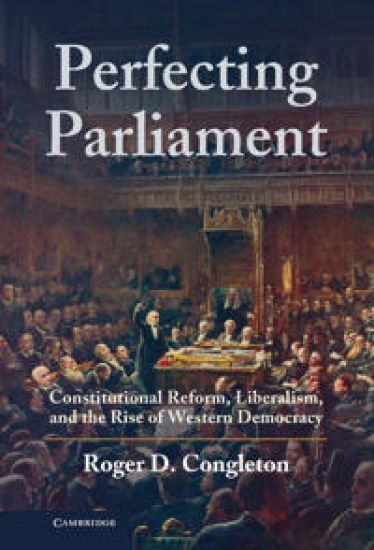
This book explains why contemporary liberal democracies are based on historical templates rather than revolutionary reforms; why the transition in Europe occurred during a relatively short period in the nineteenth century; why politically and economically powerful men and women voluntarily supported such reforms; how interests, ideas, and pre-existing institutions affected the reforms adopted; and why the countries that liberalized their political systems also produced the Industrial Revolution. The analysis is organized in three parts. The first part develops new rational choice models of (1) governance, (2) the balance of authority between parliaments and kings, (3) constitutional exchange, and (4) suffrage reform. The second part provides historical overviews and detailed constitutional histories of six important countries. The third part provides additional evidence in support of the theory, summarizes the results, contrasts the approach taken in this book with that of other scholars, and discusses methodological issues.
Perfecting Parliament

Perfecting Parliament

Roger D. Congleton

Cambridge University Press
2010
pokkari
This book explains why contemporary liberal democracies are based on historical templates rather than revolutionary reforms; why the transition in Europe occurred during a relatively short period in the nineteenth century; why politically and economically powerful men and women voluntarily supported such reforms; how interests, ideas, and pre-existing institutions affected the reforms adopted; and why the countries that liberalized their political systems also produced the Industrial Revolution. The analysis is organized in three parts. The first part develops new rational choice models of (1) governance, (2) the balance of authority between parliaments and kings, (3) constitutional exchange, and (4) suffrage reform. The second part provides historical overviews and detailed constitutional histories of six important countries. The third part provides additional evidence in support of the theory, summarizes the results, contrasts the approach taken in this book with that of other scholars, and discusses methodological issues.
Politics by Principle, Not Interest

Politics by Principle, Not Interest

James M. Buchanan; Roger D. Congleton

Cambridge University Press
2006
pokkari
The very logic of majority rule implies unequal treatment or discrimination. If left unconstrained, majority coalitions will promote the interests of their own members at the expense of other persons. This book focuses on the effects of applying a generality constraint on the political process. Under this requirement, majorities would be constitutionally prohibited from treating different persons and groups differently. The generality principle is familiar in that all persons are to be treated equally. In summary, this book extends the generality norm to politics. Several defences of equal treatment or generality are developed and applied. These include the familiar intuition that invokes fairness. But the primary argument here is centred on political efficiency, which is increased when governments are constrained to treat persons or groups generally rather than differentially. The political efficiency defence of the generality constraint is based on a public choice analysis of the implication of majoritarian discrimination.
Improving Democracy Through Constitutional Reform

Improving Democracy Through Constitutional Reform

Roger D. Congleton

Springer-Verlag New York Inc.
2003
sidottu
Do constitutions matter? Are constitutions simply symbols of the political times at which they were adopted, or do they systematically affect the course of public policy? Are the policy crises of failing democracies the result of bad luck or of fundamental problems associated with the major and minor constitutional reforms adopted during their recent histories? The purpose of the present study is to address these questions using a blend of theory, history, and statistical analysis. The Swedish experience provides a nearly perfect laboratory in which to study the effects of constitutional reform. During the past 200 years, Swedish governance has shifted from a king-dominated system with an unelected four-chamber parliament to a bicameral legislature elected with wealth-weighted voting in 1866, and then to a new electoral system based on proportional representation and universal suffrage in 1920, and finally to a unicameral parliamentary system in 1970. All these radical reorganizations of Swedish governance were accomplished peacefully using formal amendment procedures established by previous constitutions. By focusing on constitutional issues rather than Sweden's political history, this book extends our understanding of constitutional reform and parliamentary democracy in general.
Politics by Principle, Not Interest

Politics by Principle, Not Interest

James M. Buchanan; Roger D. Congleton

Cambridge University Press
1998
sidottu
The very logic of majority rule implies unequal treatment or discrimination. If left unconstrained, majority coalitions will promote the interests of their own members at the expense of other persons. This book focuses on the effects of applying a generality constraint on the political process. Under this requirement, majorities would be constitutionally prohibited from treating different persons and groups differently. The generality principle is familiar in that all persons are to be treated equally. In summary, this book extends the generality norm to politics. Several defenses or equal treatment or generality are developed and applied. These include the familiar intuition that invokes fairness. But the primary argument here is centred on political efficiency, which is increased when governments are constrained to treat persons or groups generally rather than differentially. The political efficiency defense of the generality constraint is based on a public choice analysis of the implication of majoritarian discrimination.