Kirjojen hintavertailu – 12 859 829 kirjaa ja 27 kauppaa

Kirjailija

Roger Finke

Kirjat ja teokset yhdessä paikassa: 6 kirjaa, julkaisuja vuosilta 2000–2012, suosituimpiin kuuluu Places of Faith. Vertaile teosten hintoja ja tarkista saatavuus suomalaisista kirjakaupoista.

6 kirjaa

Kirjojen julkaisuvuodet: 2000–2012.

Places of Faith

Places of Faith

Christopher P. Scheitle; Roger Finke

Oxford University Press Inc
2012
sidottu
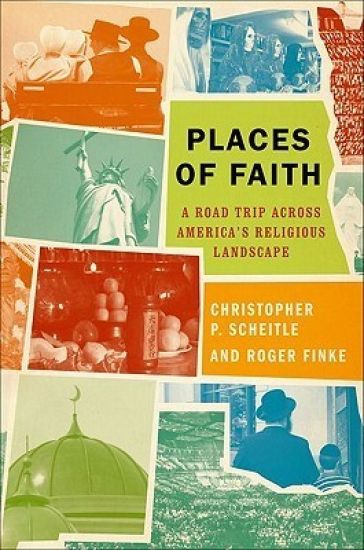
Lavishly illustrated with over 100 color photographs, Places of Faith takes readers on a fascinating religious road trip. Christopher Scheitle and Roger Finke have crisscrossed America, visiting churches in small towns and rural areas, as well as the mega-churches, storefronts, synagogues, Islamic centers, Eastern temples, and other places of faith in major cities. Each stop on their tour provides an opportunity to introduce a particular current of American religion. Memphis serves as a window into the Black Church, a visit to Colorado Springs provides insight into evangelicalism, and a stop in Detroit sheds light on American Muslims. Readers visit Hare Krishnas in San Francisco, the Amish in central Pennsylvania, and a "cowboy church" in Amarillo, Texas. As the authors journey across the country, they retell unique religious histories and touch on local religious profiles and trends. They draw from conversations they had with pastors, imams, bishops, priests, and monks, along with ordinary believers of all kinds. Most of all, they tell the reader what they saw and heard, putting a human face on America's astounding religious diversity.
Places of Faith

Places of Faith

Christopher P. Scheitle; Roger Finke

Oxford University Press Inc
2012
nidottu
Lavishly illustrated with over 100 color photographs, Places of Faith takes readers on a fascinating religious road trip. Christopher Scheitle and Roger Finke have crisscrossed America, visiting churches in small towns and rural areas, as well as the mega-churches, storefronts, synagogues, Islamic centers, Eastern temples, and other places of faith in major cities. Each stop on their tour provides an opportunity to introduce a particular current of American religion. Memphis serves as a window into the Black Church, a visit to Colorado Springs provides insight into evangelicalism, and a stop in Detroit sheds light on American Muslims. Readers visit Hare Krishnas in San Francisco, the Amish in central Pennsylvania, and a "cowboy church" in Amarillo, Texas. As the authors journey across the country, they retell unique religious histories and touch on local religious profiles and trends. They draw from conversations they had with pastors, imams, bishops, priests, and monks, along with ordinary believers of all kinds. Most of all, they tell the reader what they saw and heard, putting a human face on America's astounding religious diversity.

The Price of Freedom Denied

The Price of Freedom Denied

Brian J. Grim; Roger Finke

Cambridge University Press
2010
sidottu
The Price of Freedom Denied shows that, contrary to popular opinion, ensuring religious freedom for all reduces violent religious persecution and conflict. Others have suggested that restrictions on religion are necessary to maintain order or preserve a peaceful religious homogeneity. Brian J. Grim and Roger Finke show that restricting religious freedoms is associated with higher levels of violent persecution. Relying on a new source of coded data for nearly 200 countries and case studies of six countries, the book offers a global profile of religious freedom and religious persecution. Grim and Finke report that persecution is evident in all regions and is standard fare for many. They also find that religious freedoms are routinely denied and that government and the society at large serve to restrict these freedoms. They conclude that the price of freedom denied is high indeed.
The Price of Freedom Denied

The Price of Freedom Denied

Brian J. Grim; Roger Finke

Cambridge University Press
2010
pokkari
The Price of Freedom Denied shows that, contrary to popular opinion, ensuring religious freedom for all reduces violent religious persecution and conflict. Others have suggested that restrictions on religion are necessary to maintain order or preserve a peaceful religious homogeneity. Brian J. Grim and Roger Finke show that restricting religious freedoms is associated with higher levels of violent persecution. Relying on a new source of coded data for nearly 200 countries and case studies of six countries, the book offers a global profile of religious freedom and religious persecution. Grim and Finke report that persecution is evident in all regions and is standard fare for many. They also find that religious freedoms are routinely denied and that government and the society at large serve to restrict these freedoms. They conclude that the price of freedom denied is high indeed.
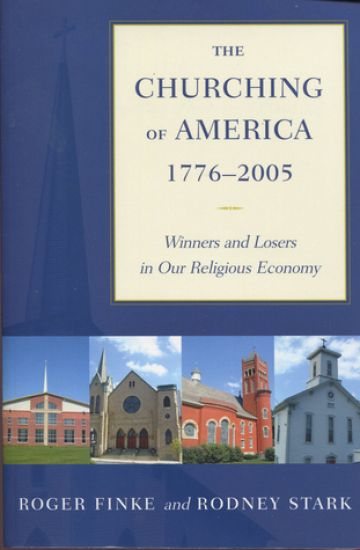
The Churching of America, 1776-2005

The Churching of America, 1776-2005

Roger Finke; Rodney Stark

Rutgers University Press
2005
nidottu
Although many Americans assume that religious participation has declined in America, Finke and Stark present a different picture. In 1776, fewer than 1 in 5 Americans were active in church affairs. Today, church membership includes about 6 out of 10 people. But, as Finke and Stark show, not all denominations benefited. They explain how and why the early nineteenth-century churches began their descent, while two newcomer sects, the Baptists and the Methodists, gained ground. They also analyze why the Methodists then began a long, downward slide, why the Baptists continued to succeed, how the Catholic Church met the competition of ardent Protestant missionaries, and why the Catholic commitment has declined since Vatican II. The authors also explain why ecumenical movements always fail In short, Americans are not abandoning religion; they have been moving away from established denominations. A "church-sect process" is always under way, Finke and Stark argue, as successful churches lose their organizational vigor and are replaced by less worldly groups. Some observers assert that the rise in churching rates indicates increased participation, not increased belief. Finke and Stark challenge this as well. They find that those groups that have gained the greatest numbers have demanded that their followers accept traditional doctrines and otherworldliness. They argue that religious organizations can thrive only when they comfort souls and demand sacrifice. When theology becomes too logical, or too secular, it loses people.
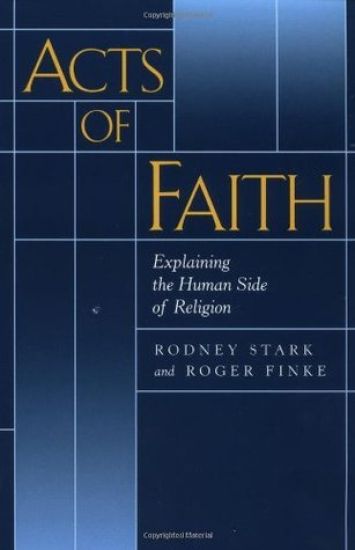
Acts of Faith

Acts of Faith

Rodney Stark; Roger Finke

University of California Press
2000
pokkari
Finally, social scientists have begun to attempt to understand religious behavior rather than to discredit it as irrational, ignorant, or foolish--and Rodney Stark and Roger Finke have played a major role in this new approach. Acknowledging that science cannot assess the supernatural side of religion (and therefore should not claim to do so), Stark and Finke analyze the observable, human side of faith. In clear and engaging prose, the authors combine explicit theorizing with animated discussions as they move from considering the religiousness of individuals to the dynamics of religious groups and then to the religious workings of entire societies as religious groups contend for support. The result is a comprehensive new paradigm for the social-scientific study of religion.