Kirjojen hintavertailu – 12 903 735 kirjaa ja 27 kauppaa

Kirjailija

Roger Hayter

Kirjat ja teokset yhdessä paikassa: 8 kirjaa, julkaisuja vuosilta 1990–2025, suosituimpiin kuuluu The Thin Edge of Innovation. Vertaile teosten hintoja ja tarkista saatavuus suomalaisista kirjakaupoista.

8 kirjaa

Kirjojen julkaisuvuodet: 1990–2025.

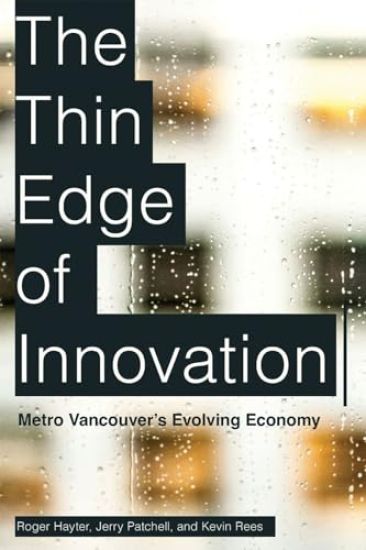
The Thin Edge of Innovation

The Thin Edge of Innovation

Roger Hayter; Jerry Patchell; Kevin Rees

University of British Columbia Press
2025
pokkari
Aligned with global trends in post-industrialization, the economy of Metro Vancouver is changing, but along its own trajectory. The focus is shifting away from resource-based activities to local entrepreneurial initiatives across a remarkable range of industries, from software to craft beer, biopharmaceuticals to mountain bikes. This evolution is being shaped by local business and the city's location on the national and global periphery. The Thin Edge of Innovation focusses on the performance of signature businesses in these entrepreneurial sectors to grow and foster industrial clusters and integrate with the global economy. The contributors give a mixed report card to this economic transition. Within Metro Vancouver, innovation has stimulated economic diversification and promises to deliver high-income jobs. But this diversification has also been thinly spread and lacks deep local roots or dominant anchor companies. This constructive study examines the distinctive opportunities facing Metro Vancouver. Despite challenges, it reveals a region with undoubted potential for sustained, broadly beneficial local development
The Thin Edge of Innovation

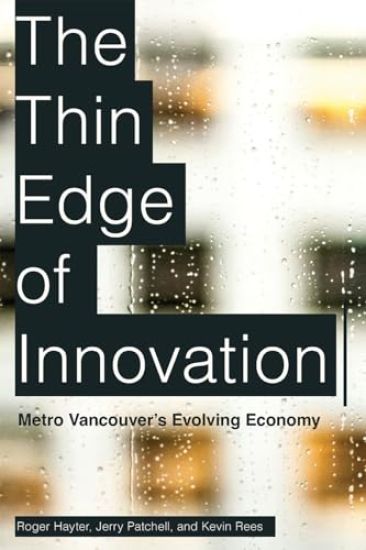
The Thin Edge of Innovation

Roger Hayter; Jerry Patchell; Kevin Rees

University of British Columbia Press
2025
sidottu
Aligned with global trends in post-industrialization, the economy of Metro Vancouver is changing, but along its own trajectory. The focus is shifting away from resource-based activities to local entrepreneurial initiatives across a remarkable range of industries, from software to craft beer, biopharmaceuticals to mountain bikes. This evolution is being shaped by local business and the city's location on the national and global periphery. The Thin Edge of Innovation focusses on the performance of signature businesses in these entrepreneurial sectors to grow and foster industrial clusters and integrate with the global economy. The contributors give a mixed report card to this economic transition. Within Metro Vancouver, innovation has stimulated economic diversification and promises to deliver high-income jobs. But this diversification has also been thinly spread and lacks deep local roots or dominant anchor companies. This constructive study examines the distinctive opportunities facing Metro Vancouver. Despite challenges, it reveals a region with undoubted potential for sustained, broadly beneficial local development
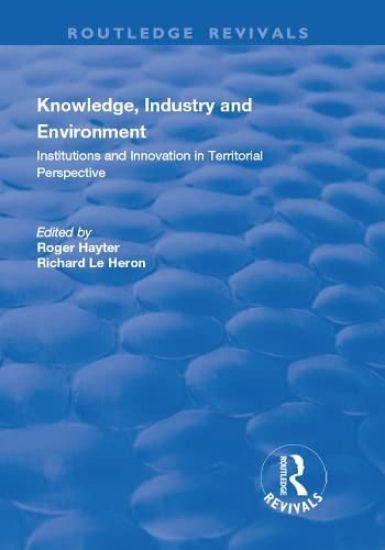
Knowledge, Industry and Environment

Knowledge, Industry and Environment

Richard Le Heron; Roger Hayter

Routledge
2019
nidottu
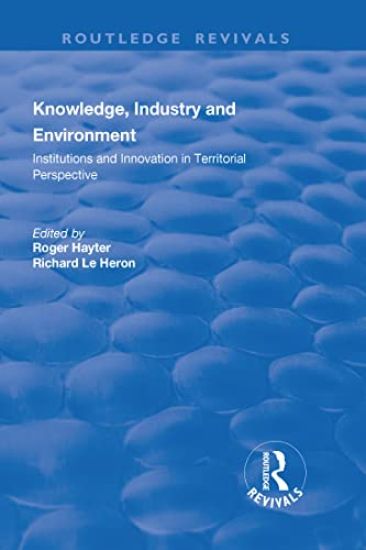
This title was first published in 2002. Bringing together a wide range of theoretical and empirical case studies from Canada, New Zealand, South Korea, Turkey, China, Germany, Spain, Sweden, Poland, South Africa, Japan, The Netherlands and the United Kingdom, this book addresses these neglected issues, in particular, contemplating the vitally important nexus between industry, environment and the knowledge economy. Throughout the book, four key themes and issues are explored: institution building strategies; agglomeration as territorial context; sustainable industrial-environmental processes and policy initiatives; globalization, learning and industrial location dynamics. The book concludes with an outline of future research directions within the paradigm.
Knowledge, Industry and Environment

Knowledge, Industry and Environment

Richard Le Heron; Roger Hayter

Routledge
2017
sidottu
This title was first published in 2002. Bringing together a wide range of theoretical and empirical case studies from Canada, New Zealand, South Korea, Turkey, China, Germany, Spain, Sweden, Poland, South Africa, Japan, The Netherlands and the United Kingdom, this book addresses these neglected issues, in particular, contemplating the vitally important nexus between industry, environment and the knowledge economy. Throughout the book, four key themes and issues are explored: institution building strategies; agglomeration as territorial context; sustainable industrial-environmental processes and policy initiatives; globalization, learning and industrial location dynamics. The book concludes with an outline of future research directions within the paradigm.
Economic Geography

Economic Geography

Roger Hayter; Jerry Patchell

Oxford University Press, Canada
2016
nidottu
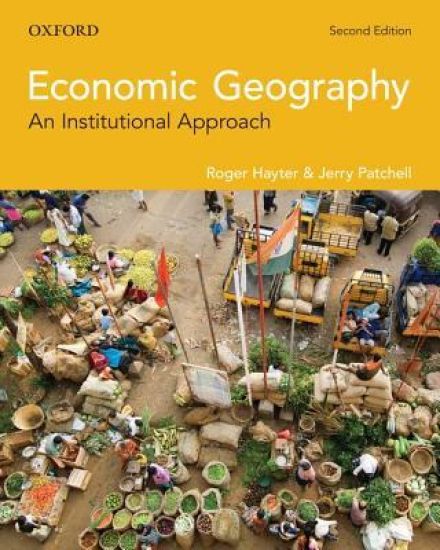
Economic Geography: An Institutional Approach 2e is a comprehensive introduction to the study of economic activity in place and across space. Perfect for all second- and third-year courses in economic geography, the text provides both a solid foundation in the location dynamics of value chains and a perspective that recognizes the interdependence of places, institutions, activities, and ways of life around the world. Instead of taking the traditional approach, which surveys this history of economic geography as a whole, the authors trace the historical developments of individual sectors, focusing on the way economic, social, and political institutions interact to determine the quality of life in a particular location.
Flexible Crossroads

Flexible Crossroads

Roger Hayter

University of British Columbia Press
2000
pokkari
British Columbia's forest economy is at a crucial crossroads. Its survival, Roger Hayter argues, rests on its ability to remain flexible and open to innovation -- a future by no means assured given recent policy initiatives and the current contested nature of British Columbia's forests. Flexible Crossroads looks at the contemporary restructuring of British Columbia's forest economy, demonstrating how both resource dynamics -- the transition from old growth to managed forests -- and industrial dynamics -- changing technology and global market forces -- have shaped this transformation. Conceptually, the restructuring is portrayed as a shift from a commodity-based, cost-minimizing production system (Fordism) to a more product-differentiated, value-maximizing production system informed by the imperative of flexibility. The first part of the book provides global and historical perspectives by situating British Columbia's forest economy within the wider context of global industrialization, the history of resource dynamics, and the current shift from Fordist to more flexible systems of production. In the second part, Hayter assesses the extent to which British Columbia's forest economy is enacting this shift by focusing on factors such as foreign ownership, the strategies and structure of MacMillan Bloedel, the role of small firms, trade relations, employment and labour relations, forest community development, environmentalism and resource use, and innovation policy. Flexible Crossroads will appeal to geographers, political economists and forestry professionals, as well as to students of British Columbia's economy and forest economies generally.
Flexible Crossroads

Flexible Crossroads

Roger Hayter

University of British Columbia Press
2000
sidottu
British Columbia's forest economy is at a crucial crossroads. Its survival, Roger Hayter argues, rests on its ability to remain flexible and open to innovation -- a future by no means assured given recent policy initiatives and the current contested nature of British Columbia's forests. Flexible Crossroads looks at the contemporary restructuring of British Columbia's forest economy, demonstrating how both resource dynamics -- the transition from old growth to managed forests -- and industrial dynamics -- changing technology and global market forces -- have shaped this transformation. Conceptually, the restructuring is portrayed as a shift from a commodity-based, cost-minimizing production system (Fordism) to a more product-differentiated, value-maximizing production system informed by the imperative of flexibility. The first part of the book provides global and historical perspectives by situating British Columbia's forest economy within the wider context of global industrialization, the history of resource dynamics, and the current shift from Fordist to more flexible systems of production. In the second part, Hayter assesses the extent to which British Columbia's forest economy is enacting this shift by focusing on factors such as foreign ownership, the strategies and structure of MacMillan Bloedel, the role of small firms, trade relations, employment and labour relations, forest community development, environmentalism and resource use, and innovation policy. Flexible Crossroads will appeal to geographers, political economists and forestry professionals, as well as to students of British Columbia's economy and forest economies generally.