
Kirjojen hintavertailu – 12 903 725 kirjaa ja 27 kauppaa

Kirjailija

Roger M. Barker

Kirjat ja teokset yhdessä paikassa: 2 kirjaa, julkaisuja vuosilta 2010–2017, suosituimpiin kuuluu Corporate Governance and Investment Management. Vertaile teosten hintoja ja tarkista saatavuus suomalaisista kirjakaupoista.

2 kirjaa

Kirjojen julkaisuvuodet: 2010–2017.

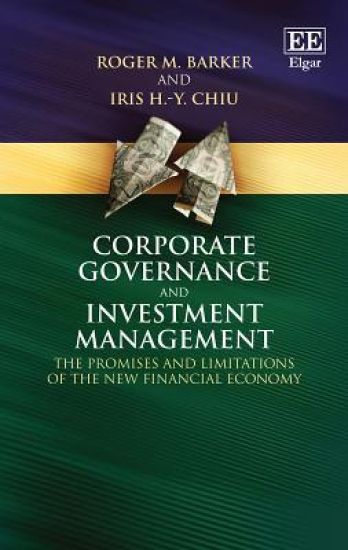
Corporate Governance and Investment Management

Corporate Governance and Investment Management

Roger M. Barker; Iris H.-Y. Chiu

Edward Elgar Publishing Ltd
2017
sidottu
Shareholder engagement with publicly listed companies is often seen as a key means to monitor corporate performance and behavior. In this book, the authors examine the corporate governance roles of key institutional investors in UK corporate equity, including pension funds, insurance companies, collective investment funds, hedge and private equity funds and sovereign wealth funds. The authors argue that institutions' corporate governance roles are an instrument ultimately shaped by private interests and market forces, as well as law and regulatory obligations, and that policy-makers should not readily make assumptions regarding their effectiveness, or their alignment with public interest or social good. They critically discuss the possibilities and limitations of shareholder stewardship i.e. the UK Stewardship Code and the EU Shareholder Rights Directive 2017 as well as explore various reforms of the UK pension fund structures, including the Local Government Pension Funds reform, the move from defined benefit to defined contribution schemes and implications for funds' asset allocation, investment management and corporate governance roles. This book will be of interest to academics in corporate law and governance as well as those in the corporate governance industry, such as institutions, trade associations, proxy advisors and other corporate governance service providers. Think tanks and research institutes tied to institutional investment, corporate governance, law and business may also be a key audience.

Corporate Governance, Competition, and Political Parties

Corporate Governance, Competition, and Political Parties

Roger M. Barker

Oxford University Press
2010
sidottu
The corporate governance systems of continental Europe have traditionally been quite different to those of the liberal market economies (e.g. the US and the UK). Company ownership has been dominated by incumbent blockholders, with a relatively minor role for minority shareholders and institutional investors. Business strategy has focused on the achievement of social stability - taking into account the interests of a broad group stakeholders - rather than the maximisation of shareholder value. However, since the mid-1990s, European corporations have adopted many of the characteristics of the Anglo-American shareholder model. Furthermore, such an increased shareholder-orientation has coincided with a significant role for the Left in European government. This presents a puzzle, as conventional wisdom does not usually conceive of the Left as an enthusiastic proponent of pro-shareholder capitalism. This book provides an analysis of this paradox by examining how economic factors have interacted with the policy preferences of political parties to cause a significant change in the European system of corporate governance. This book argues that the post-war support of the European Left for the prevailing blockholder-dominated corporate system depended on the willingness of blockholders to share economic rents with employees, both through higher wages and greater employment stability. However, during the 1990s, product markets became more competitive in many European countries. The sharing of rents between social actors became increasingly difficult to sustain. In such an environment, the Left relinquished its traditional social partnership with blockholders and embraced many aspects of the shareholder model. This explanation is supported through a panel data econometric analysis of 15 non-liberal market economies. Subsequent case study chapters examine the political economy of recent corporate governance change in Germany and Italy.