Kirjojen hintavertailu – 12 903 725 kirjaa ja 27 kauppaa

Kirjailija

Roger Nichols

Kirjat ja teokset yhdessä paikassa: 11 kirjaa, julkaisuja vuosilta 1989–2025, suosituimpiin kuuluu Ravel. Vertaile teosten hintoja ja tarkista saatavuus suomalaisista kirjakaupoista.

11 kirjaa

Kirjojen julkaisuvuodet: 1989–2025.

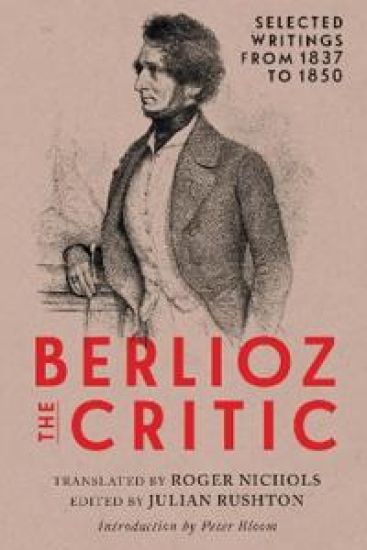
Berlioz the Critic

Berlioz the Critic

Roger Nichols

BOYDELL BREWER LTD
2025
sidottu
Hector Berlioz combined writing music with lively and informed music criticism. This collection of articles, engagingly translated by Roger Nichols, covers the middle years of his critical career. Berlioz's music criticism from 1837 to 1850 covers a period druing which he composed some of his finest works, and travelled abroad to perform them before appreciative audiences in Germany, Russia, and England. Roger Nichols has chosen and translated extracts from fifty-eight articles of particular interest, with commentary and notes identifying people mentioned. Berlioz scholars Peter Bloom and Julian Rushton provide an informative introduction and a comprehensive editorial apparatus. In the selected articles Berlioz discusses Paris performances of early and modern music, including new operas and revivals, and concerts at the Paris Conservatoire. He comments freely but with understanding on conductors, singers and instrumentalists. The essays demonstrate the composer's concern with innovation in the design of musical instruments and assess the quality of performing venues. Berlioz writes on the musical life of London, France, and Germany, most entertainingly about the inauguration of statues of Beethoven and Rossini. The selection is framed by major articles on "Imitation in Music" and on Gluck's opera Alceste.
Sturm-Liouville Operators, Their Spectral Theory, and Some Applications

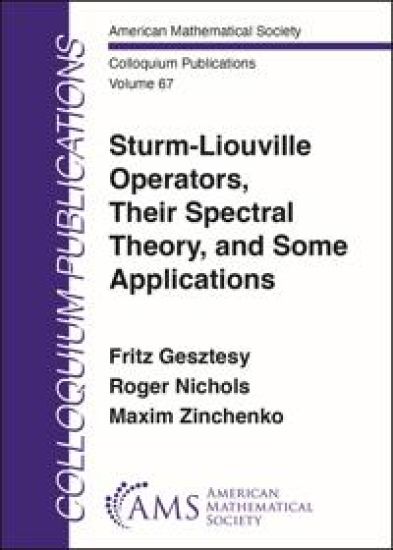
Sturm-Liouville Operators, Their Spectral Theory, and Some Applications

Fritz Gesztesy; Roger Nichols; Maxim Zinchenko

AMERICAN MATHEMATICAL SOCIETY
2024
sidottu
This book provides a detailed treatment of the various facets of modern Sturm-Liouville theory, including such topics as Weyl-Titchmarsh theory, classical, renormalized, and perturbative oscillation theory, boundary data maps, traces and determinants for Sturm-Liouville operators, strongly singular Sturm-Liouville differential operators, generalized boundary values, and Sturm-Liouville operators with distributional coefficients. To illustrate the theory, the book develops an array of examples from Floquet theory to short-range scattering theory, higher-order KdV trace relations, elliptic and algebro-geometric finite gap potentials, reflectionless potentials and the Sodin-Yuditskii class, as well as a detailed collection of singular examples, such as the Bessel, generalized Bessel, and Jacobi operators. A set of appendices contains background on the basics of linear operators and spectral theory in Hilbert spaces, Schatten-von Neumann classes of compact operators, self-adjoint extensions of symmetric operators, including the Friedrichs and Krein-von Neumann extensions, boundary triplets for ODEs, Krein-type resolvent formulas, sesquilinear forms, Nevanlinna-Herglotz functions, and Bessel functions.
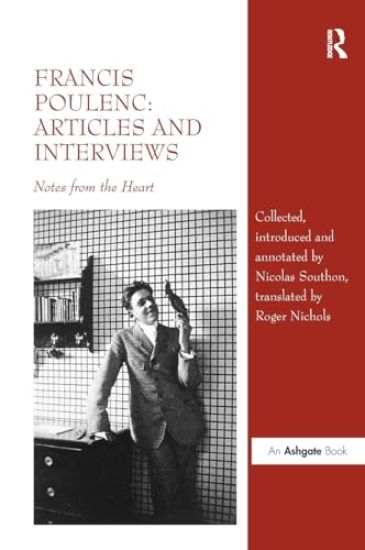
Francis Poulenc: Articles and Interviews

Francis Poulenc: Articles and Interviews

Nicolas Southon; Roger Nichols

TAYLOR FRANCIS LTD
2024
nidottu
’He plays the piano well,’ wrote the society hostess Mme de Saint-Marceaux in her diary on 18 March 1927. ’His compositions are not devoid of talent but he’s not a genius, and I’m afraid he thinks he is.’ Intelligent though the lady was, she got this one spectacularly wrong. Poulenc has in fact outpaced his colleagues in Les Six by many a mile, as singers and instrumentalists all over the world will attest, and while he would never have accepted the title of ’genius’, preferring ’artisan’, a genius is increasingly what he appears to have been. Part of the answer lay in always being his own man, and this independence of spirit shows through in his writings and interviews just as brightly as in his music, whether it’s boasting that he’d be happy never to hear The Mastersingers ever again, pointing out that what critics condemn as the ’formlessness’ of French music is one of its delights, voicing his outrage at attempts to ’finish’ the Unfinished Symphony, writing ’in praise of banality’ - or remembering the affair of Debussy’s hat. And in every case, his intelligence, humour and generosity of spirit help explain why he was so widely and deeply loved. This volume comprises selected articles from Francis Poulenc: J’écris ce qui me chante (Fayard, 2011) edited by Nicholas Southon. Many of these articles and interviews have not been available in English before and Roger Nichols's translation, capturing the very essence of Poulenc’s lively writing style, makes more widely accessible this significant contribution to Poulenc scholarship.
From Berlioz to Boulez

From Berlioz to Boulez

Roger Nichols; Jeremy Sams

KAHN AVERILL
2022
sidottu
Awarded the legion d'Honneur by the French government in 2006 for his services to French culture, acclaimed writer and broadcaster Roger Nichols invites the reader to accompany him on his journey through the century-and-a-half turbulent and fertile period in the history of French music from Berlioz to Boulez. In compiling his collection of articles, interviews, radio plays and talks, Nichols begins with Berlioz's Symphonie Fantastique and ends with his obituary of Pierre Boulez. Along the way, he includes in-depth studies of Debussy and Ravel, connecting the two by a comparison of their operatic masterpieces, Pelleas et Melisande and l'Enfant et les sortileges. Twenty other significant composers from this fascinating period come in for Nichols' hallmark combination of erudition and wit.
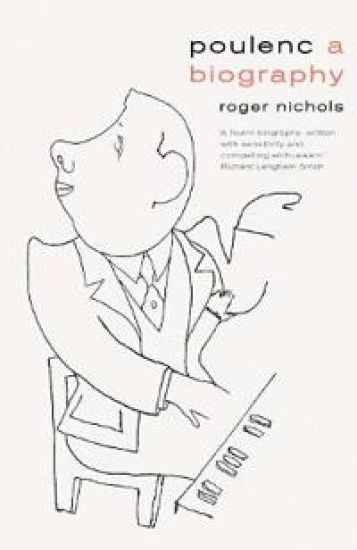
Poulenc

Poulenc

Roger Nichols

Yale University Press
2020
sidottu
An authoritative account of the life and work of Francis Poulenc, one of the most prolific and striking figures in twentieth-century classical music"An assured overview of Poulenc’s life and work."—Alex Ross, New Yorker“Essential reading for anyone interested in the French musical culture of Poulenc’s time. This is the biography the composer deserves.”—Christopher Dingle, BBC Music Magazine, Named one of the Best Books on Classical Music in 2020 by BBC Music Magazine Francis Poulenc is a key figure in twentieth-century classical music, as well as an unorthodox and striking individual. Roger Nichols draws upon Poulenc's music and other primary sources to write an authoritative life of this great artist. Although associated with five other French composers in what came to be called “Les Six”, Poulenc was very much sui generis in personality and in his music, where he excelled over a wide repertoire—opera, songs, ballet scores, chamber works, piano pieces, sacred and secular choral works, orchestral works and concertos. This book fully covers this wide range, while also describing the vicissitudes of Poulenc's life and the many important relationships he had with major figures such as Satie, Ravel, Stravinsky, Diaghilev, Cocteau and others.
Francis Poulenc: Articles and Interviews

Francis Poulenc: Articles and Interviews

Nicolas Southon; Roger Nichols

Ashgate Publishing Limited
2014
sidottu
’He plays the piano well,’ wrote the society hostess Mme de Saint-Marceaux in her diary on 18 March 1927. ’His compositions are not devoid of talent but he’s not a genius, and I’m afraid he thinks he is.’ Intelligent though the lady was, she got this one spectacularly wrong. Poulenc has in fact outpaced his colleagues in Les Six by many a mile, as singers and instrumentalists all over the world will attest, and while he would never have accepted the title of ’genius’, preferring ’artisan’, a genius is increasingly what he appears to have been. Part of the answer lay in always being his own man, and this independence of spirit shows through in his writings and interviews just as brightly as in his music, whether it’s boasting that he’d be happy never to hear The Mastersingers ever again, pointing out that what critics condemn as the ’formlessness’ of French music is one of its delights, voicing his outrage at attempts to ’finish’ the Unfinished Symphony, writing ’in praise of banality’ - or remembering the affair of Debussy’s hat. And in every case, his intelligence, humour and generosity of spirit help explain why he was so widely and deeply loved. This volume comprises selected articles from Francis Poulenc: J’écris ce qui me chante (Fayard, 2011) edited by Nicholas Southon. Many of these articles and interviews have not been available in English before and Roger Nichols's translation, capturing the very essence of Poulenc’s lively writing style, makes more widely accessible this significant contribution to Poulenc scholarship.
Ravel

Ravel

Roger Nichols

Yale University Press
2012
pokkari

Halvin toimitettuna 31,00 €

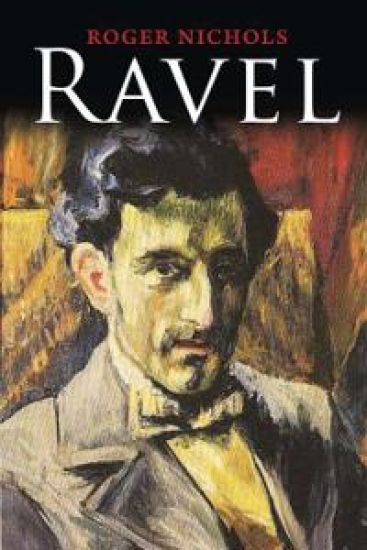
This new biography of Maurice Ravel (1875–1937), by one of the leading scholars of nineteenth- and twentieth-century French music, is based on a wealth of written and oral evidence, some newly translated and some derived from interviews with the composer’s friends and associates. As well as describing the circumstances in which Ravel composed, the book explores new evidence to present radical views of the composer’s background and upbringing, his notorious failure in the Prix de Rome, his incisive and often combative character, his sexual preferences, and his long final illness. It also contains the most detailed account so far published of his hugely successful American tour of 1928. The world of Maurice Ravel—including friendships (and some fallings-out) with Debussy, Fauré, Diaghilev, Gershwin, and Toscanini—is deftly uncovered in this sensitive portrait.
The Life of Debussy

The Life of Debussy

Roger Nichols

Cambridge University Press
1998
sidottu
'That great blue Sphinx', Debussy called the sea. Debussy himself was something of a Sphinx: in the early 1890s he was thinking of 'founding a society for musical esotericism', and although, on the surface, most of his music is instantly engaging and accessible, at a deeper level run currents that are dangerous, unpredictable, destructive. In this biography, Roger Nichols considers the life and music of this seminal figure, charting the currents and the whirlpools in which other humans were sometimes unlucky enough to get caught. Debussy's status is such that no modern composer has been able to ignore him, asking, as he does, any number of riddles to which late twentieth-century music is still searching for answers.
The Life of Debussy

The Life of Debussy

Roger Nichols

Cambridge University Press
1998
nidottu
‘That great blue Sphinx’, Debussy called the sea. Debussy himself was something of a Sphinx: in the early 1890s he was thinking of ‘founding a society for musical esotericism’, and although, on the surface, most of his music is instantly engaging and accessible, at a deeper level run currents that are dangerous, unpredictable, destructive. In this new biography, Roger Nichols considers the life and music of this seminal figure, charting the currents and the whirlpools in which other humans were sometimes unlucky enough to get caught. Debussy’s status is such that no modern composer has been able to ignore him, asking, as he does, any number of riddles to which late twentieth-century music is still searching for answers.
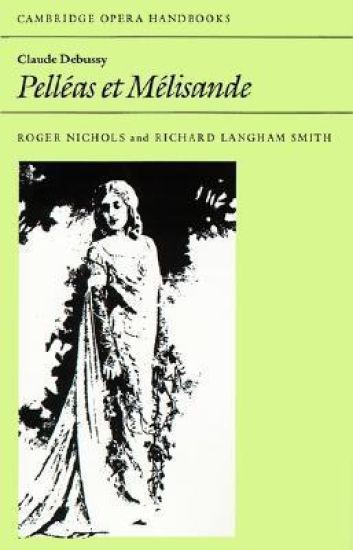
Claude Debussy: Pelléas et Mélisande

Claude Debussy: Pelléas et Mélisande

Roger Nichols; Richard Langham Smith

Cambridge University Press
1989
pokkari
The first comprehensive guide to Pelléas et Mélisande, Debussy’s only completed opera, this book is written by three of the leading authorities on French music of the period. As a background to the opera Richard Langham Smith discusses the play, by the Belgian dramatist Maeterlinck, and considers its literary roots. David Grayson then traces the genesis and composition of the opera, examining also the sketches and rejected versions in order to illuminate Debussy’s compositional strategies. A detailed synopsis by Roger Nichols, which considers carefully Debussy’s musical response to the text, forms a central chapter. The book then moves on to consider more detailed aspects of the style and language of the opera. The relationship between symbols and musical motives forms the basis of a chapter by Richard Langham Smith, and a subsequent chapter by him considers the themes of darkness and light and the key-schemes used to portray them. Two chapters by Roger Nichols on the various performances since 1902 and on the ideas of interpreters and commentators complete the text. The book concludes with a detailed bibliography and a discography.