

Kirjailija
Roger Temam
Kirjat ja teokset yhdessä paikassa: 8 kirjaa, julkaisuja vuosilta 1984–2019, suosituimpiin kuuluu Mathematical Problems in Plasticity. Vertaile teosten hintoja ja tarkista saatavuus suomalaisista kirjakaupoista.
8 kirjaa
Kirjojen julkaisuvuodet: 1984–2019.
Infinite-Dimensional Dynamical Systems in Mechanics and Physics
Roger Temam
Springer-Verlag New York Inc.
2013
nidottu
In this book the author presents the dynamical systems in infinite dimension, especially those generated by dissipative partial differential equations. This book attempts a systematic study of infinite dimensional dynamical systems generated by dissipative evolution partial differential equations arising in mechanics and physics and in other areas of sciences and technology. This second edition has been updated and extended.
Modélisation mathématique et mécanique des milieux continus
Roger Temam; Alain Miranville
Springer-Verlag Berlin and Heidelberg GmbH Co. K
2002
sidottu
Ecrit dans un style qui convient aux mathématiciens et à leur formation, cette introduction à la mécanique des milieux continus et à la modélisation mathématique reste néanmoins proche de la physique. En particulier, les Auteurs font une distinction claire entre ce qui est admis et ce qui est prouvé. Outre les fondements de la mécanique des milieux continus, cet ouvrage contient des introductions plus ou moins détaillées à diverses disciplines connexes: magnétohydrodynamique, combustion, dynamique des fluides géophysiques,... Les Auteurs ont voulu éviter une approche trop abstraite des problèmes traités et garder un langage mathématique élémentaire (les pré-requis sont l'algèbre linéaire et le calcul différentiel et intégral connus de tout étudiant de licence ou de classes préparatoires et de tout ingénieur). Ce livre sera utile à un public très large, depuis les ingénieurs modélisateurs jusqu'aux étudiants des deux premiers cycles de l'Université, des Classes préparatoires.
Convex Analysis and Variational Problems
Ivar Ekeland; Roger Temam
Society for Industrial Applied Mathematics,U.S.
1999
pokkari
No one working in duality should be without a copy of this book. It contains different developments of infinite dimensional convex programming in the context of convex analysis, including duality, minmax and Lagrangians, and convexification of nonconvex optimization problems in the calculus of variations (infinite dimension). It also includes the theory of convex duality applied to partial differential equations; no other reference presents this in a systematic way. The minmax theorems contained in this book have many useful applications, in particular the robust control of partial differential equations in finite time horizon. This SIAM Classics in Applied Mathematics edition contains the original text along with a new preface and some additional references.
Dynamic Multilevel Methods and the Numerical Simulation of Turbulence
Thierry Dubois; François Jauberteau; Roger Temam
Cambridge University Press
1999
sidottu
This book describes the implementation of multilevel methods for the numerical simulation of turbulent flows. The general ideas for the algorithms presented stem from dynamical systems theory and are based on the decomposition of the unknown function into two or more arrays corresponding to different scales in the Fourier space. Before describing in detail the numerical algorithm, survey chapters are included on the mathematical theory of the Navier-Stokes equations and on the physics of the conventional theory of turbulence. The multilevel methods are applied here to the simulation of homogeneous isotropic turbulent flows as well as turbulent channel flows. The implementation issues are discussed in detail and numerical simulations of the flows cited above are presented and analysed. The methods have been applied in the context of the direct numerical simulation and are therefore compared to such simulations.
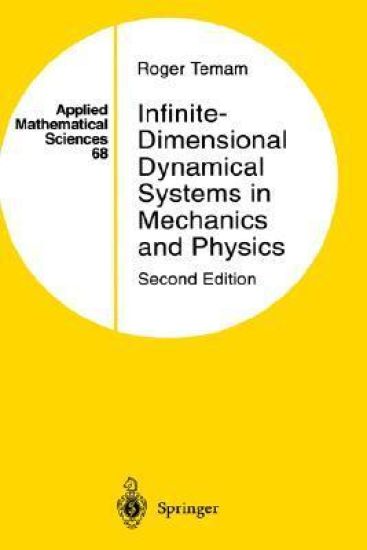
Infinite-Dimensional Dynamical Systems in Mechanics and Physics
Roger Temam
Springer-Verlag New York Inc.
1997
sidottu
In this book the author presents the dynamical systems in infinite dimension, especially those generated by dissipative partial differential equations. This book attempts a systematic study of infinite dimensional dynamical systems generated by dissipative evolution partial differential equations arising in mechanics and physics and in other areas of sciences and technology. This second edition has been updated and extended.
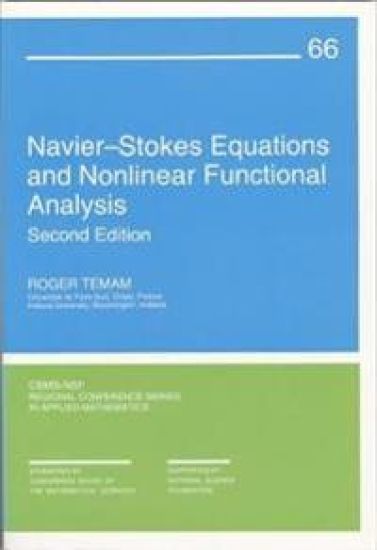
Navier-Stokes Equations and Nonlinear Functional Analysis
Roger Temam
Society for Industrial Applied Mathematics,U.S.
1995
pokkari
This second edition, like the first, attempts to arrive as simply as possible at some central problems in the Navier Stokes equations in the following areas: existence, uniqueness, and regularity of solutions in space dimensions two and three; large time behaviour of solutions and attractors; and numerical analysis of the Navier Stokes equations. Since publication of the first edition of these lectures in 1983, there has been extensive research in the area of inertial manifolds for Navier Stokes equations. These developments are addressed in a new section devoted entirely to inertial manifolds. Inertial manifolds were first introduced under this name in 1985 and, since then, have been systematically studied for partial differential equations of the Navier Stokes type. Inertial manifolds are a global version of central manifolds. When they exist they encompass the complete dynamics of a system, reducing the dynamics of an infinite system to that of a smooth, finite dimensional one called the inertial system. Although the theory of inertial manifolds for Navier Stokes equations is not complete at this time, there is already a very interesting and significant set of results which deserves to be known, in the hope that it will stimulate further research in this area. These results are reported in this edition. Part I presents the Navier Stokes equations of viscous incompressible fluids and the main boundary value problems usually associated with these equations. The case of the flow in a bounded domain with periodic or zero boundary conditions is studied and the functional setting of the equation as well as various results on existence, uniqueness, and regularity of time dependent solutions are given. Part II studies the behavior of solutions of the Navier Stokes equation when t approaches infinity and attempts to explain turbulence. Part III treats questions related to numerical approximation. In the Appendix, which is new to the second edition, concepts of inertial manifolds are described, definitions and some typical results are recalled, and the existence of inertial systems for two dimensional Navier Stokes equations is shown.
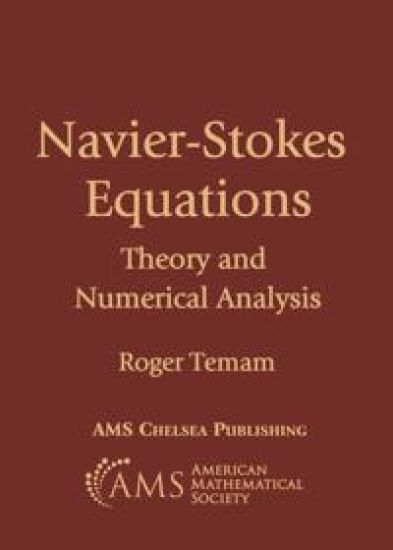
Originally published in 1977, the book is devoted to the theory and numerical analysis of the Navier-Stokes equations for viscous incompressible fluid. On the theoretical side, results related to the existence, the uniqueness, and, in some cases, the regularity of solutions are presented. On the numerical side, various approaches to the approximation of Navier-Stokes problems by discretization are considered, such as the finite dereference method, the finite element method, and the fractional steps method. The problems of stability and convergence for numerical methods are treated as completely as possible. The new material in the present book (as compared to the preceding 1984 edition) is an appendix reproducing a survey article written in 1998. This appendix touches upon a few aspects not addressed in the earlier editions, in particular a short derivation of the Navier-Stokes equations from the basic conservation principles in continuum mechanics, further historical perspectives, and indications on new developments in the area. The appendix also surveys some aspects of the related Euler equations and the compressible Navier-Stokes equations. The book is written in the style of a textbook and the author has attempted to make the treatment self-contained. It can be used as a textbook or a reference book for researchers. Prerequisites for reading the book include some familiarity with the Navier-Stokes equations and some knowledge of functional analysis and Sololev spaces.