Kirjojen hintavertailu – 12 903 725 kirjaa ja 27 kauppaa

Kirjailija

Rolf Drechsler

Kirjat ja teokset yhdessä paikassa: 60 kirjaa, julkaisuja vuosilta 1998–2025, suosituimpiin kuuluu Quality-Driven SystemC Design. Vertaile teosten hintoja ja tarkista saatavuus suomalaisista kirjakaupoista.

60 kirjaa

Kirjojen julkaisuvuodet: 1998–2025.

Towards a Design Flow for Reversible Logic

Towards a Design Flow for Reversible Logic

Robert Wille; Rolf Drechsler

Springer
2014
nidottu
The development of computing machines found great success in the last decades. But the ongoing miniaturization of integrated circuits will reach its limits in the near future. Shrinking transistor sizes and power dissipation are the major barriers in the development of smaller and more powerful circuits. Reversible logic p- vides an alternative that may overcome many of these problems in the future. For low-power design, reversible logic offers signi?cant advantages since zero power dissipation will only be possible if computation is reversible. Furthermore, quantum computation pro?ts from enhancements in this area, because every quantum circuit is inherently reversible and thus requires reversible descriptions. However, since reversible logic is subject to certain restrictions (e.g. fanout and feedback are not directly allowed), the design of reversible circuits signi?cantly differs from the design of traditional circuits. Nearly all steps in the design ?ow (like synthesis, veri?cation, or debugging) must be redeveloped so that they become applicable to reversible circuits as well. But research in reversible logic is still at the beginning. No continuous design ?ow exists so far. Inthisbook,contributionstoadesign?owforreversiblelogicarepresented. This includes advanced methods for synthesis, optimization, veri?cation, and debugging.
Spectral Techniques in VLSI CAD

Spectral Techniques in VLSI CAD

Mitchell Aaron Thornton; Rolf Drechsler; D. Michael Miller

Springer-Verlag New York Inc.
2012
nidottu
Spectral Techniques in VLSI CAD have become a subject of renewed interest in the design automation community due to the emergence of new and efficient methods for the computation of discrete function spectra. In the past, spectral computations for digital logic were too complex for practical implementation. The use of decision diagrams for spectral computations has greatly reduced this obstacle allowing for the development of new and useful spectral techniques for VLSI synthesis and verification. Several new algorithms for the computation of the Walsh, Reed-Muller, arithmetic and Haar spectra are described. The relation of these computational methods to traditional ones is also provided. Spectral Techniques in VLSI CAD provides a unified formalism of the representation of bit-level and word-level discrete functions in the spectral domain and as decision diagrams. An alternative and unifying interpretation of decision diagram representations is presented since it is shown that many of the different commonly used varieties of decision diagrams are merely graphical representations of various discrete function spectra. Viewing various decision diagrams as being described by specific sets of transformation functions not only illustrates the relationship between graphical and spectral representations of discrete functions, but also gives insight into how various decision diagram types are related. Spectral Techniques in VLSI CAD describes several new applications of spectral techniques in discrete function manipulation including decision diagram minimization, logic function synthesis, technology mapping and equivalence checking. The use of linear transformations in decision diagram size reduction is described and the relationship to the operation known as spectral translation is described. Several methods for synthesizing digital logic circuits based on a subset of spectral coefficients are described. An equivalence checking approach for functional verification is described based upon the use of matching pairs of Haar spectral coefficients.
High Quality Test Pattern Generation and Boolean Satisfiability

High Quality Test Pattern Generation and Boolean Satisfiability

Stephan Eggersglüß; Rolf Drechsler

Springer-Verlag New York Inc.
2012
sidottu
This book provides an overview of automatic test pattern generation (ATPG) and introduces novel techniques to complement classical ATPG, based on Boolean Satisfiability (SAT). A fast and highly fault efficient SAT-based ATPG framework is presented which is also able to generate high-quality delay tests such as robust path delay tests, as well as tests with long propagation paths to detect small delay defects. The aim of the techniques and methodologies presented in this book is to improve SAT-based ATPG, in order to make it applicable in industrial practice. Readers will learn to improve the performance and robustness of the overall test generation process, so that the ATPG algorithm reliably will generate test patterns for most targeted faults in acceptable run time to meet the high fault coverage demands of industry. The techniques and improvements presented in this book provide the following advantages: Provides a comprehensive introduction to test generation and Boolean Satisfiability (SAT); Describes a highly fault efficient SAT-based ATPG framework; Introduces circuit-oriented SAT solving techniques, which make use of structural information and are able to accelerate the search process significantly;Provides SAT formulations for the prevalent delay faults models, in addition to the classical stuck-at fault model;Includes an industrial perspective on the state-of-the-art in the testing, along with SAT; two topics typically distinguished from each other.
Towards One-Pass Synthesis

Towards One-Pass Synthesis

Rolf Drechsler; Wolfgang Günther

Springer-Verlag New York Inc.
2010
nidottu
The design process of digital circuits is often carried out in individual steps, like logic synthesis, mapping, and routing. Since originally the complete process was too complex, it has been split up in several - more or less independen- phases. In the last 40 years powerful algorithms have been developed to find optimal solutions for each of these steps. However, the interaction of these different algorithms has not been considered for a long time. This leads to quality loss e. g. in cases where highly optimized netlists fit badly onto the target architecture. Since the resulting circuits are often far from being optimal and insufficient regarding the optimization criteria, like area and delay, several iterations of the complete design process have to be carried out to get high quality results. This is a very time consuming and costly process. For this reason, some years ago the idea of one-pass synthesis came up. There were two main approaches how to guarantee that a design got "first time right" : 1. Combining levels that were split before, e. g. to use layout information already during the logic synthesis phase. 2. Restricting the optimization in one level such that it better fits to the next one. So far, several approaches in these two directions have been presented and new techniques are under development. In this book we describe the new paradigm that is used in one-pass synthesis and present examples for the two techniques above.
Evolutionary Algorithms for VLSI CAD

Evolutionary Algorithms for VLSI CAD

Rolf Drechsler

Springer-Verlag New York Inc.
2010
nidottu
In VLSI CAD, difficult optimization problems have to be solved on a constant basis. Various optimization techniques have been proposed in the past. While some of these methods have been shown to work well in applications and have become somewhat established over the years, other techniques have been ignored. Recently, there has been a growing interest in optimization algorithms based on principles observed in nature, termed Evolutionary Algorithms (EAs). Evolutionary Algorithms in VLSI CAD presents the basic concepts of EAs, and considers the application of EAs in VLSI CAD. It is the first book to show how EAs could be used to improve IC design tools and processes. Several successful applications from different areas of circuit design, like logic synthesis, mapping and testing, are described in detail. Evolutionary Algorithms in VLSI CAD consists of two parts. The first part discusses basic principles of EAs and provides some easy-to-understand examples. Furthermore, a theoretical model for multi-objective optimization is presented. In the second part a software implementation of EAs is supplied together with detailed descriptions of several EA applications. These applications cover a wide range of VLSI CAD, and different methods for using EAs are described. Evolutionary Algorithms in VLSI CAD is intended for CAD developers and researchers as well as those working in evolutionary algorithms and techniques supporting modern design tools and processes.
Binary Decision Diagrams

Binary Decision Diagrams

Rolf Drechsler; Bernd Becker

Springer-Verlag New York Inc.
2010
nidottu
For someone with a hammer the whole world looks like a nail. Within the last 10-13 years Binar·y Decision Diagmms (BDDs) have become the state-of-the-art data structure in VLSI CAD for representation and ma­ nipulation of Boolean functions. Today, BDDs are widely used and in the meantime have also been integrated in commercial tools, especially in the area of verijication and synthesis. The interest in BDDs results from the fact that the data structure is generally accepted as providing a good compromise between conciseness of representation and efficiency of manipulation. With increasing number of applications, also in non CAD areas, classical methods to handle BDDs are being improved and new questions and problems evolve and have to be solved. The book should help the reader who is not familiar with BDDs (or DDs in general) to get a quick start. On the other hand it will discuss several new aspects of BDDs, e.g. with respect to minimization and implementation of a package. This will help people working with BDDs (in industry or academia) to keep informed about recent developments in this area.
Formal Verification of Circuits

Formal Verification of Circuits

Rolf Drechsler

Springer-Verlag New York Inc.
2010
nidottu
Formal verification has become one of the most important steps in circuit design. Since circuits can contain several million transistors, verification of such large designs becomes more and more difficult. Pure simulation cannot guarantee the correct behavior and exhaustive simulation is often impossible. However, many designs, like ALUs, have very regular structures that can be easily described at a higher level of abstraction. For example, describing (and verifying) an integer multiplier at the bit-level is very difficult, while the verification becomes easy when the outputs are grouped to build a bit-string. Recently, several approaches for formal circuit verification have been proposed that make use of these regularities. These approaches are based on Word-Level Decision Diagrams (WLDDs) which are graph-based representations of functions (similar to BDDs) that allow for the representation of functions with a Boolean range and an integer domain. Formal Verification of Circuits is devoted to the discussion of recent developments in the field of decision diagram-based formal verification. Firstly, different types of decision diagrams (including WLDDs) are introduced and theoretical properties are discussed that give further insight into the data structure. Secondly, implementation and minimization concepts are presented. Applications to arithmetic circuit verification and verification of designs specified by hardware description languages are described to show how WLDDs work in practice. Formal Verification of Circuits is intended for CAD developers and researchers as well as designers using modern verification tools. It will help people working with formal verification (in industry or academia) to keep informed about recent developments in this area.
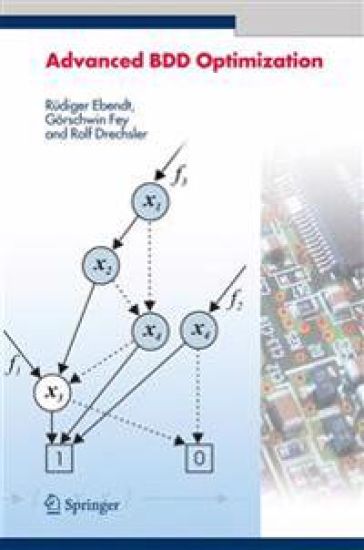
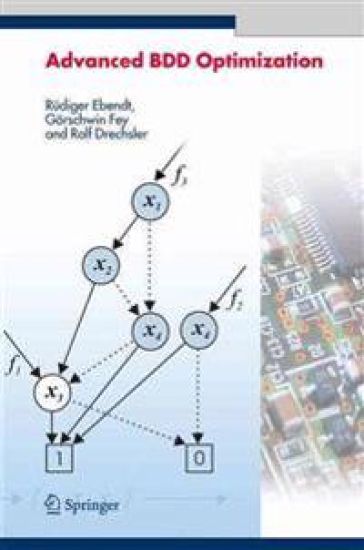
Advanced BDD Optimization

Advanced BDD Optimization

Rudiger Ebendt; Görschwin Fey; Rolf Drechsler

Springer-Verlag New York Inc.
2010
nidottu
VLSI CADhas greatly bene?ted from the use of reduced ordered Binary Decision Diagrams (BDDs) and the clausal representation as a problem of Boolean Satis?ability (SAT), e.g. in logic synthesis, ver- cation or design-for-testability. In recent practical applications, BDDs are optimized with respect to new objective functions for design space exploration. The latest trends show a growing number of proposals to fuse the concepts of BDD and SAT. This book gives a modern presentation of the established as well as of recent concepts. Latest results in BDD optimization are given, c- ering di?erent aspects of paths in BDDs and the use of e?cient lower bounds during optimization. The presented algorithms include Branch ? and Bound and the generic A -algorithm as e?cient techniques to - plore large search spaces. ? The A -algorithm originates from Arti?cial Intelligence (AI), and the EDA community has been unaware of this concept for a long time. Re- ? cently, the A -algorithm has been introduced as a new paradigm to explore design spaces in VLSI CAD. Besides AI search techniques, the book also discusses the relation to another ?eld of activity bordered to VLSI CAD and BDD optimization: the clausal representation as a SAT problem.
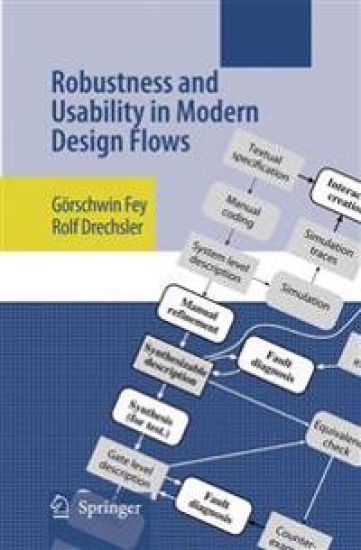
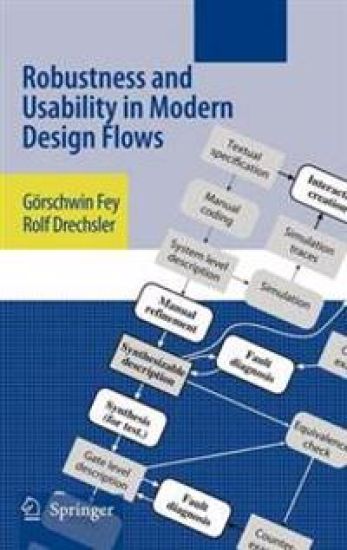
Robustness and Usability in Modern Design Flows

Robustness and Usability in Modern Design Flows

Görschwin Fey; Rolf Drechsler

Springer
2010
nidottu
The size of technically producible integrated circuits increases continuously. But the ability to design and verify these circuits does not keep up with this development. Therefore, today’s design ?ow has to be improved to achieve a higher productivity. In this book the current design methodology and ver- cation methodology are analyzed, a number of de?ciencies are identi?ed, and solutions are suggested. Improvements in the methodology as well as in the underlying algorithms are proposed. An in-depth presentation of preliminary concepts makes the book self-contained. Based on this foundation major - sign problems are targeted. In particular, a complete tool ?ow for Synthesis for Testability of SystemC descriptions is presented. The resulting circuits are completely testable and test pattern generation in polynomial time is possible. Veri?cation issues are covered in even more detail. A whole new paradigm for formal design veri?cation is suggested. This is based upon design und- standing, the automatic generation of properties, and powerful tool support for debugging failures. All these new techniques are empirically evaluated and - perimental results are provided. As a result, an enhanced design ?ow is created that provides more automation (i.e. better usability) and reduces the probability of introducing conceptual errors (i.e. higher robustness). Acknowledgments We would like to thank all members of the research group for computer arc- tecture in Bremen for the helpful discussions and the great atmosphere during work and research.
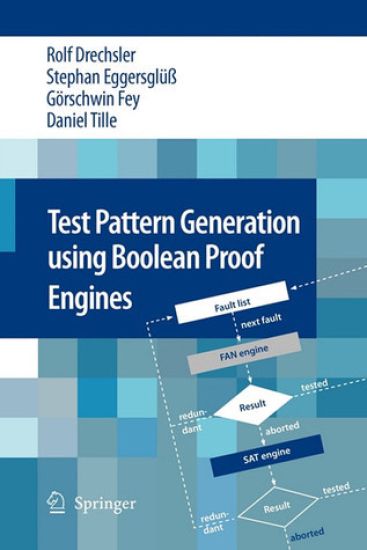
Test Pattern Generation using Boolean Proof Engines

Test Pattern Generation using Boolean Proof Engines

Rolf Drechsler; Stephan Eggersglüß; Görschwin Fey; Daniel Tille

Springer
2010
nidottu
In Test Pattern Generation using Boolean Proof Engines, we give an introduction to ATPG. The basic concept and classical ATPG algorithms are reviewed. Then, the formulation as a SAT problem is considered. As the underlying engine, modern SAT solvers and their use on circuit related problems are comprehensively discussed. Advanced techniques for SAT-based ATPG are introduced and evaluated in the context of an industrial environment. The chapters of the book cover efficient instance generation, encoding of multiple-valued logic, usage of various fault models, and detailed experiments on multi-million gate designs. The book describes the state of the art in the field, highlights research aspects, and shows directions for future work.
Towards a Design Flow for Reversible Logic

Towards a Design Flow for Reversible Logic

Robert Wille; Rolf Drechsler

Springer
2010
sidottu
The development of computing machines found great success in the last decades. But the ongoing miniaturization of integrated circuits will reach its limits in the near future. Shrinking transistor sizes and power dissipation are the major barriers in the development of smaller and more powerful circuits. Reversible logic p- vides an alternative that may overcome many of these problems in the future. For low-power design, reversible logic offers signi?cant advantages since zero power dissipation will only be possible if computation is reversible. Furthermore, quantum computation pro?ts from enhancements in this area, because every quantum circuit is inherently reversible and thus requires reversible descriptions. However, since reversible logic is subject to certain restrictions (e.g. fanout and feedback are not directly allowed), the design of reversible circuits signi?cantly differs from the design of traditional circuits. Nearly all steps in the design ?ow (like synthesis, veri?cation, or debugging) must be redeveloped so that they become applicable to reversible circuits as well. But research in reversible logic is still at the beginning. No continuous design ?ow exists so far. Inthisbook,contributionstoadesign?owforreversiblelogicarepresented. This includes advanced methods for synthesis, optimization, veri?cation, and debugging.

Debugging at the Electronic System Level

Debugging at the Electronic System Level

Frank Rogin; Rolf Drechsler

Springer
2010
sidottu
Debugging becomes more and more the bottleneck to chip design productivity, especially while developing modern complex integrated circuits and systems at the Electronic System Level (ESL). Today, debugging is still an unsystematic and lengthy process. Here, a simple reporting of a failure is not enough, anymore. Rather, it becomes more and more important not only to find many errors early during development but also to provide efficient methods for their isolation. In Debugging at the Electronic System Level the state-of-the-art of modeling and verification of ESL designs is reviewed. There, a particular focus is taken onto SystemC. Then, a reasoning hierarchy is introduced. The hierarchy combines well-known debugging techniques with whole new techniques to improve the verification efficiency at ESL. The proposed systematic debugging approach is supported amongst others by static code analysis, debug patterns, dynamic program slicing, design visualization, property generation, and automatic failure isolation. All techniques were empirically evaluated using real-world industrial designs. Summarized, the introduced approach enables a systematic search for errors in ESL designs. Here, the debugging techniques improve and accelerate error detection, observation, and isolation as well as design understanding.
Robustness and Usability in Modern Design Flows

Robustness and Usability in Modern Design Flows

Görschwin Fey; Rolf Drechsler

Springer-Verlag New York Inc.
2008
sidottu
The size of technically producible integrated circuits increases continuously. But the ability to design and verify these circuits does not keep up with this development. Therefore, today’s design ?ow has to be improved to achieve a higher productivity. In this book the current design methodology and ver- cation methodology are analyzed, a number of de?ciencies are identi?ed, and solutions are suggested. Improvements in the methodology as well as in the underlying algorithms are proposed. An in-depth presentation of preliminary concepts makes the book self-contained. Based on this foundation major - sign problems are targeted. In particular, a complete tool ?ow for Synthesis for Testability of SystemC descriptions is presented. The resulting circuits are completely testable and test pattern generation in polynomial time is possible. Veri?cation issues are covered in even more detail. A whole new paradigm for formal design veri?cation is suggested. This is based upon design und- standing, the automatic generation of properties, and powerful tool support for debugging failures. All these new techniques are empirically evaluated and - perimental results are provided. As a result, an enhanced design ?ow is created that provides more automation (i.e. better usability) and reduces the probability of introducing conceptual errors (i.e. higher robustness). Acknowledgments We would like to thank all members of the research group for computer arc- tecture in Bremen for the helpful discussions and the great atmosphere during work and research.
Advanced BDD Optimization

Advanced BDD Optimization

Rudiger Ebendt; Görschwin Fey; Rolf Drechsler

Springer-Verlag New York Inc.
2005
sidottu
VLSI CADhas greatly bene?ted from the use of reduced ordered Binary Decision Diagrams (BDDs) and the clausal representation as a problem of Boolean Satis?ability (SAT), e.g. in logic synthesis, ver- cation or design-for-testability. In recent practical applications, BDDs are optimized with respect to new objective functions for design space exploration. The latest trends show a growing number of proposals to fuse the concepts of BDD and SAT. This book gives a modern presentation of the established as well as of recent concepts. Latest results in BDD optimization are given, c- ering di?erent aspects of paths in BDDs and the use of e?cient lower bounds during optimization. The presented algorithms include Branch ? and Bound and the generic A -algorithm as e?cient techniques to - plore large search spaces. ? The A -algorithm originates from Arti?cial Intelligence (AI), and the EDA community has been unaware of this concept for a long time. Re- ? cently, the A -algorithm has been introduced as a new paradigm to explore design spaces in VLSI CAD. Besides AI search techniques, the book also discusses the relation to another ?eld of activity bordered to VLSI CAD and BDD optimization: the clausal representation as a SAT problem.
Towards One-Pass Synthesis

Towards One-Pass Synthesis

Rolf Drechsler; Wolfgang Günther

Springer-Verlag New York Inc.
2002
sidottu
The design process of digital circuits is often carried out in individual steps, like logic synthesis, mapping, and routing. Since originally the complete process was too complex, it has been split up in several - more or less independen- phases. In the last 40 years powerful algorithms have been developed to find optimal solutions for each of these steps. However, the interaction of these different algorithms has not been considered for a long time. This leads to quality loss e. g. in cases where highly optimized netlists fit badly onto the target architecture. Since the resulting circuits are often far from being optimal and insufficient regarding the optimization criteria, like area and delay, several iterations of the complete design process have to be carried out to get high quality results. This is a very time consuming and costly process. For this reason, some years ago the idea of one-pass synthesis came up. There were two main approaches how to guarantee that a design got "first time right" : 1. Combining levels that were split before, e. g. to use layout information already during the logic synthesis phase. 2. Restricting the optimization in one level such that it better fits to the next one. So far, several approaches in these two directions have been presented and new techniques are under development. In this book we describe the new paradigm that is used in one-pass synthesis and present examples for the two techniques above.
Spectral Techniques in VLSI CAD

Spectral Techniques in VLSI CAD

Mitchell Aaron Thornton; Rolf Drechsler; D. Michael Miller

Springer
2001
sidottu
Spectral Techniques in VLSI CAD have become a subject of renewed interest in the design automation community due to the emergence of new and efficient methods for the computation of discrete function spectra. In the past, spectral computations for digital logic were too complex for practical implementation. The use of decision diagrams for spectral computations has greatly reduced this obstacle allowing for the development of new and useful spectral techniques for VLSI synthesis and verification. Several new algorithms for the computation of the Walsh, Reed-Muller, arithmetic and Haar spectra are described. The relation of these computational methods to traditional ones is also provided. Spectral Techniques in VLSI CAD provides a unified formalism of the representation of bit-level and word-level discrete functions in the spectral domain and as decision diagrams. An alternative and unifying interpretation of decision diagram representations is presented since it is shown that many of the different commonly used varieties of decision diagrams are merely graphical representations of various discrete function spectra. Viewing various decision diagrams as being described by specific sets of transformation functions not only illustrates the relationship between graphical and spectral representations of discrete functions, but also gives insight into how various decision diagram types are related. Spectral Techniques in VLSI CAD describes several new applications of spectral techniques in discrete function manipulation including decision diagram minimization, logic function synthesis, technology mapping and equivalence checking. The use of linear transformations in decision diagram size reduction is described and the relationship to the operation known as spectral translation is described. Several methods for synthesizing digital logic circuits based on a subset of spectral coefficients are described. An equivalence checking approach for functional verification is described based upon the use of matching pairs of Haar spectral coefficients.
Formal Verification of Circuits

Formal Verification of Circuits

Rolf Drechsler

Springer
2000
sidottu
Formal verification has become one of the most important steps in circuit design. Since circuits can contain several million transistors, verification of such large designs becomes more and more difficult. Pure simulation cannot guarantee the correct behavior and exhaustive simulation is often impossible. However, many designs, like ALUs, have very regular structures that can be easily described at a higher level of abstraction. For example, describing (and verifying) an integer multiplier at the bit-level is very difficult, while the verification becomes easy when the outputs are grouped to build a bit-string. Recently, several approaches for formal circuit verification have been proposed that make use of these regularities. These approaches are based on Word-Level Decision Diagrams (WLDDs) which are graph-based representations of functions (similar to BDDs) that allow for the representation of functions with a Boolean range and an integer domain. Formal Verification of Circuits is devoted to the discussion of recent developments in the field of decision diagram-based formal verification. Firstly, different types of decision diagrams (including WLDDs) are introduced and theoretical properties are discussed that give further insight into the data structure. Secondly, implementation and minimization concepts are presented. Applications to arithmetic circuit verification and verification of designs specified by hardware description languages are described to show how WLDDs work in practice. Formal Verification of Circuits is intended for CAD developers and researchers as well as designers using modern verification tools. It will help people working with formal verification (in industry or academia) to keep informed about recent developments in this area.
Binary Decision Diagrams

Binary Decision Diagrams

Rolf Drechsler; Bernd Becker

Springer
1998
sidottu
For someone with a hammer the whole world looks like a nail. Within the last 10-13 years Binar·y Decision Diagmms (BDDs) have become the state-of-the-art data structure in VLSI CAD for representation and ma­ nipulation of Boolean functions. Today, BDDs are widely used and in the meantime have also been integrated in commercial tools, especially in the area of verijication and synthesis. The interest in BDDs results from the fact that the data structure is generally accepted as providing a good compromise between conciseness of representation and efficiency of manipulation. With increasing number of applications, also in non CAD areas, classical methods to handle BDDs are being improved and new questions and problems evolve and have to be solved. The book should help the reader who is not familiar with BDDs (or DDs in general) to get a quick start. On the other hand it will discuss several new aspects of BDDs, e.g. with respect to minimization and implementation of a package. This will help people working with BDDs (in industry or academia) to keep informed about recent developments in this area.
Evolutionary Algorithms for VLSI CAD
In VLSI CAD, difficult optimization problems have to be solved on a constant basis. Various optimization techniques have been proposed in the past. While some of these methods have been shown to work well in applications and have become somewhat established over the years, other techniques have been ignored. Recently, there has been a growing interest in optimization algorithms based on principles observed in nature, termed Evolutionary Algorithms (EAs). Evolutionary Algorithms in VLSI CAD presents the basic concepts of EAs, and considers the application of EAs in VLSI CAD. It is the first book to show how EAs could be used to improve IC design tools and processes. Several successful applications from different areas of circuit design, like logic synthesis, mapping and testing, are described in detail. Evolutionary Algorithms in VLSI CAD consists of two parts. The first part discusses basic principles of EAs and provides some easy-to-understand examples. Furthermore, a theoretical model for multi-objective optimization is presented. In the second part a software implementation of EAs is supplied together with detailed descriptions of several EA applications. These applications cover a wide range of VLSI CAD, and different methods for using EAs are described. Evolutionary Algorithms in VLSI CAD is intended for CAD developers and researchers as well as those working in evolutionary algorithms and techniques supporting modern design tools and processes.