
Kirjojen hintavertailu – 12 859 819 kirjaa ja 27 kauppaa

Kirjailija

Rolf Rannacher

Kirjat ja teokset yhdessä paikassa: 2 kirjaa, julkaisuja vuosilta 2003–2008, suosituimpiin kuuluu Hemodynamical Flows. Vertaile teosten hintoja ja tarkista saatavuus suomalaisista kirjakaupoista.

2 kirjaa

Kirjojen julkaisuvuodet: 2003–2008.

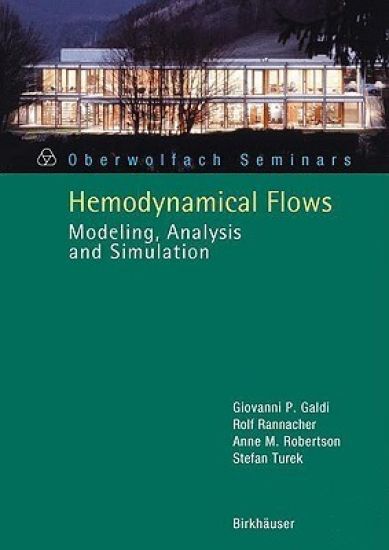
Hemodynamical Flows

Hemodynamical Flows

Giovanni P. Galdi; Rolf Rannacher; Anne M. Robertson; Stefan Turek

Birkhauser Verlag AG
2008
nidottu
This book surveys research results on the physical and mathematical modeling, as well as the numerical simulation of complex fluid and structural mechanical processes occurring in the human blood circulation system. Topics treated include continuum mechanical description; choice of suitable liquid and wall models; mathematical analysis of coupled models; numerical methods for flow simulation; parameter identification and model calibration; fluid-solid interaction; mathematical analysis of piping systems; particle transport in channels and pipes; artificial boundary conditions, and many more. The book was developed from lectures presented by the authors at the Oberwolfach Research Institute (MFO), in Oberwolfach-Walke, Germany, November, 2005.

Adaptive Finite Element Methods for Differential Equations

Adaptive Finite Element Methods for Differential Equations

Wolfgang Bangerth; Rolf Rannacher

Birkhauser Verlag AG
2003
nidottu
These Lecture Notes have been compiled from the material presented by the second author in a lecture series ('Nachdiplomvorlesung') at the Department of Mathematics of the ETH Zurich during the summer term 2002. Concepts of 'self­ adaptivity' in the numerical solution of differential equations are discussed with emphasis on Galerkin finite element methods. The key issues are a posteriori er­ ror estimation and automatic mesh adaptation. Besides the traditional approach of energy-norm error control, a new duality-based technique, the Dual Weighted Residual method (or shortly D WR method) for goal-oriented error estimation is discussed in detail. This method aims at economical computation of arbitrary quantities of physical interest by properly adapting the computational mesh. This is typically required in the design cycles of technical applications. For example, the drag coefficient of a body immersed in a viscous flow is computed, then it is minimized by varying certain control parameters, and finally the stability of the resulting flow is investigated by solving an eigenvalue problem. 'Goal-oriented' adaptivity is designed to achieve these tasks with minimal cost. The basics of the DWR method and various of its applications are described in the following survey articles: R. Rannacher [114], Error control in finite element computations. In: Proc. of Summer School Error Control and Adaptivity in Scientific Computing (H. Bulgak and C. Zenger, eds), pp. 247-278. Kluwer Academic Publishers, 1998. M. Braack and R. Rannacher [42], Adaptive finite element methods for low­ Mach-number flows with chemical reactions.