Kirjojen hintavertailu – 12 903 733 kirjaa ja 27 kauppaa

Kirjailija

Ronald Wintrobe

Kirjat ja teokset yhdessä paikassa: 7 kirjaa, julkaisuja vuosilta 1998–2017, suosituimpiin kuuluu The Political Economy of Dictatorship. Vertaile teosten hintoja ja tarkista saatavuus suomalaisista kirjakaupoista.

7 kirjaa

Kirjojen julkaisuvuodet: 1998–2017.

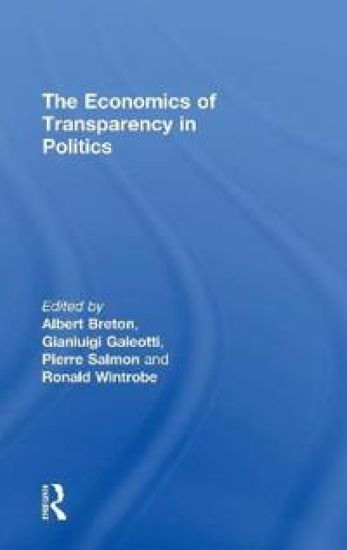
The Economics of Transparency in Politics

The Economics of Transparency in Politics

Gianluigi Galeotti; Ronald Wintrobe

Routledge
2017
nidottu
The purpose of this book is to formulate economic models of the advantages and costs of transparency in various areas of public sector activity and to assess what level of obfuscation in politics is rational. The chapters are arranged in four parts. Part 1 is concerned with the manifestations of transparency and obfuscation in domestic democratic settings whilst Part 2 deals with the same realities but in an international context. Part 3 looks at corruption and Part 4 considers some of the implications of transparency and obfuscation for the working of governments and the formulation of public policies.
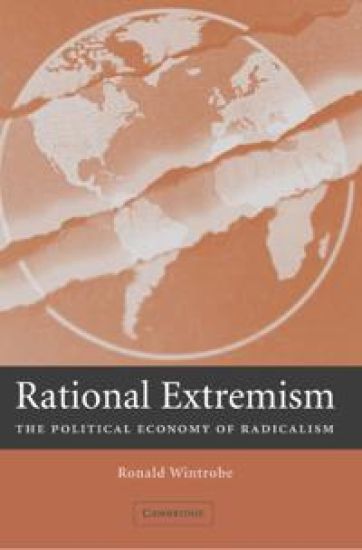
Rational Extremism

Rational Extremism

Ronald Wintrobe

Cambridge University Press
2012
pokkari
Extremists are people whose ideas or tactics are viewed as outside the mainstream. Looked at this way, extremists are not necessarily twisted or evil. But they can be, especially when they are intolerant and violent. What makes extremists turn violent? This 2006 book assumes that extremists are rational: given their ends, they choose the best means to achieve them. The analysis explains why extremist leaders use the tactics they do, and why they are often insensitive to punishment and to loss of life. It also explains how rational people can be motivated to die for the cause. The book covers different aspects of extremism such as revolution, suicide terrorism, and global jihad. The arguments are illustrated with important episodes of extremism, including the French Revolution, the rise of nationalism in Yugoslavia under Milosevic, and the emergence of suicide terror and Al Qaeda today.
The Logic of Bureaucratic Conduct

The Logic of Bureaucratic Conduct

Albert Breton; Ronald Wintrobe

Cambridge University Press
2008
pokkari
In this work the authors present a general theory of bureaucracy and use it to explain behaviour in large organizations and to explain what determines efficiency in both governments and business corporations. The theory uses the methods of standard neoclassical economic theory. It relies on two central principles: that members of an organization trade with one another and that they compete with one another. Authority, which is the basis for conventional theories of bureaucracy, is given a role, despite reliance on the idea of trade between bureaucracies. It is argued, however, that bureaucracies cannot operate efficiently on the basis of authority alone. Exchange between bureaucrats is hampered because promises are not enforceable. So trust and loyalty between members of bureaucratic networks play an important part. The authors find that vertical networks promote efficiency while horizontal ones impede it.
The Economics of Transparency in Politics

The Economics of Transparency in Politics

Gianluigi Galeotti; Ronald Wintrobe

Ashgate Publishing Limited
2007
sidottu
The purpose of this book is to formulate economic models of the advantages and costs of transparency in various areas of public sector activity and to assess what level of obfuscation in politics is rational. The chapters are arranged in four parts. Part 1 is concerned with the manifestations of transparency and obfuscation in domestic democratic settings whilst Part 2 deals with the same realities but in an international context. Part 3 looks at corruption and Part 4 considers some of the implications of transparency and obfuscation for the working of governments and the formulation of public policies.
Rational Extremism

Rational Extremism

Ronald Wintrobe

Cambridge University Press
2006
sidottu
Extremists are people whose ideas or tactics are viewed as outside the mainstream. Looked at this way, extremists are not necessarily twisted or evil. But they can be, especially when they are intolerant and violent. What makes extremists turn violent? This 2006 book assumes that extremists are rational: given their ends, they choose the best means to achieve them. The analysis explains why extremist leaders use the tactics they do, and why they are often insensitive to punishment and to loss of life. It also explains how rational people can be motivated to die for the cause. The book covers different aspects of extremism such as revolution, suicide terrorism, and global jihad. The arguments are illustrated with important episodes of extremism, including the French Revolution, the rise of nationalism in Yugoslavia under Milosevic, and the emergence of suicide terror and Al Qaeda today.
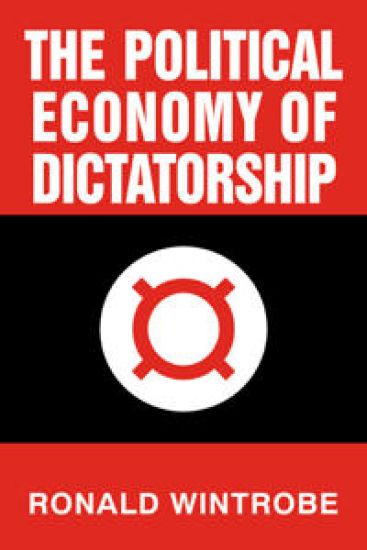
The Political Economy of Dictatorship

The Political Economy of Dictatorship

Ronald Wintrobe

Cambridge University Press
2000
pokkari
Although much of the world still lives today, as always, under dictatorship, the behavior of these regimes and of their leaders often appears irrational and mysterious. In The Political Economy of Dictatorship, Ronald Wintrobe uses rational choice theory to model dictatorships: their strategies for accumulating power, the constraints on their behavior, and why they are often more popular than is commonly accepted. The book explores both the politics and the economics of dictatorships, and the interaction between them. The questions addressed include: What determines the repressiveness of a regime? Can political authoritarianism be ‘good’ for the economy? After the fall, who should be held responsible for crimes against human rights? The book contains many applications, including chapters on Nazi Germany, Soviet Communism, South Africa under apartheid, the ancient Roman Empire and Pinochet’s Chile. It also provides a guide to the policies which should be followed by the democracies towards dictatorships.
The Political Economy of Dictatorship

The Political Economy of Dictatorship

Ronald Wintrobe

Cambridge University Press
1998
sidottu
Although much of the world still lives today, as always, under dictatorship, the behavior of these regimes and of their leaders often appears irrational and mysterious. In The Political Economy of Dictatorship, Ronald Wintrobe uses rational choice theory to model dictatorships: their strategies for accumulating power, the constraints on their behavior, and why they are often more popular than is commonly accepted. The book explores both the politics and the economics of dictatorships, and the interaction between them. The questions addressed include: What determines the repressiveness of a regime? Can political authoritarianism be ‘good’ for the economy? After the fall, who should be held responsible for crimes against human rights? The book contains many applications, including chapters on Nazi Germany, Soviet Communism, South Africa under apartheid, the ancient Roman Empire and Pinochet’s Chile. It also provides a guide to the policies which should be followed by the democracies towards dictatorships.