Kirjojen hintavertailu – 12 903 725 kirjaa ja 27 kauppaa

Kirjailija

Ronnie Cann

Kirjat ja teokset yhdessä paikassa: 5 kirjaa, julkaisuja vuosilta 1993–2009, suosituimpiin kuuluu Semantics. Vertaile teosten hintoja ja tarkista saatavuus suomalaisista kirjakaupoista.

5 kirjaa

Kirjojen julkaisuvuodet: 1993–2009.

Semantics

Semantics

Ronnie Cann; Ruth Kempson; Eleni Gregoromichelaki

Cambridge University Press
2009
pokkari
The study of meaning in language has developed dramatically over the last fifty years. Semantics is distinctive as it not only presents a general introduction to the topic, including the most recent developments, but it also provides a unique perspective for addressing current issues. It opens by introducing readers to the study of logic (natural deduction) as the background against which developments have taken place. This demonstrates the link between semantics and the study of reasoning and how this view can provide new solutions to the puzzles that have plagued the approaches presented in other textbooks. The major subject areas of semantics are discussed, including quantification, anaphora and discourse, tense and aspect, ellipsis and context, and word meaning. The book also presents state-of-the-art research in topics at the forefront of semantics.
Semantics

Semantics

Ronnie Cann; Ruth Kempson; Eleni Gregoromichelaki

Cambridge University Press
2009
sidottu
The study of meaning in language has developed dramatically over the last fifty years. Semantics is distinctive as it not only presents a general introduction to the topic, including the most recent developments, but it also provides a unique perspective for addressing current issues. It opens by introducing readers to the study of logic (natural deduction) as the background against which developments have taken place. This demonstrates the link between semantics and the study of reasoning and how this view can provide new solutions to the puzzles that have plagued the approaches presented in other textbooks. The major subject areas of semantics are discussed, including quantification, anaphora and discourse, tense and aspect, ellipsis and context, and word meaning. The book also presents state-of-the-art research in topics at the forefront of semantics.
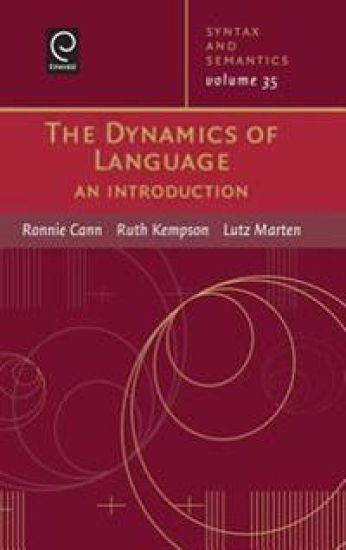
The Dynamics of Language

The Dynamics of Language

Ronnie Cann; Ruth Kempson; Lutz Marten

Elsevier Science Publishing Co Inc
2006
sidottu
For the whole of the last half-century, most theoretical syntacticians have assumed that knowledge of language is different from the tasks of speaking and understanding. There have been some dissenters, but, by and large, this view still holds sway. This book takes a different view: it continues the task set in hand by Kempson et al (2001) of arguing that the common-sense intuition is correct that knowledge of language consists in being able to use it in speaking and understanding. The Dynamics of Language argues that interpretation is built up across as sequence of words relative to some context and that this is all that is needed to explain the structural properties of language. The dynamics of how interpretation is built up is the syntax of a language system. The authors' first task is to convey to a general linguistic audience with a minimum of formal apparatus, the substance of that formal system. Secondly, as linguists, they set themselves the task of applying the formal system to as broad an array of linguistic puzzles as possible, the languages analysed ranging from English to Japanese and Swahili. It argues that knowledge in language consists of being able to use it in speaking and understanding. It analyses a variety of languages, from English to Japanese and Swahili. It appeals to a wide audience in the disciplines of language, linguistics, anthropology, education, psychology, cognitive science, law, media studies, and medicine.
Formal Semantics

Formal Semantics

Ronnie Cann

Cambridge University Press
1993
sidottu
This book provides a clear and accessible introduction to formal, and especially Montague, semantics within a linguistic framework. It presupposes no previous background in logic, but takes the student step-by-step from simple predicate/argument structures and their interpretation through to Montague’s intentional logic. It covers all the major aspects, including set theory, propositional logic, type theory, lambda abstraction, traditional and generalised quantifiers, inference, tense and aspect, possible worlds semantics, and intensionality. Throughout the emphasis is on the use of logical tools for linguistic semantics, rather than on purely logical topics, and the introductory chapter situates formal semantics within the general framework of linguistic semantics. It assumes some basic knowledge of linguistics, but aims to be as non-technical as possible within a technical subject. Formal Semantics will be welcomed by students of linguistics, artificial intelligence and cognitive science alike.
Formal Semantics

Formal Semantics

Ronnie Cann

Cambridge University Press
1993
pokkari
This book provides a clear and accessible introduction to formal, and especially Montague, semantics within a linguistic framework. It presupposes no previous background in logic, but takes the student step-by-step from simple predicate/argument structures and their interpretation through to Montague’s intentional logic. It covers all the major aspects, including set theory, propositional logic, type theory, lambda abstraction, traditional and generalised quantifiers, inference, tense and aspect, possible worlds semantics, and intensionality. Throughout the emphasis is on the use of logical tools for linguistic semantics, rather than on purely logical topics, and the introductory chapter situates formal semantics within the general framework of linguistic semantics. It assumes some basic knowledge of linguistics, but aims to be as non-technical as possible within a technical subject. Formal Semantics will be welcomed by students of linguistics, artificial intelligence and cognitive science alike.