Kirjojen hintavertailu – 12 859 824 kirjaa ja 27 kauppaa

Kirjailija

Rosalind C. Morris

Kirjat ja teokset yhdessä paikassa: 10 kirjaa, julkaisuja vuosilta 2000–2025, suosituimpiin kuuluu Wars I Have (not) Seen. Vertaile teosten hintoja ja tarkista saatavuus suomalaisista kirjakaupoista.

Nimi esiintyy myös muodoissa: Rosalind C Morris

10 kirjaa

Kirjojen julkaisuvuodet: 2000–2025.

Unstable Ground

Unstable Ground

Rosalind C. Morris

Columbia University Press
2025
sidottu
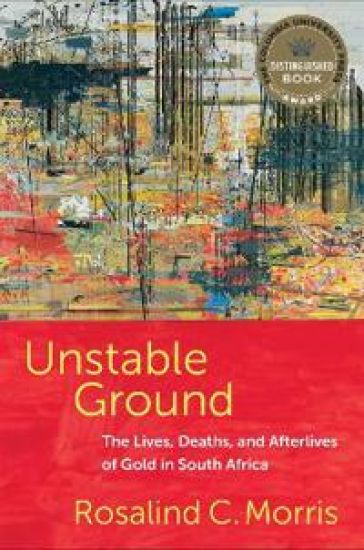
What has gold done to people? What has it made them do? The Witwatersrand in South Africa, once home to the world’s richest goldfields, is today scattered with abandoned mines into which informal miners known as zama zamas venture in an illicit—often deadly—search for ore. Based on field research conducted across more than twenty-five years around these mines, Unstable Ground reveals the worlds that gold made possible—and gold’s profound costs for those who have lived in its shadow and dreamt of its transformative power. From the vantage point of the closure of South Africa’s gold mines, Rosalind C. Morris reconsiders their histories, beginning in the present and descending into the pasts that shaped them. Anchored in evocative descriptions of mining in the ruins, this book explores the social worlds built on gold and the lives that were remade and sometimes undone by the industry over a century and a half. Viewing this industry from its margins, against the backdrop of the cyanide revolution, the gold standard’s demise, and recurrent sinkholes, as well as the insurrectionary protests and violence that continue to this day, it recasts the history of South Africa and the incomplete effort to overcome apartheid amid the transformations of the global economy. In writing that is by turns immersive, incisive, and poetic, Morris unearths a history that was born of imperial aspiration and that persists as a speculative mirage. Interweaving ethnography, history, personal testimony, and political thought with striking readings of South African literary texts, Unstable Ground is a work of extraordinary ambition and depth.
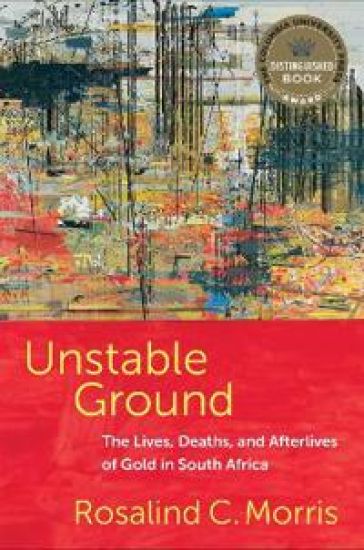
Unstable Ground

Unstable Ground

Rosalind C. Morris

Columbia University Press
2025
pokkari

Halvin toimitettuna 39,10 €

What has gold done to people? What has it made them do? The Witwatersrand in South Africa, once home to the world’s richest goldfields, is today scattered with abandoned mines into which informal miners known as zama zamas venture in an illicit—often deadly—search for ore. Based on field research conducted across more than twenty-five years around these mines, Unstable Ground reveals the worlds that gold made possible—and gold’s profound costs for those who have lived in its shadow and dreamt of its transformative power. From the vantage point of the closure of South Africa’s gold mines, Rosalind C. Morris reconsiders their histories, beginning in the present and descending into the pasts that shaped them. Anchored in evocative descriptions of mining in the ruins, this book explores the social worlds built on gold and the lives that were remade and sometimes undone by the industry over a century and a half. Viewing this industry from its margins, against the backdrop of the cyanide revolution, the gold standard’s demise, and recurrent sinkholes, as well as the insurrectionary protests and violence that continue to this day, it recasts the history of South Africa and the incomplete effort to overcome apartheid amid the transformations of the global economy. In writing that is by turns immersive, incisive, and poetic, Morris unearths a history that was born of imperial aspiration and that persists as a speculative mirage. Interweaving ethnography, history, personal testimony, and political thought with striking readings of South African literary texts, Unstable Ground is a work of extraordinary ambition and depth.
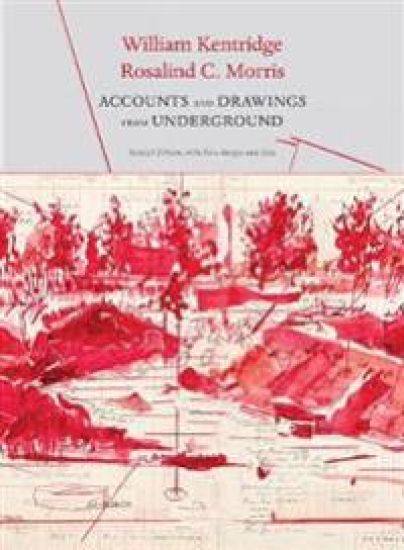
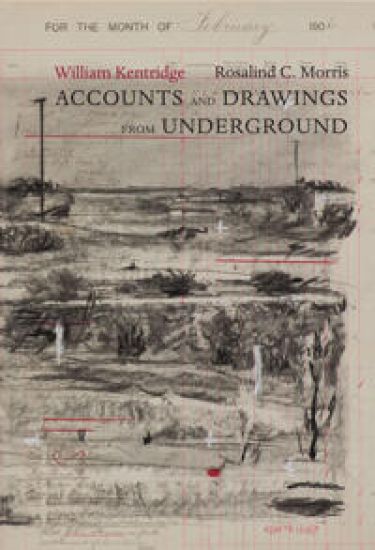
Accounts and Drawings from Underground

Accounts and Drawings from Underground

William Kentridge; Rosalind C Morris

Seagull Books London Ltd
2021
sidottu
In Accounts and Drawings from Underground, published in 2015, renowned artist William Kentridge and scholar Rosalind C. Morris brought us an unprecedented collaboration, taking pages of the 1906 Cash Book of the East Rand Proprietary Mines Corporation in South Africa and transforming them into something entirely new. While Kentridge contributed breathtaking landscape drawings in response to the transient terrain mining created, Morris plumbed the text of the cash book to generate a unique narrative account. Now, they revisit those ruined mines, with a visual and verbal addendum that provides an account of the ongoing metamorphosis of the world that gold mines created. Kentridge works on the threshold between the visible and the invisible, while Morris mines the unsaid in order to make it understandable. Together they’ve created a landmark book that chronicles the exploitation of African communities and sheds further light on global Black history. With fifteen stunning new color drawings by Kentridge and an additional coda, this revised edition of Accounts and Drawings from Underground continues its remarkable documentation of the stories of migrant laborers and the flows of capital and desire, providing us with a palpable sense of a vanished world.
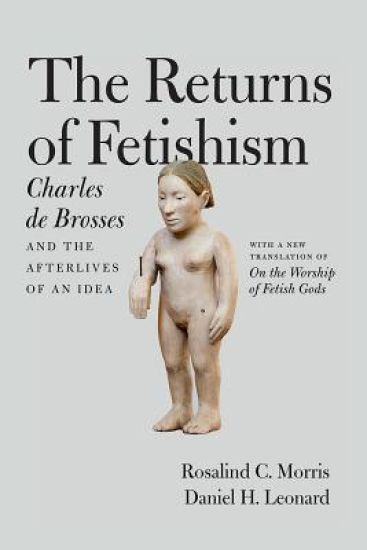
The Returns of Fetishism

The Returns of Fetishism

Charles de Brosses; Rosalind C. Morris; Daniel H. Leonard

University of Chicago Press
2017
sidottu
For more than 250 years, Charles de Brosses's term "fetishism" has exerted great influence over our most ambitious thinkers. Used as an alternative to "magic" but nonetheless expressing the material force of magical thought, de Brosses's term has proved indispensable to thinkers as diverse as Kant, Hegel, Marx, Freud, Lacan, Baudrillard, and Derrida. With this book, Daniel H. Leonard offers the first fully annotated English translation of the text that started it all: On the Worship of Fetish Gods, and Rosalind C. Morris offers incisive commentary that helps modern readers better understand it and its legacy. The product of de Brosses's autodidactic curiosity and idiosyncratic theories of language, On the Worship of Fetish Gods is an enigmatic text that is often difficult for contemporary audiences to assess. In a thorough introduction to the text, Leonard situates de Brosses's work within the cultural and intellectual milieu of his time. Then, Morris traces the concept of fetishism through its extraordinary permutations as it was picked up and transformed by the fields of philosophy, comparative religion, political economy, psychoanalysis, and anthropology. Ultimately, she breaks new ground, moving into and beyond recent studies by thinkers such as William Pietz, Hartmut Bohme, Alfonso Iacono through illuminating, new discussions on topics ranging from translation issues to Africanity to new materialism.
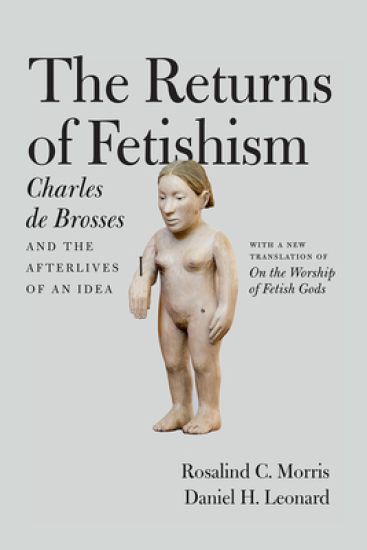
The Returns of Fetishism

The Returns of Fetishism

Charles de Brosses; Rosalind C. Morris; Daniel H. Leonard

University of Chicago Press
2017
nidottu
For more than 250 years, Charles de Brosses's term "fetishism" has exerted great influence over our most ambitious thinkers. Used as an alternative to "magic" but nonetheless expressing the material force of magical thought, de Brosses's term has proved indispensable to thinkers as diverse as Kant, Hegel, Marx, Freud, Lacan, Baudrillard, and Derrida. With this book, Daniel H. Leonard offers the first fully annotated English translation of the text that started it all: On the Worship of Fetish Gods, and Rosalind C. Morris offers incisive commentary that helps modern readers better understand it and its legacy. The product of de Brosses's autodidactic curiosity and idiosyncratic theories of language, On the Worship of Fetish Gods is an enigmatic text that is often difficult for contemporary audiences to assess. In a thorough introduction to the text, Leonard situates de Brosses's work within the cultural and intellectual milieu of his time. Then, Morris traces the concept of fetishism through its extraordinary permutations as it was picked up and transformed by the fields of philosophy, comparative religion, political economy, psychoanalysis, and anthropology. Ultimately, she breaks new ground, moving into and beyond recent studies by thinkers such as William Pietz, Hartmut Bohme, Alfonso Iacono through illuminating, new discussions on topics ranging from translation issues to Africanity to new materialism.
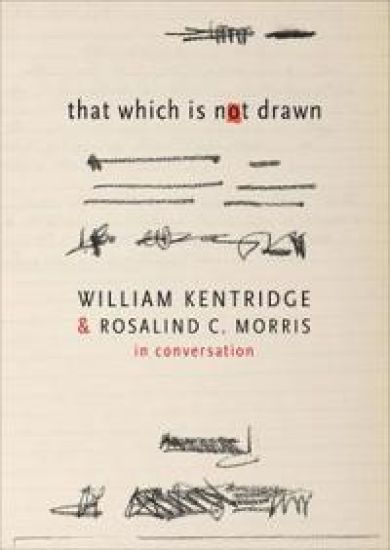
That Which Is Not Drawn

That Which Is Not Drawn

William Kentridge; Rosalind C. Morris

Seagull Books London Ltd
2017
nidottu

Halvin toimitettuna 30,80 €

For more than three decades, artist William Kentridge has explored in his work the nature of subjectivity, the possibilities of revolution, the Enlightenment's legacy in Africa, and the nature of time itself. At the same time, his creative work has stretched the boundaries of the very media he employs. Though his pieces have allowed viewers to encounter the traditions of landscape and self-portraiture, the limits of representation and the possibilities for animated drawing, and the labor of art, a guide to understanding the full scope of his art has been available until now. For five days, Kentridge sat with Rosalind C. Morris to talk about his work. The result That Which Is Not Drawn;is a wide-ranging conversation and deep investigation into the artist's techniques and into the psychic and philosophical underpinnings of his body of work. In these pages, Kentridge explains the key concerns of his art, including the virtues of bastardy, the ethics of provisionality, the nature of translation and the activity of the viewer. And together, Kentridge and Morris trace the migration of images across his works and consider the possibilities for a revolutionary art that remains committed to its own transformation. "That's the thing about a conversation," Kentridge reflects. "The activity and the performance, whether it's the performance of drawing or the performance of speech and conversation, is also the engine for new thoughts to happen. It's not just a report of something you know." And here, in this engaging dialogue, we at last have a guide to the continually exciting, continually changing work of one of our greatest living artists.
Accounts and Drawings from Underground

Accounts and Drawings from Underground

William Kentridge; Rosalind C. Morris

Seagull Books London Ltd
2015
sidottu
Over the last twenty years, William Kentridge has built a world-wide reputation as a contemporary artist, best known for his series of ten animated films created from charcoal drawings. The films introduced a significant character in contemporary fiction: Soho Eckstein, a Highveld mining magnate and Kentridge's alter ego. In The Soho Chronicles, Kentridge's brother, Matthew, shares a never-before-seen perspective on both William and Soho that sheds new light on the creator and his alter ego. Richly illustrated, the book includes a special feature that connects with smartphones and tablets. In Accounts and Drawings from Underground, William Kentridge and Rosalind C. Morris bring us an unprecedented collaboration using the pages of the 1906 Cash Book of the East Rand Proprietary Mines Corporation. Kentridge contributes forty landscape drawings in response to the transient terrain mining, while Morris plumbs the text of the cash book to generate a unique narrative account, drawing together the stories of migrant laborers and charting the flows of capital and desire.
Wars I Have (not) Seen

Wars I Have (not) Seen

Rosalind C. Morris

Seagull Books London Ltd
2012
sidottu
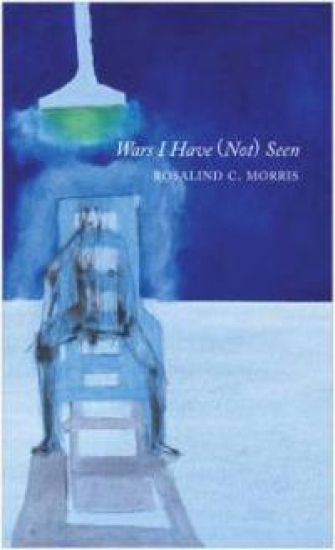
Do the relentless media images of the military campaigns in Afghanistan and Iraq convey a tangible picture of the human reality involved? Do they obstruct rather than bring into view the post-9/11 world? Gertrude Stein wrote of her experiences in World War II under the heading of "Wars I Have Seen"; in her answer, "Wars I Have (Not) Seen", Rosalind C. Morris describes a world in which our everyday reality is insistently sealed off from the fact of war, despite the prevalence of media imagery. Gathered here are essays that Morris has been writing since the American invasion of Afghanistan in 2001. In these works, she explores the relationship among war, the war on terror, and the mass media, and she reflects on transformations in the understanding and representation of the war throughout the last decade. "Wars I Have (Not) Seen" explores the technological structures that bind play and war in an uncomfortable imitation of each other, and Morris traces appearances of war in contemporary culture. Trenchant and reasoned, these essays insist that we must look beyond our daily media dosage to fully understand the human and political dynamics being reconfigured today on a global scale.
In the Place of Origins

In the Place of Origins

Rosalind C. Morris

Duke University Press
2000
pokkari
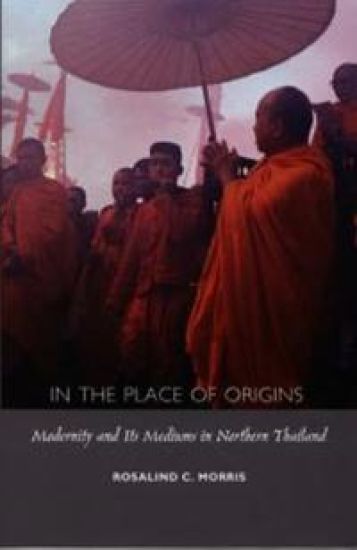
In the Place of Origins tells the tale of modernity in Northern Thailand, discerning its oblique signs in the performances of contemporary spirit mediums. In a world driven by the twin fantasies of pastness and newness, Rosalind C. Morris reveals that spirit mediumship is not simply a theater of atavistic tendency but an arena in which it is possible to read the relationships between new forms of representation and subjectivity, as well as new modes of magic and political power. Through her careful examination of the transformations of spirit mediumship wrought by the mass media, Morris takes readers into the world of the northern Thai past to discover the anticipations of future histories. In this process, she finds new objects for anthropological inquiry, including romantic love and epistolary poetry. She then turns her eye toward the relationships between commodification and prosaic form and photography and the discourses of gendered and national identity. Attending to these issues as they manifest themselves in the practices of mediums, Morris describes both the mundane activities of spirit mediums and the grand ambitions to political authority that are embodied in the increasingly spectacular forms of possession that are becoming so popular with both tourists and local culture brokers. In the Place of Origins traverses this ground with accounts of right-wing militarism and ritual revival during the 70s, and of the democracy movement of 1992, when a global mass media was galvanized by images of military repression and the spectacle of traditional ritual power in cursing. Finally, considering the claims that mediums make to magical power in the face of both AIDS and the Asian economic crisis, Morris reveals the potency of extrajudicial forms of power and violence in the late modern era. This provocative study will interest anthropologists, historians, Asianists, and those involved in gender, performance, media, and literary studies.
In the Place of Origins

In the Place of Origins

Rosalind C. Morris

Duke University Press
2000
sidottu
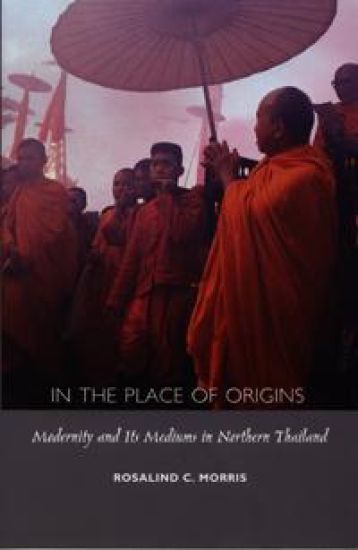
In the Place of Origins tells the tale of modernity in Northern Thailand, discerning its oblique signs in the performances of contemporary spirit mediums. In a world driven by the twin fantasies of pastness and newness, Rosalind C. Morris reveals that spirit mediumship is not simply a theater of atavistic tendency but an arena in which it is possible to read the relationships between new forms of representation and subjectivity, as well as new modes of magic and political power. Through her careful examination of the transformations of spirit mediumship wrought by the mass media, Morris takes readers into the world of the northern Thai past to discover the anticipations of future histories. In this process, she finds new objects for anthropological inquiry, including romantic love and epistolary poetry. She then turns her eye toward the relationships between commodification and prosaic form and photography and the discourses of gendered and national identity. Attending to these issues as they manifest themselves in the practices of mediums, Morris describes both the mundane activities of spirit mediums and the grand ambitions to political authority that are embodied in the increasingly spectacular forms of possession that are becoming so popular with both tourists and local culture brokers. In the Place of Origins traverses this ground with accounts of right-wing militarism and ritual revival during the 70s, and of the democracy movement of 1992, when a global mass media was galvanized by images of military repression and the spectacle of traditional ritual power in cursing. Finally, considering the claims that mediums make to magical power in the face of both AIDS and the Asian economic crisis, Morris reveals the potency of extrajudicial forms of power and violence in the late modern era. This provocative study will interest anthropologists, historians, Asianists, and those involved in gender, performance, media, and literary studies.