Kirjojen hintavertailu – 12 903 725 kirjaa ja 27 kauppaa

Kirjailija

Rosamond McKitterick

Kirjat ja teokset yhdessä paikassa: 11 kirjaa, julkaisuja vuosilta 1983–2023, suosituimpiin kuuluu Codex Epistolaris Carolinus. Vertaile teosten hintoja ja tarkista saatavuus suomalaisista kirjakaupoista.

11 kirjaa

Kirjojen julkaisuvuodet: 1983–2023.

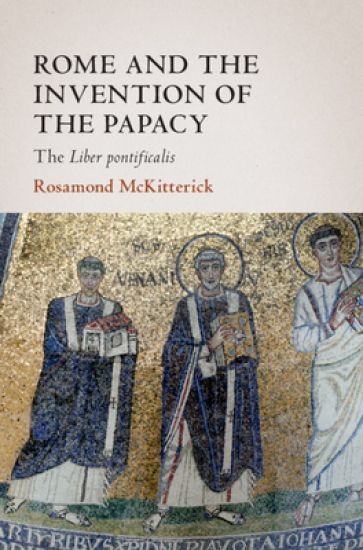
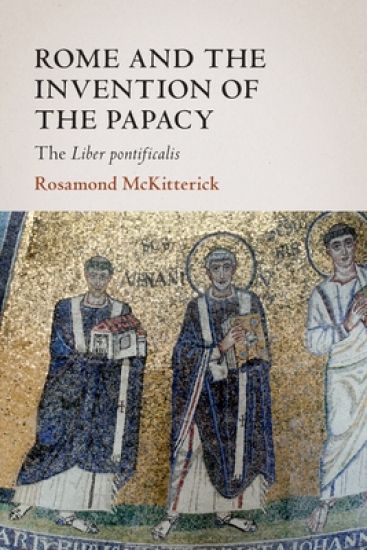
Rome and the Invention of the Papacy

Rome and the Invention of the Papacy

Rosamond McKitterick

Cambridge University Press
2023
pokkari

Halvin toimitettuna 30,00 €

The remarkable, and permanently influential, papal history known as the Liber pontificalis shaped perceptions and the memory of Rome, the popes, and the many-layered past of both city and papacy within western Europe. Rosamond McKitterick offers a new analysis of this extraordinary combination of historical reconstruction, deliberate selection and political use of fiction, to illuminate the history of the early popes and their relationship with Rome. She examines the content, context, and transmission of the text, and the complex relationships between the reality, representation, and reception of authority that it reflects. The Liber pontificalis presented Rome as a holy city of Christian saints and martyrs, as the bishops of Rome established their visible power in buildings, and it articulated the popes' spiritual and ministerial role, accommodated within their Roman imperial inheritance. Drawing on wide-ranging and interdisciplinary international research, Rome and the Invention of the Papacy offers pioneering insights into the evolution of this extraordinary source, and its significance for the history of early medieval Europe.
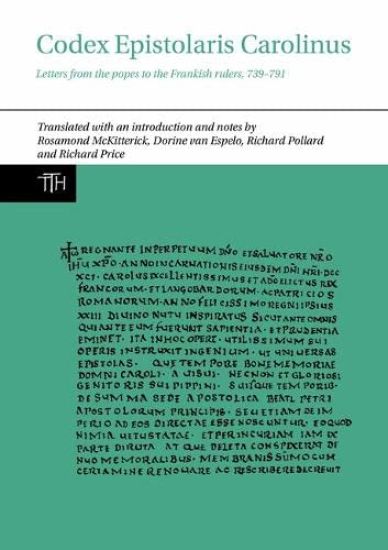
Codex Epistolaris Carolinus

Codex Epistolaris Carolinus

Rosamond McKitterick; Dorine van Espelo; Richard Matthew Pollard; Richard Price

LIVERPOOL UNIVERSITY PRESS
2023
nidottu
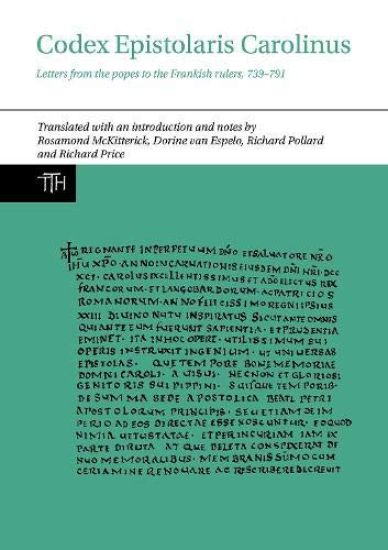
The Codex epistolaris Carolinus preserves ninety-nine letters, dated between 739 and 791 and sent by the popes to the Frankish king Charlemagne and his predecessors. The compilation was commissioned by Charlemagne in 791, but the sole surviving medieval manuscript of the letters was made at Cologne in the later ninth century and is now in Vienna (Österreichische Nationalbibliothek Cod. 449). The headings or lemmata provided for each letter by the Frankish compilers in 791 and faithfully preserved in the codex, add a distinctive Frankish commentary on events in Rome and Italy in the second half of the eighth century. This book not only provides the first full English translation of the letters and lemmata in the Codex epistolaris Carolinus but also re-creates the original Carolingian order of presentation of the letters according to the manuscript. A substantial introduction discusses the historical significance of the collection, the compilation and contexts of the Vienna manuscript, especially the significance of the lemmata, the peculiarities of the Latin of the papal letters and the biblical citations, and the historical context of the letters themselves. The lemmata and letter translations are augmented with introductions to each letter and a comprehensive historical commentary and glossary.
Codex Epistolaris Carolinus

Codex Epistolaris Carolinus

Rosamond McKitterick; Dorine van Espelo; Richard Matthew Pollard; Richard Price

Liverpool University Press
2021
sidottu
The Codex epistolaris Carolinus preserves ninety-nine letters, dated between 739 and 791 and sent by the popes to the Frankish king Charlemagne and his predecessors. The compilation was commissioned by Charlemagne in 791, but the sole surviving medieval manuscript of the letters was made at Cologne in the later ninth century and is now in Vienna (Österreichische Nationalbibliothek Cod. 449). The headings or lemmata provided for each letter by the Frankish compilers in 791 and faithfully preserved in the codex, add a distinctive Frankish commentary on events in Rome and Italy in the second half of the eighth century. This book not only provides the first full English translation of the letters and lemmata in the Codex epistolaris Carolinus but also re-creates the original Carolingian order of presentation of the letters according to the manuscript. A substantial introduction discusses the historical significance of the collection, the compilation and contexts of the Vienna manuscript, especially the significance of the lemmata, the peculiarities of the Latin of the papal letters and the biblical citations, and the historical context of the letters themselves. The lemmata and letter translations are augmented with introductions to each letter and a comprehensive historical commentary and glossary.
Rome and the Invention of the Papacy

Rome and the Invention of the Papacy

Rosamond McKitterick

Cambridge University Press
2020
sidottu
The remarkable, and permanently influential, papal history known as the Liber pontificalis shaped perceptions and the memory of Rome, the popes, and the many-layered past of both city and papacy within western Europe. Rosamond McKitterick offers a new analysis of this extraordinary combination of historical reconstruction, deliberate selection and political use of fiction, to illuminate the history of the early popes and their relationship with Rome. She examines the content, context, and transmission of the text, and the complex relationships between the reality, representation, and reception of authority that it reflects. The Liber pontificalis presented Rome as a holy city of Christian saints and martyrs, as the bishops of Rome established their visible power in buildings, and it articulated the popes' spiritual and ministerial role, accommodated within their Roman imperial inheritance. Drawing on wide-ranging and interdisciplinary international research, Rome and the Invention of the Papacy offers pioneering insights into the evolution of this extraordinary source, and its significance for the history of early medieval Europe.
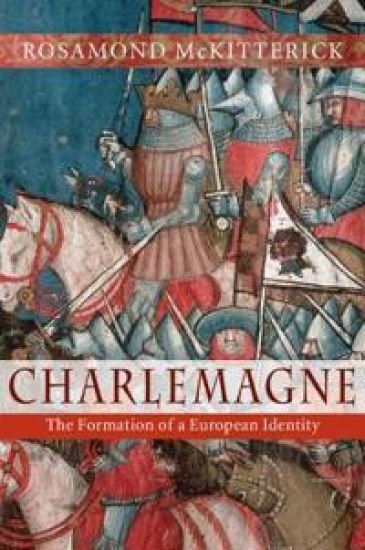
Charlemagne

Charlemagne

Rosamond McKitterick

Cambridge University Press
2008
pokkari
Charlemagne is often claimed as the greatest ruler in Europe before Napoleon. This magisterial study re-examines Charlemagne the ruler and his reputation. It analyses the narrative representations of Charlemagne produced after his death, and thereafter focuses on the evidence from Charlemagne's lifetime concerning the creation of the Carolingian dynasty and the growth of the kingdom, the court and the royal household, communications and identities in the Frankish realm in the context of government, and Charlemagne's religious and cultural strategies. The book offers a critical examination of the contemporary sources and in so doing transforms our understanding of the development of the Carolingian empire, the formation of Carolingian political identity, and the astonishing changes effected throughout Charlemagne's forty-six year period of rule. This is a major contribution to Carolingian history which will be essential reading for anyone interested in the medieval past. Rosamond McKitterick has also received the 2010 Dr A. H. Heineken Prize for History for her research into the Carolingians.
Charlemagne

Charlemagne

Rosamond McKitterick

Cambridge University Press
2008
sidottu
Charlemagne is often claimed as the greatest ruler in Europe before Napoleon. This magisterial study re-examines Charlemagne the ruler and his reputation. It analyses the narrative representations of Charlemagne produced after his death, and thereafter focuses on the evidence from Charlemagne's lifetime concerning the creation of the Carolingian dynasty and the growth of the kingdom, the court and the royal household, communications and identities in the Frankish realm in the context of government, and Charlemagne's religious and cultural strategies. The book offers a critical examination of the contemporary sources and in so doing transforms our understanding of the development of the Carolingian empire, the formation of Carolingian political identity, and the astonishing changes effected throughout Charlemagne's forty-six year period of rule. This is a major contribution to Carolingian history which will be essential reading for anyone interested in the medieval past. Rosamond McKitterick has also received the 2010 Dr A. H. Heineken Prize for History for her research into the Carolingians.
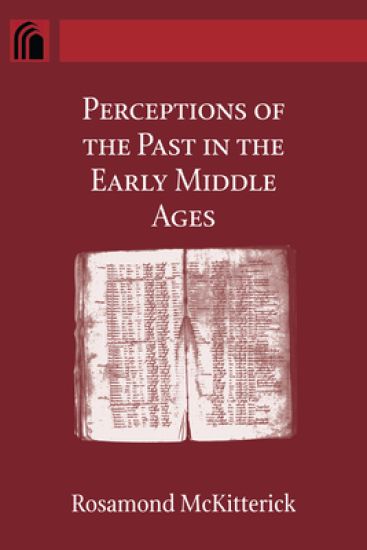
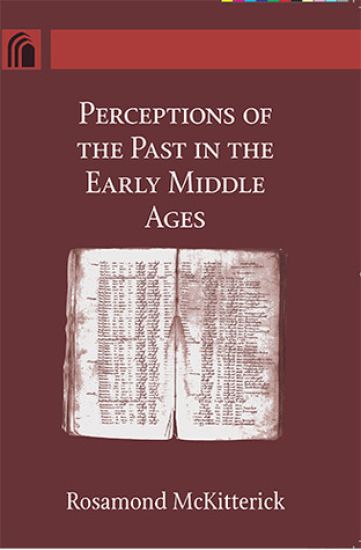
Perceptions of the Past in the Early Middle Ages

Perceptions of the Past in the Early Middle Ages

Rosamond McKitterick

University of Notre Dame Press
2006
sidottu
Historical writing of the early middle ages tends to be regarded as little more than a possible source of facts, but Rosamond McKitterick establishes that early medieval historians conveyed in their texts a sophisticated set of multiple perceptions of the past. In these essays, McKitterick focuses on the Frankish realms in the eighth and ninth centuries and examines different methods and genres of historical writing in relation to the perceptions of time and chronology. She claims that there is an extraordinary concentration of new text production and older text reproduction in this period that has to be accounted for, and whose influence is still being investigated and established. Three themes are addressed in Perceptions of the Past in the Early Middle Ages. McKitterick begins by discussing the Chronicon of Eusebius-Jerome as a way of examining the composition and reception of universal history in the ninth and early tenth centuries. She demonstrates that original manuscripts turn out in many cases to be compilations of sequential historical texts with a chronology extending back to the creation of the world or the origin of the Franks. In the second chapter, she explores the significance of Rome in Carolingian perceptions of the past and argues that its importance loomed large and was communicated in a great range of texts and material objects. In the third chapter, she looks at eighth- and ninth-century perceptions of the local past in the Frankish realm within the wider contexts of Christian and national history. She concludes that in the very rich, complex, and sometimes, contradictory early medieval perceptions of a past stretching back to the creation of the world, the Franks in the Carolingian period forged their own special place.
Perceptions of the Past in the Early Middle Ages

Perceptions of the Past in the Early Middle Ages

Rosamond McKitterick

University of Notre Dame Press
2006
nidottu
Historical writing of the early middle ages tends to be regarded as little more than a possible source of facts, but Rosamond McKitterick establishes that early medieval historians conveyed in their texts a sophisticated set of multiple perceptions of the past. In these essays, McKitterick focuses on the Frankish realms in the eighth and ninth centuries and examines different methods and genres of historical writing in relation to the perceptions of time and chronology. She claims that there is an extraordinary concentration of new text production and older text reproduction in this period that has to be accounted for, and whose influence is still being investigated and established. Three themes are addressed in Perceptions of the Past in the Early Middle Ages. McKitterick begins by discussing the Chronicon of Eusebius-Jerome as a way of examining the composition and reception of universal history in the ninth and early tenth centuries. She demonstrates that original manuscripts turn out in many cases to be compilations of sequential historical texts with a chronology extending back to the creation of the world or the origin of the Franks. In the second chapter, she explores the significance of Rome in Carolingian perceptions of the past and argues that its importance loomed large and was communicated in a great range of texts and material objects. In the third chapter, she looks at eighth- and ninth-century perceptions of the local past in the Frankish realm within the wider contexts of Christian and national history. She concludes that in the very rich, complex, and sometimes, contradictory early medieval perceptions of a past stretching back to the creation of the world, the Franks in the Carolingian period forged their own special place.
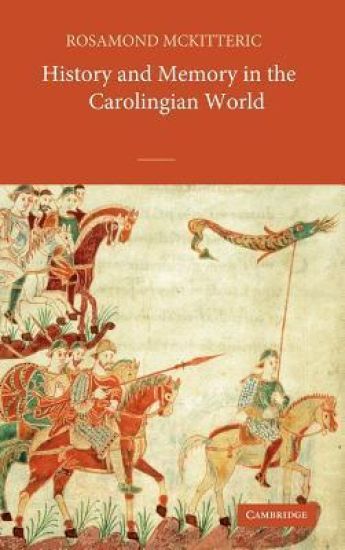
History and Memory in the Carolingian World

History and Memory in the Carolingian World

Rosamond McKitterick

Cambridge University Press
2004
sidottu
The writing and reading of history in the early Middle Ages form the key themes of this 2004 book. The primary focus is on the remarkable manifestations of historical writing in relation to historical memory in the Frankish kingdoms of the eighth and ninth centuries. It considers the audiences for history in the Frankish kingdoms, the recording of memory in new genres including narrative histories, cartularies and Libri memoriales, and thus particular perceptions of the Frankish and Christian past. It analyses both original manuscript material and key historical texts from the Carolingian period, a remarkably creative period in the history of European culture. Presentations of the past developed in this period were crucial in forming an historical understanding of the Greco-Roman and Judaeo-Christian past and, in subsequent centuries, of early medieval Europe. They also played an extraordinarily influential role in the formation of political ideologies and senses of identity within Europe.
Books, Scribes and Learning in the Frankish Kingdoms, 6th-9th centuries
The focus of this volume is the book production of the Frankish regions of Western Europe in the early Middle Ages. By means of a detailed scrutiny of individual manuscripts, groups of manuscripts, and categories of texts, Dr McKitterick shows how they can be used to throw light on questions such as women and literacy, the knowledge of canon and secular law, and the English contribution to the religious culture of the Continent . Some of the studies are more concerned with palaeography and the achievements of particular scriptoria; studies; others look primarily at the fact of production, the dissemination of the texts, and their implications for intellectual and cultural history. Au centre de ce volume se trouve la production du livre dans les régions franques d’Europe occidentale au début du Moyan Age. Au travers d’un examen approfondi de manuscrits individuels, de groupes de manuscrits et de catégories de textes, le docteur McKitterick démontre l’utilisation qui peut en être faite afin d’éclaircir un certain nombre de questions dont: les femmes et l’alphabétisation, la connaissance du droit canon et séculaire, ainsi que la contribution anglaise à la culture religieuse de continent. Certaines des études s’attachent plus spécifiquement à la paléographie et aux résultats de certains scriptoria; d’autres examinent avant tout le fait même de la production, la dissémination des textes et leurs implications quant à l’histoire intellectuelle et culturelle.
The Frankish Kingdoms Under the Carolingians 751-987
An exciting examination of the entire history of the Carolingian 'dynasty' in western Europe. The author shows the whole period to be one of immense political, religious. cultural and intellectual dynamism; not only did it lay the foundations of the governmental and administrative institutions of Europe and the organisation of the Church, but it also securely established the intellectual and cultural traditions which were to dominate western Christendom for centuries to come.