Kirjojen hintavertailu – 12 903 735 kirjaa ja 27 kauppaa

Kirjailija

Rose-Anne Dana

Kirjat ja teokset yhdessä paikassa: 4 kirjaa, julkaisuja vuosilta 2002–2010, suosituimpiin kuuluu Financial Markets in Continuous Time. Vertaile teosten hintoja ja tarkista saatavuus suomalaisista kirjakaupoista.

4 kirjaa

Kirjojen julkaisuvuodet: 2002–2010.

Dynamic Programming in Economics

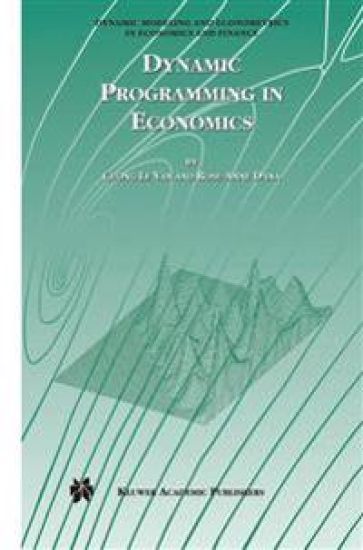
Dynamic Programming in Economics

Cuong Van; Rose-Anne Dana

Springer-Verlag New York Inc.
2010
nidottu
Dynamic Programming in Economics is an outgrowth of a course intended for students in the first year PhD program and for researchers in Macroeconomics Dynamics. It can be used by students and researchers in Mathematics as well as in Economics. The purpose of Dynamic Programming in Economics is twofold: (a) to provide a rigorous, but not too complicated, treatment of optimal growth models in infinite discrete time horizon, (b) to train the reader to the use of optimal growth models and hence to help him to go further in his research. We are convinced that there is a place for a book which stays somewhere between the "minimum tool kit" and specialized monographs leading to the frontiers of research on optimal growth.
Financial Markets in Continuous Time

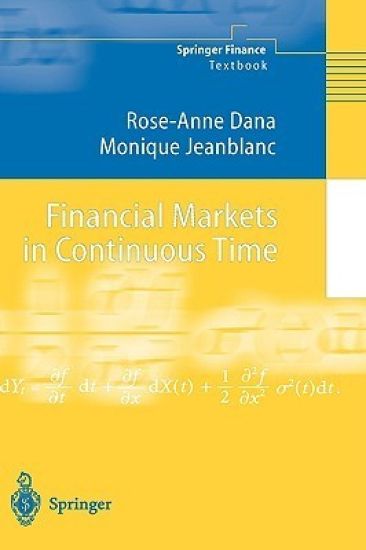
Financial Markets in Continuous Time

Rose-Anne Dana; Monique Jeanblanc

Springer-Verlag Berlin and Heidelberg GmbH Co. K
2007
nidottu
In modern financial practice, asset prices are modelled by means of stochastic processes, and continuous-time stochastic calculus thus plays a central role in financial modelling. This approach has its roots in the foundational work of the Nobel laureates Black, Scholes and Merton. Asset prices are further assumed to be rationalizable, that is, determined by equality of demand and supply on some market. This approach has its roots in the foundational work on General Equilibrium of the Nobel laureates Arrow and Debreu and in the work of McKenzie. This book has four parts. The first brings together a number of results from discrete-time models. The second develops stochastic continuous-time models for the valuation of financial assets (the Black-Scholes formula and its extensions), for optimal portfolio and consumption choice, and for obtaining the yield curve and pricing interest rate products. The third part recalls some concepts and results of general equilibrium theory, and applies this in financial markets. The last part is more advanced and tackles market incompleteness and the valuation of exotic options in a complete market.
Dynamic Programming in Economics

Dynamic Programming in Economics

Cuong Van; Rose-Anne Dana

Springer-Verlag New York Inc.
2003
sidottu
Dynamic Programming in Economics is an outgrowth of a course intended for students in the first year PhD program and for researchers in Macroeconomics Dynamics. It can be used by students and researchers in Mathematics as well as in Economics. The purpose of Dynamic Programming in Economics is twofold: (a) to provide a rigorous, but not too complicated, treatment of optimal growth models in infinite discrete time horizon, (b) to train the reader to the use of optimal growth models and hence to help him to go further in his research. We are convinced that there is a place for a book which stays somewhere between the "minimum tool kit" and specialized monographs leading to the frontiers of research on optimal growth.
Financial Markets in Continuous Time

Financial Markets in Continuous Time

Rose-Anne Dana; Monique Jeanblanc

Springer-Verlag Berlin and Heidelberg GmbH Co. K
2002
sidottu
In modern financial practice, asset prices are modelled by means of stochastic processes, and continuous-time stochastic calculus thus plays a central role in financial modelling. This approach has its roots in the foundational work of the Nobel laureates Black, Scholes and Merton. Asset prices are further assumed to be rationalizable, that is, determined by equality of demand and supply on some market. This approach has its roots in the foundational work on General Equilibrium of the Nobel laureates Arrow and Debreu and in the work of McKenzie. This book has four parts. The first brings together a number of results from discrete-time models. The second develops stochastic continuous-time models for the valuation of financial assets (the Black-Scholes formula and its extensions), for optimal portfolio and consumption choice, and for obtaining the yield curve and pricing interest rate products. The third part recalls some concepts and results of general equilibrium theory, and applies this in financial markets. The last part is more advanced and tackles market incompleteness and the valuation of exotic options in a complete market.