Kirjojen hintavertailu – 12 903 725 kirjaa ja 27 kauppaa

Kirjailija

Rosemary Foot

Kirjat ja teokset yhdessä paikassa: 14 kirjaa, julkaisuja vuosilta 1986–2026, suosituimpiin kuuluu Bounded Ambition. Vertaile teosten hintoja ja tarkista saatavuus suomalaisista kirjakaupoista.

14 kirjaa

Kirjojen julkaisuvuodet: 1986–2026.

Bounded Ambition

Bounded Ambition

Rosemary Foot; Xueying Zhang

Cambridge University Press
2026
sidottu
Since the 1980s, China has become steadily enmeshed in multilateral international organizations (MIOs). A rich body of rhetoric and behaviour is available to deepen our understanding of why and how Beijing engages with MIOs, additionally allowing a response to the question of whether China's engagement is shifting the global normative landscape in ways that significantly affect the on-going transition in global order. With these aims in mind, this Element first adopts a 'snapshot' macro-analytical perspective that draws on existing scholarship and official documentation to compare two eras of Chinese MIO engagement across several issue areas. The Element next adopts a case-study, process-driven, understanding of China and MIOs, examining the evolution of the Asian Infrastructure Investment Bank, the BRICS, and the Shanghai Cooperation Organization. It concludes that China, through incremental measures, is fashioning reordering that pushes in similar directions. However, this capacity to effect significant change varies considerably across institutional settings.

Bounded Ambition

Bounded Ambition

Rosemary Foot; Xueying Zhang

Cambridge University Press
2026
pokkari
Since the 1980s, China has become steadily enmeshed in multilateral international organizations (MIOs). A rich body of rhetoric and behaviour is available to deepen our understanding of why and how Beijing engages with MIOs, additionally allowing a response to the question of whether China's engagement is shifting the global normative landscape in ways that significantly affect the on-going transition in global order. With these aims in mind, this Element first adopts a 'snapshot' macro-analytical perspective that draws on existing scholarship and official documentation to compare two eras of Chinese MIO engagement across several issue areas. The Element next adopts a case-study, process-driven, understanding of China and MIOs, examining the evolution of the Asian Infrastructure Investment Bank, the BRICS, and the Shanghai Cooperation Organization. It concludes that China, through incremental measures, is fashioning reordering that pushes in similar directions. However, this capacity to effect significant change varies considerably across institutional settings.
The Wrong War

The Wrong War

Rosemary Foot

CORNELL UNIVERSITY PRESS
2023
pokkari
In 1951, General Omar Bradley declared publicly that war with China would involve the United States "in the wrong war, at the wrong place, at the wrong time, and with the wrong enemy." Despite the stated intent of the U. S. to keep the Korean conflict from spreading, the debate on extending the war was far more intense and protracted than previous accounts of this period have suggested. Concentrating on the debate over expansion, Rosemary Foot reveals the strains it caused both within the U. S. bureaucracy and between America and its North Atlantic allies. She supplies important new information on the U. S. government's appraisal of Sino-Soviet relations between 1950 and 1953, and makes clear that a high proportion of U. S. officials came to recognize the limited nature of Soviet support for China. Explaining why the Eisenhower administration nearly unleashed nuclear weapons on China in the spring of 1953, Foot demonstrates that the Korean war would very likely have grown into a conflict of major proportions if the Chinese and North Koreans had not conceded the final issue of the truce talks—the question of the voluntary repatriation of prisoners of war.
China, the UN, and Human Protection

China, the UN, and Human Protection

Rosemary Foot

Oxford University Press
2020
nidottu
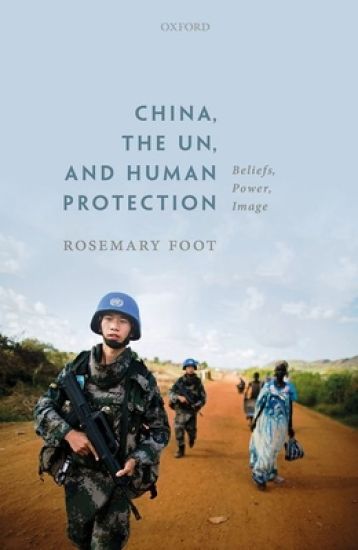
Over a relatively short period of time, Beijing moved from dismissing the UN to embracing it. How are we to make sense of the People's Republic of China's (PRC) embrace of the UN, and what does its engagement mean in larger terms? This study focuses directly on Beijing's involvement in one of the most contentious areas of UN activity -- human protection -- contentious because the norm of human protection tips the balance away from the UN's Westphalian state-based profile, towards the provision of greater protection for the security of individuals and their individual liberties. The argument that follows shows that, as an ever-more crucial actor within the United Nations, Beijing's rhetoric and some of its practices are playing an increasingly important role in determining how this norm is articulated and interpreted. In some cases, the PRC is also influencing how these ideas of human protection are implemented. At stake in the questions this book tackles is both how we understand the PRC as a participant in shaping global order, and the future of some of the core norms which constitute that order.
China, the UN, and Human Protection

China, the UN, and Human Protection

Rosemary Foot

Oxford University Press
2020
sidottu
Over a relatively short period of time, Beijing moved from dismissing the UN to embracing it. How are we to make sense of the People's Republic of China's (PRC) embrace of the UN, and what does its engagement mean in larger terms? This study focuses directly on Beijing's involvement in one of the most contentious areas of UN activity -- human protection -- contentious because the norm of human protection tips the balance away from the UN's Westphalian state-based profile, towards the provision of greater protection for the security of individuals and their individual liberties. The argument that follows shows that, as an ever-more crucial actor within the United Nations, Beijing's rhetoric and some of its practices are playing an increasingly important role in determining how this norm is articulated and interpreted. In some cases, the PRC is also influencing how these ideas of human protection are implemented. At stake in the questions this book tackles is both how we understand the PRC as a participant in shaping global order, and the future of some of the core norms which constitute that order.
Human Rights and Counter-terrorism in America's Asia Policy
This book examines the effects of the terrorist attacks on New York and Washington of 11 September 2001 on America's human rights and counter-terrorism policies towards a number of countries in Asia. Five countries have been chosen for examination, divided into two front-lines states (Pakistan and Uzbekistan), two second-front countries (Indonesia and Malaysia), and a third-front country, China. The paper also looks at changes in US domestic legislation and its treatment of prisoners at Guantanamo Bay and elsewhere in order to analyse the extent to which the US promotion of an external human rights policy might also have been compromised by its own legislative changes as a result of the struggle against terrorism. The paper concludes that the attacks on US territory, overall, have constrained America's willingness and capacity to promote an external human rights policy with respect to these five countries. However, some attention - especially at the rhetorical level - to these countries' human rights records has been retained to differing degrees among the five states. This degree of difference is not explained entirely in reference to a country's perceived centrality to the struggle against terrorism. It depends on the extent to which the US executive and legislative branches are united - either singly or in combination - in their disapproval of a state's record, or in their understanding about how best to reach the policy goals that are sought.
China, the United States, and Global Order

China, the United States, and Global Order

Rosemary Foot; Andrew Walter

Cambridge University Press
2010
pokkari
The United States and China are the two most important states in the international system and are crucial to the evolution of global order. Both recognize each other as vital players in a range of issues of global significance, including the use of force, macroeconomic policy, nonproliferation of nuclear weapons, climate change and financial regulation. In this book, Rosemary Foot and Andrew Walter, both experts in the fields of international relations and the East Asian region, explore the relationship of the two countries to these global order issues since 1945. They ask whether the behaviour of each country is consistent with global order norms, and which domestic and international factors shape this behaviour. They investigate how the bilateral relationship of the United States and China influences the stances that each country takes. This is a sophisticated analysis that adroitly engages the historical, theoretical and policy literature.
China, the United States, and Global Order

China, the United States, and Global Order

Rosemary Foot; Andrew Walter

Cambridge University Press
2010
sidottu
The United States and China are the two most important states in the international system and are crucial to the evolution of global order. Both recognize each other as vital players in a range of issues of global significance, including the use of force, macroeconomic policy, nonproliferation of nuclear weapons, climate change and financial regulation. In this book, Rosemary Foot and Andrew Walter, both experts in the fields of international relations and the East Asian region, explore the relationship of the two countries to these global order issues since 1945. They ask whether the behaviour of each country is consistent with global order norms, and which domestic and international factors shape this behaviour. They investigate how the bilateral relationship of the United States and China influences the stances that each country takes. This is a sophisticated analysis that adroitly engages the historical, theoretical and policy literature.
Human Rights and Counter-terrorism in America's Asia Policy

Human Rights and Counter-terrorism in America's Asia Policy

Rosemary Foot

Oxford University Press Inc
2005
nidottu
This book examines the effects of the terrorist attacks on New York and Washington of 11 September 2001 on America's human rights and counter-terrorism policies towards a number of countries in Asia. Five countries have been chosen for examination, divided into two front-lines states (Pakistan and Uzbekistan), two second-front countries (Indonesia and Malaysia), and a third-front country, China. The paper also looks at changes in US domestic legislation and its treatment of prisoners at Guantanamo Bay and elsewhere in order to analyse the extent to which the US promotion of an external human rights policy might also have been compromised by its own legislative changes as a result of the struggle against terrorism. The paper concludes that the attacks on US territory, overall, have constrained America's willingness and capacity to promote an external human rights policy with respect to these five countries. However, some attention - especially at the rhetorical level - to these countries' human rights records has been retained to differing degrees among the five states. This degree of difference is not explained entirely in reference to a country's perceived centrality to the struggle against terrorism. It depends on the extent to which the US executive and legislative branches are united - either singly or in combination - in their disapproval of a state's record, or in their understanding about how best to reach the policy goals that are sought.
Rights Beyond Borders

Rights Beyond Borders

Rosemary Foot

Oxford University Press
2000
sidottu
Over the five decades since the establishment of the UN Charter and Universal Declaration of Human Rights, human rights issues have become a dominant feature of the international system, embracing new actors, eroding the traditional Westphalian concept of sovereignty, and leading to an acceptance that the treatment of individuals and groups within domestic societies is legitimately a focus of global attention. This book examines the effect of this normative evolution on the individual, state, institutional and advocacy network behaviour. Having described this normative environment it assesses its impact on key actors' relationships with China, particularly in the period since the Tiananmen bloodshed in June 1989. It also examines China's responses–international and internal–to being the focus of global attention in this issue area. The book's theoretical concerns are to uncover the mechanisms through which international human rights norms influence especially the external but also the domestic behaviour of states.
Rights Beyond Borders

Rights Beyond Borders

Rosemary Foot

Oxford University Press
2000
nidottu
Over the five decades since the establishment of the UN Charter and Universal Declaration of Human Rights, human rights issues have become a dominant feature of the international system, embracing new actors, eroding the traditional Westphalian concept of sovereignty, and leading to an acceptance that the treatment of individuals and groups within domestic societies is legitimately a focus of global attention. This book examines the affect that this normative evolution has had on the individual, state, institutional and advocacy network behaviour. Having described this normative environment it assesses its impact on key actors' relationships with China, especially in the period since the Tiananmen bloodshed in June 1989. It also examines China's responses–international and internal–to being the focus of global attention in this issue area. The book's theoretical concerns are to uncover the conditions under which international human rights norms influence behaviour, including domestic changes within states, and about the operation of norms in the global system.
The Practice of Power

The Practice of Power

Rosemary Foot

Clarendon Press
1997
nidottu
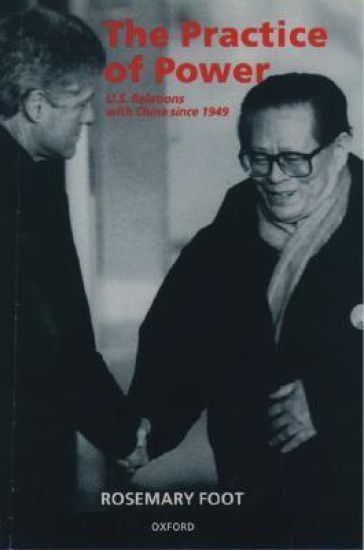
This absorbing study examines the change in American relations with China after 1949 from hostility to rapproachement, and to full normalization of the ties in 1979. Rosemary Foot goes on to examine the relationship after normalization, a period when the United States has come to view China as less of a challenge but still resistant to certain of the norms of the current international order. The book begins by examining US efforts to build, and then maintain an international and domestic consensus behind its China policy. It then looks at changing US perceptions of the capabilities of the Chinese state. It shows how American positions on Chinese representation at the UN and on the trade embargo were subtly eroded, not least by changes in US domestic public opinion. The author argues that previous explantions of American relations with China have dwelt too single-mindedly on ideas associated with the strategic triangle and that instead we need to embed our understanding of the evolution of American relations with China within a wider structure of relationships at the global and domestic level. Reviews: `A valuable interpretative analysis of US-People's Republic of China relationships...she substantially contributes to post-Soviet era theoretical understanding. Strongly recommended for courses in foreign policy, diplomatic history, and international relations.' Choice `contains much that is valuable to those whose interests are primarily on the other side of the Pacific... The chapter on American public opinion and Chinese policy is also something which is not readily found in existing accounts of China'a post-1949 foreign relations' Times Higher Education Supplement `her analysis remains cautious and astute' The Economist
A Substitute for Victory

A Substitute for Victory

Rosemary Foot

Cornell University Press
1990
sidottu
After more than two years of bitter negotiations during which combatants & civilians continued to suffer casualties, the Korean armistice was concluded in July 1953. Focusing on the Americans formulation of negotiating positions & on their attempts to coordinate political goals with military tactics, Rosemary Foot here charts the tortuous path to peace & offers a new explanation for the agonizing length of the talks. She also takes into account the role of the Western allies & the Indian, South Korean, North Korean, & Chinese governments as she examines the complex international setting in which the armistice took place.