

Kirjojen hintavertailu – 12 867 221 kirjaa ja 27 kauppaa

Kirjailija

Rosemary J Erickson

Kirjat ja teokset yhdessä paikassa: 2 kirjaa, julkaisuja vuosilta 1997–2018, suosituimpiin kuuluu The Use of Social Science Data in Supreme Court Decisions. Vertaile teosten hintoja ja tarkista saatavuus suomalaisista kirjakaupoista.

Nimi esiintyy myös muodoissa: Rosemary J. Erickson

2 kirjaa

Kirjojen julkaisuvuodet: 1997–2018.

Serial Killers and the Aftermath

Serial Killers and the Aftermath

Rosemary J. Erickson

Createspace Independent Publishing Platform
2018
nidottu
This is not a smiley-face book. Rather, it provides a gritty coverage of four serial killer cases, for which Dr. Rosemary J. Erickson was an expert witness. Dr. Erickson is a forensic sociologist and expert witness. The first part of her book provides a behind- the-scenes look of how she became a female expert witness on violent crime, and the later part covers the violent criminal cases and her involvement in the aftermath. The aftermath occurs, when the civil suit is filed. That is when Dr. Erickson goes to work to determine if the place where the crime occurred has liability. The book also reveals the dysfunctional childhoods of the serial killers and their psychopathy, which led them to their crimes-- characteristics so similar to the mass shooters of today.
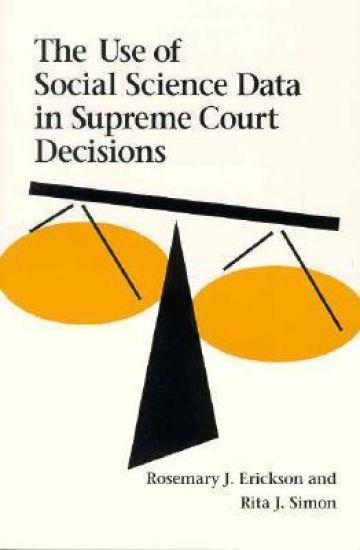
The Use of Social Science Data in Supreme Court Decisions

The Use of Social Science Data in Supreme Court Decisions

Rosemary J Erickson; Rita J Simon

University of Illinois Press
1997
nidottu
The legal community traditionally has drawn unsystematically and at will on the findings of social science, sometimes with unfortunate results. The authors of this study explore this issue by focusing on the way the United States Supreme Court uses social science data in reaching its decisions. Concentrating on decisions involving abortion, sex discrimination, and sexual harassment, they show that the use of such data has increased over the last twenty years, but that the data's use by the court appears to hinge more on the judges' liberal, conservative, or long-held positions and the types of cases involved than on the objectivity or validity of the data. By offering insights into how data are used by the Supreme Court, the authors hope to show social scientists how to make their research more suitable for courtroom use and to show the legal community how such data can be used more effectively. The volume includes an overview of the kinds of research used, a list of cases in which such research was used, and a discussion of justices and how they voted on cases in which such data were used from 1972 to 1992.