Kirjojen hintavertailu – 12 903 725 kirjaa ja 27 kauppaa

Kirjailija

Rosemary Thorp

Kirjat ja teokset yhdessä paikassa: 7 kirjaa, julkaisuja vuosilta 1978–2020, suosituimpiin kuuluu Decentralizing Development. Vertaile teosten hintoja ja tarkista saatavuus suomalaisista kirjakaupoista.

7 kirjaa

Kirjojen julkaisuvuodet: 1978–2020.

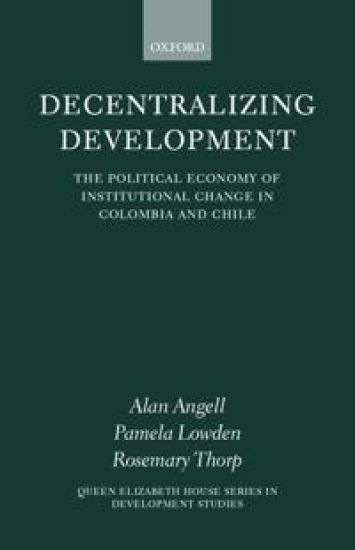
Decentralizing Development

Decentralizing Development

Alan Angell; Pamela Lowden; Rosemary Thorp

Oxford University Press
2001
sidottu
Decentralization has become a fashionable policy prescription among reformers in Latin America. But how does it work in practice? Are the claims that it promotes efficiency, participation, and fiscal responsibility justified? Does the process improve the delivery of social services at the local level and encourage the participation of local communities? What conditions allow a positive response to the challenges of decentralization? This book seeks to explore these questions by examining the experience of seven medium sized provincial towns in Colombia and Chile. The overall national context is analyzed and the differences between the two countries emphasized. Colombia embarked on a process of radical decentralization, largely because of perceived failures of the state at the central level, while in Chile the process of change was much more cautious, since a relatively efficient central state wished to maintain tight control over reform. The effect on the development and politics of the seven cities is also described, and the reasons for the very different outcomes assessed. Particular attention is paid to the role of the mayor and the ability to construct a local coalition for reform. Three thematic chapters further explore the impact of decentralization on the local economy and the role of the private sector in fostering development; the way in which educational reform has been advanced by local authority and community involvement; and the manner in which the new institutional structures affect the development of policies for local poverty alleviation. The authors draw on extensive fieldwork involving numerous interviews with actors at all levels and from all sectors. The result is a unique test, at the local level in Latin America, of the outcome of reforms to the institutional structure of government.
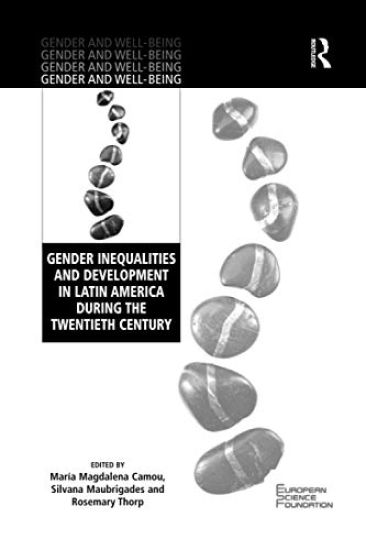
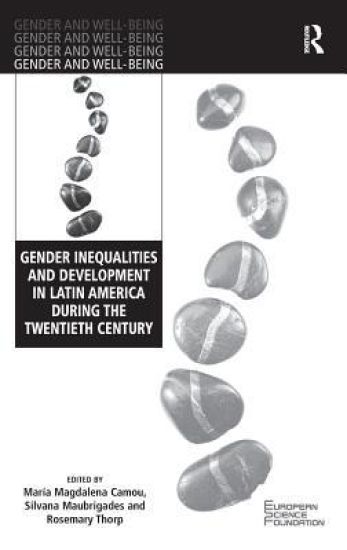
Gender Inequalities and Development in Latin America During the Twentieth Century

Gender Inequalities and Development in Latin America During the Twentieth Century

María Magdalena Camou; Silvana Maubrigades; Rosemary Thorp

Routledge
2020
nidottu
This book presents evidence of the evolution of the gender inequalities in Latin America during the twentieth century, using basic indicators of human development, namely education, health and the labour market. There are very few historical studies that centre on gender as the main analytical category in Latin America, so this book breaks new ground. Using case-studies from Argentina, Chile, Colombia, Mexico and Uruguay, the authors show that there is evidence of a correlation between economic growth and the decrease in gender inequality, but this process is also not linear. Although the activity rate of women was high at the beginning of the twentieth century, female participation in the labour market diminished, until the 1970s, when it began to increase dramatically. Since the 1970s, fertility reduction and education improvements and worsening labour market conditions are associated to the steadily increase of women participation in the labour market. By gauging the extent to which gender gaps in the formation of human capital, access to resources, quality of life and opportunities may have operated as a restriction on women’s capabilities and on economic growth in the region, this book demonstrates that Latin America has lagged behind in terms of gender equality.
Gender Inequalities and Development in Latin America During the Twentieth Century

Gender Inequalities and Development in Latin America During the Twentieth Century

María Magdalena Camou; Silvana Maubrigades; Rosemary Thorp

Routledge
2016
sidottu
This book presents evidence of the evolution of the gender inequalities in Latin America during the twentieth century, using basic indicators of human development, namely education, health and the labour market. There are very few historical studies that centre on gender as the main analytical category in Latin America, so this book breaks new ground. Using case-studies from Argentina, Chile, Colombia, Mexico and Uruguay, the authors show that there is evidence of a correlation between economic growth and the decrease in gender inequality, but this process is also not linear. Although the activity rate of women was high at the beginning of the twentieth century, female participation in the labour market diminished, until the 1970s, when it began to increase dramatically. Since the 1970s, fertility reduction and education improvements and worsening labour market conditions are associated to the steadily increase of women participation in the labour market. By gauging the extent to which gender gaps in the formation of human capital, access to resources, quality of life and opportunities may have operated as a restriction on women’s capabilities and on economic growth in the region, this book demonstrates that Latin America has lagged behind in terms of gender equality.
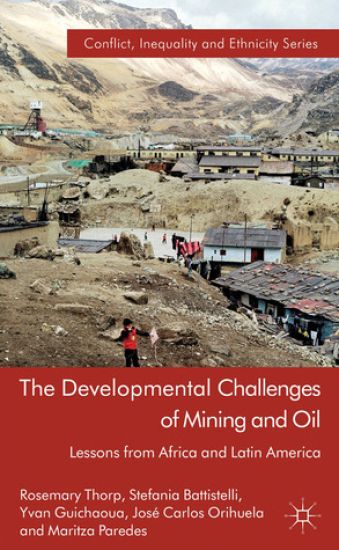
The Developmental Challenges of Mining and Oil

The Developmental Challenges of Mining and Oil

Rosemary Thorp; S. Battistelli; Y. Guichaoua; J. Orihuela; M. Paredes

Palgrave Macmillan
2012
sidottu
The authors explain why the discovery and development of natural resources is commonly associated with unstable and unequal development, and frequently with violence. They demonstrate the need for policies and institutions by reflecting on both successes and failures in case studies on Botswana, Nigeria and Niger as well as Bolivia, Chile and Peru.
Economic Management and Economic Development in Peru and Colombia
Today Peru is undoubtedly poorer than Colombia. Yet at the turn of the century the opposite was true. This study asks why Peru has made relatively so much less progress, and finds part of the answer in the greater coherence and competence of short term policy management in Colombia. Whether the international economy has provided positive or negative shocks, Colombia has tended to manage them more skilfully than Peru - not be relying on the market but by generally pragmatic and prudent interventionist policies.