
Kirjailija
Roy A. Medvedev
Kirjat ja teokset yhdessä paikassa: 8 kirjaa, julkaisuja vuosilta 1976–2020, suosituimpiin kuuluu Nikolai Bukharin. Vertaile teosten hintoja ja tarkista saatavuus suomalaisista kirjakaupoista.
8 kirjaa
Kirjojen julkaisuvuodet: 1976–2020.
Zhores Medvedev, a Soviet biochemist and outspoken critic of the Soviet bureaucracy, who was railroaded into a mental hospital, and his brother, historian Roy Medvedev, who rallied the Soviet scientific and intellectual community in protest, together tell the story of “repression by psychiatry” in Russia today.
Roy Medvedev, one of the world's best-known Russian scholars and a former consultant to both Gorbachev and Yeltsin analyzes the main events that have transpired in the Russian federation since late August 1991. He looks at the plans that were meant to restructure a society in crisis but-for reasons both complex and obvious-were destined to fail. From the drastic liberalization of prices and "shock therapy" to the privatization of state owned property and Yeltsin's resignation and replacement by Vladimir Putin, this is an intricately fascinating saga of good intentions, philosophical warfare, and catastrophic miscalculations. Among the many compelling facts detailed here are Yeltsin's utter surprise-and lack of preparation-at the failed coup against Gorbachev in 1991, when power fell virtually into his lap; his failure to heed the warnings of learned advisers like Yuri Yaremenko, who knew that Western economics could not be applied to Russia; and Yeltsin's dramatic (and unprecedented) decree in 1992 allowing anyone to sell or buy anything they wished. In a sweeping conclusion covering the critical events of 1998 and 1999 as well as a detailed analysis of the 1995 and 1996 elections, Medvedev lays forth an exhaustive survey of recent political shifts, attitudes, statistics, and trends. From birth and death rates on the farm and in the city through a number of highly charged campaigns and elections to the new goal of the Communist Youth League (to become millionaires), this is a breathtakingly detailed survey of an unforgettable chapter in Russia's history.
Roy Medvedev, one of the world's best-known Russian scholars and a former consultant to both Gorbachev and Yeltsin analyzes the main events that have transpired in the Russian federation since late August 1991. He looks at the plans that were meant to restructure a society in crisis but-for reasons both complex and obvious-were destined to fail. From the drastic liberalization of prices and "shock therapy" to the privatization of state owned property and Yeltsin's resignation and replacement by Vladimir Putin, this is an intricately fascinating saga of good intentions, philosophical warfare, and catastrophic miscalculations. Among the many compelling facts detailed here are Yeltsin's utter surprise-and lack of preparation-at the failed coup against Gorbachev in 1991, when power fell virtually into his lap; his failure to heed the warnings of learned advisers like Yuri Yaremenko, who knew that Western economics could not be applied to Russia; and Yeltsin's dramatic (and unprecedented) decree in 1992 allowing anyone to sell or buy anything they wished. In a sweeping conclusion covering the critical events of 1998 and 1999 as well as a detailed analysis of the 1995 and 1996 elections, Medvedev lays forth an exhaustive survey of recent political shifts, attitudes, statistics, and trends. From birth and death rates on the farm and in the city through a number of highly charged campaigns and elections to the new goal of the Communist Youth League (to become millionaires), this is a breathtakingly detailed survey of an unforgettable chapter in Russia's history.
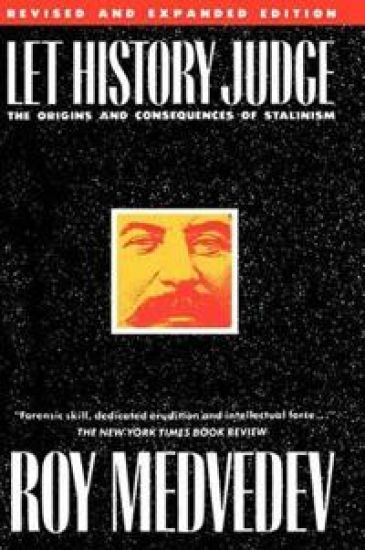
The most comprehensive and revealing investigation of Stalinism and political developments in the Soviet Union from 1922-1953, this edition is an extensively revised and expanded version of a classic work. The internationally known historian Roy Medvedev has included more than one-hundred new interviews, unpublished memoirs, and archives from survivors of Stalin's death camps. This updated version of a classic work was written during a time of great change in the Soviet Union. With the advent of perestroika and glasnost, more progressive leadership has sought to demolish the Stalinist system which had finally crippled the Soviet Union and incited public discontent. Let History Judge contains new material on purges in 1929-1931 and terror against the peasantry; the Kirov assasination and show trials; the "great terror" from 1936-1938, which caused irreparable damage to the Soviet Union and left it vulnerable for Hilter's attack in 1941; the trial of Bukharin; Trotsky's revolutionary activity and Stalin's involvement with his murder in Mexico; Stalin's miscalculations and errors during the war, which cost the Soviet Union nearly 25 million in casualties; new purges from 1946-1953; and the actual vote of the Seventeenth Congress, which decided Stalin's candidacy. Since the first edition was finished by the author in 1969 and published in 1971, dozens of new informants have come forward to give their evidence to Roy Medvedev. Distinguished Soviet literary, cultural, and political figures like the late Alexander Twardovsky, Ilja Ehrenburg, Konstantin Simonov, Yuri Trifono, Mikhail Romm and many others have accumulated documentary records of Stalinism in anticipation of an expanded version.

Roy Medvedev On Soviet Dissent:“At first, the authorities deny that dissent exists; they look astonished if you ask them about it. Then they try to portray every dissident as a criminal who’s been left unmolested only by the clemency of the government. And then, if the culprit refuses to repent, they arrest him and deport or exile him. But they must brand him as a criminal because no dialogue or discussion is possible. You must understand that describing Sakharov and other dissenters as criminals and spies is not an a posteriori cover up, but rather the government’s way of thinking and acting. The government will not and cannot admit that political opposition exists in any form whatever.”
Nikolai Bukharin was one of the most eminent leaders and theoreticians of the Bolsheviks, a man who had become famous long before the Russian Revolution. He was idolized by the youth of Soviet Russia, who identified with him and drew much of their inspiration from his writings. Prominent among the organizers of the revolution, he served for twenty years on the Central Committee and for ten years as a member of the Politburo. From 1917 to 1929 he was in charge of the newspaper Pravda, and though he and Lenin often disagreed, Lenin referred to him in his Testament as “deservedly the favorite of the Party."
Two prominent Soviet dissidents portray Khrushchev in power as a shrewd, complex, decisive, and impetuous innovator, impatient to remedy defects in the Soviet system but carried away by initial successes.