Kirjojen hintavertailu – 12 903 725 kirjaa ja 27 kauppaa

Kirjailija

Rui Diogo

Kirjat ja teokset yhdessä paikassa: 28 kirjaa, julkaisuja vuosilta 2004–2025, suosituimpiin kuuluu Muscular and Skeletal Anomalies in Human Trisomy in an Evo-Devo Context. Vertaile teosten hintoja ja tarkista saatavuus suomalaisista kirjakaupoista.

28 kirjaa

Kirjojen julkaisuvuodet: 2004–2025.

Baby Gorilla

Baby Gorilla

Rui Diogo; Juan F. Pastor; Adam Hartstone-Rose; Magdalena N. Muchlinski

Apple Academic Press Inc.
2014
sidottu
The first photographic and descriptive musculoskeletal atlas of a baby gorilla, this book details the comparative and phylogenetic context of the gross anatomy and evolutionary history of the soft tissue morphology of modern humans and one of their closest relatives. With detailed high-quality photographs of musculoskeletal structures, it provides an updated review of the anatomical variations within gorillas as well as an extensive list of the synonyms used in the literature to designate the structures discussed. It will be of interest to students, teachers, and researchers studying primatology, comparative anatomy, functional morphology, zoology, and physical anthropology.

Photographic and Descriptive Musculoskeletal Atlas of Orangutans

Photographic and Descriptive Musculoskeletal Atlas of Orangutans

Rui Diogo; Josep M. Potau; Juan F. Pastor; Felix J. de Paz; Mercedes Barbosa; Eva M. Ferrero; Gaëlle Bello; Mohammed Ashraf Aziz; Julia Arias-Martorell; Bernard Wood

CRC Press Inc
2013
sidottu
Orangutans, together with chimpanzees and gorillas, are our closest living relatives. Photographic and Descriptive Musculoskeletal Atlas of Orangutans, the first photographic and descriptive musculoskeletal atlas of the genus Pongo, adopts the same format as the photographic atlases of Gorilla, Pan and Hylobates previously published by the same authors. These four books are part of a series of monographs that will set out the comparative and phylogenetic context of the gross anatomy and evolutionary history of the soft tissue morphology of modern humans and their closest relatives. The present atlas, which includes detailed high-quality photographs of musculoskeletal structures from most anatomical regions of the body as well as textual information about the attachments, innervation, function and weight of the respective muscles, is based on dissections of five orangutans and on an extensive review of the literature. It provides an updated review of the anatomical variations within orangutans as well as an extensive list of the synonyms used in the literature to designate the structures we discuss. It will be of interest to students, teachers and researchers studying primatology, comparative anatomy, functional morphology, zoology, and physical anthropology and to medical students, doctors and researchers who are curious about the origin, evolution, homology and variations of the musculoskeletal structures of modern humans.
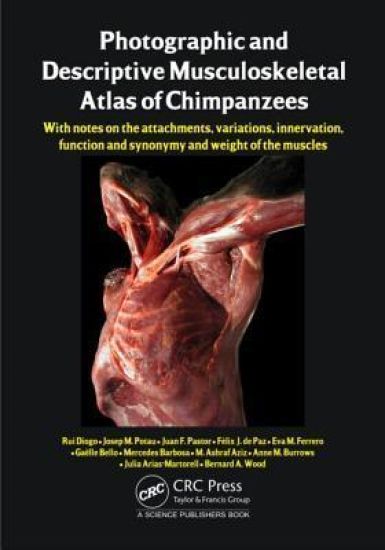
Photographic and Descriptive Musculoskeletal Atlas of Chimpanzees

Photographic and Descriptive Musculoskeletal Atlas of Chimpanzees

Rui Diogo; Josep M. Potau; Juan F. Pastor

CRC Press Inc
2013
sidottu
Chimpanzees, including common chimpanzees and bonobos, are our closest living relatives. This book, which is the first photographic and descriptive musculoskeletal atlas of the genus Pan, adopts the same format as the photographic atlases of Gorilla and Hylobates previously published by the same authors. These three books are part of a series of monographs that will set out the comparative and phylogenetic context of the gross anatomy and evolutionary history of the soft tissue morphology of modern humans and their closest relatives. The atlas, which includes detailed high-quality photographs of musculoskeletal structures from most anatomical regions of the body as well as textual information about the attachments, innervation, function and weight of the respective muscles, is based on dissections of up to 12 chimpanzees and on an extensive review of the literature. It provides an updated review of the anatomical variations within chimpanzees as well as an extensive list of the synonyms used in the literature. The book is designed for students, teachers and researchers studying primatology, comparative anatomy, functional morphology, zoology, and physical anthropology and to medical students, doctors and researchers who are curious about the origin, evolution, homology and variations of the musculoskeletal structures of modern humans.
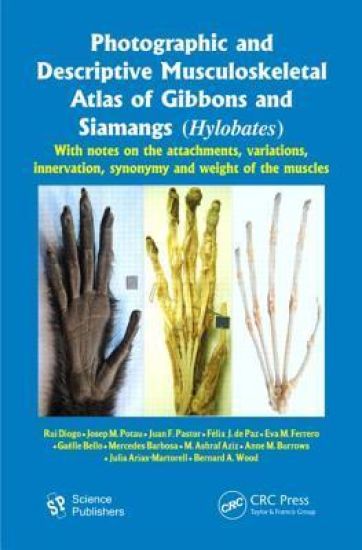
Photographic and Descriptive Musculoskeletal Atlas of Gibbons and Siamangs (Hylobates)

Photographic and Descriptive Musculoskeletal Atlas of Gibbons and Siamangs (Hylobates)

Rui Diogo; Josep M. Potau; Juan F. Pastor; Felix J. dePaz; Eva M. Ferrero; Gaelle Bello; Mercedes Barbosa; M. Ashraf Aziz; Anne M. Burrows; Julia Arias-Martorell; Bernard A. Wood

Science Publishers,U.S.
2012
sidottu
This book is the first photographic and descriptive musculoskeletal atlas of Hylobates, and adopts the same format as the photographic atlas of Gorilla published by the same authors in 2010. These two books are part of a series of monographs that will set out the comparative and phylogenetic context of the gross anatomy and evolutionary history of the soft tissue morphology of modern humans and their closest relatives. This atlas, which includes detailed high-quality photographs of musculoskeletal structures from most anatomical regions of the body as well as textual information about the attachments, innervation and weight of the respective muscles, is based on dissections and on an extensive review of the literature. It provides an updated review of the anatomical variations within hylobatids as well as an extensive list of the synonyms used in the literature to designate the structures we discuss. The atlas will be of interest to students, teachers and researchers studying primatology, comparative anatomy, functional morphology, zoology, and physical anthropology and to medical students, doctors and researchers who are curious about the origin, evolution, homology and variations of the musculoskeletal structures of modern humans.
Comparative Anatomy and Phylogeny of Primate Muscles and Human Evolution

Comparative Anatomy and Phylogeny of Primate Muscles and Human Evolution

Rui Diogo; Bernard A. Wood

Science Publishers,U.S.
2012
sidottu
This book challenges the assumption that morphological data are inherently unsuitable for phylogeny reconstruction, argues that both molecular and morphological phylogenies should play a major role in systematics, and provides the most comprehensive review of the comparative anatomy, homologies and evolution of the head, neck, pectoral and upper limb muscles of primates. Chapters 1 and 2 provide an introduction to the main aims and methodology of the book. Chapters 3 and 4 and Appendices I and II present the data obtained from dissections of the head, neck, pectoral and upper limb muscles of representative members of all the major primate groups including modern humans, and compare these data with the information available in the literature. Appendices I and II provide detailed textual (attachments, innervation, function, variations and synonyms) and visual (high quality photographs) information about each muscle for the primate taxa included in the cladistic study of Chapter 3, thus providing the first comprehensive and up to date overview of the comparative anatomy of the head, neck, pectoral and upper limb muscles of primates. The most parsimonious tree obtained from the cladistic analysis of 166 head, neck, pectoral and upper limb muscle characters in 18 primate genera, and in representatives of the Scandentia, Dermoptera and Rodentia, is fully congruent with the evolutionary molecular tree of Primates, thus supporting the idea that muscle characters are particularly useful to infer phylogenies. The combined anatomical materials provided in this book point out that modern humans have fewer head, neck, pectoral and upper limb muscles than most other living primates, but are consistent with the proposal that facial and vocal communication and specialized thumb movements have probably played an important role in recent human evolution. This book will be of interest to primatologists, comparative anatomists, functional morphologists, zoologists, physical anthropologists, and systematicians, as well as to medical students, physicians and researchers interested in understanding the origin, evolution, homology and variations of the muscles of modern humans. Contains 132 color plates.
Muscles of Vertebrates

Muscles of Vertebrates

Rui Diogo; Virginia Abdala

Science Publishers,U.S.
2010
sidottu
The Vertebrata is one of the most speciose groups of animals, comprising more than 58,000 living species. This book provides a detailed account on the comparative anatomy, development, homologies and evolution of the head, neck, pectoral and forelimb muscles of vertebrates. It includes hundreds of illustrations, as well as numerous tables showing the homologies between the muscles of all the major extant vertebrate taxa, including lampreys, elasmobranchs, hagfish, coelacanths, dipnoans, actinistians, teleosts, halecomorphs, ginglymodians, chondrosteans, caecilians, anurans, urodeles, turtles, lepidosaurs, crocodylians, birds, and mammals such as monotremes, rodents, tree-shrews, flying lemurs and primates, including modern humans. It also provides a list of more than a thousand synonyms that have been used by other authors to designate these muscles in the literature. Importantly, it also reviews data obtained in the fields of evolutionary developmental biology, molecular biology and embryology, and explains how this data helps to understand the evolution and homologies of vertebrate muscles. The book will useful to students, teachers, and researchers working in fields such as functional morphology, ecomorphology, evolutionary developmental biology, zoology, molecular biology, evolution, and phylogeny. As the book includes crucial information about the anatomy, development, homologies, evolution and muscular abnormalities of our own species, Homo sapiens, it will also be helpful to physicians and medical students.
The Origin of Higher Clades

The Origin of Higher Clades

Rui Diogo

Science Publishers,U.S.
2008
nidottu
The book provides insight on the osteology, myology, phylogeny and evolution of Osteichthyes. It not only provides an extensive cladistic analysis of osteichthyan higher-level inter-relationships based on a phylogenetic comparison of 356 characters in 80 extant and fossil terminal taxa representing all major groups of Osteichthyes, but also analyses various terminal taxa and osteological characters. And also provides a general discussion on issues such as the comparative anatomy, homologies and evolution of osteichthyan cranial and pectoral muscles, the development of zebrafish cephalic muscles and the implications for evolutionary developmental studies, the origin homologies and evolution of one of the most peculiar and enigmatic structural complexes of osteichthyans, the Weberian apparatus, and the use of myological versus osteological characters in phylogenetic reconstructions.
Morphological Evolution, Adaptations, Homoplasies, Constraints, and Evolutionary Trends
The major aim of this work is, to help clarify the interrelationships of catfishes, with major implications on the study of the general evolution of these fishes. A great part of this work, therefore, deals with a cladistic analysis of catfish higher-level phylogeny based on extensive morphological data, in which are included some terminal taxa not included in previous analyses, but principally a large number of characters traditionally excluded from those analyses, with particular attention being given to catfish morphology. This analysis gives particular importance to complex, integrated structures. It will be interest to students, ichthyologists and biologists working in evolution, taxonomy and phylogeny.