Kirjojen hintavertailu – 12 903 725 kirjaa ja 27 kauppaa

Kirjailija

Ruqaiya Hasan

Kirjat ja teokset yhdessä paikassa: 14 kirjaa, julkaisuja vuosilta 1989–2019, suosituimpiin kuuluu Verbal Art and Verbal Science. Vertaile teosten hintoja ja tarkista saatavuus suomalaisista kirjakaupoista.

14 kirjaa

Kirjojen julkaisuvuodet: 1989–2019.

Verbal Art and Verbal Science

Verbal Art and Verbal Science

Jonathan J. Webster; M.A.K. Halliday; Ruqaiya Hasan; David Butt

Bloomsbury Academic
2019
sidottu
Over the course of history, humankind has relied on the power of language to impose regularities on experience and bring "the environment more within our power to control." Professor M. A. K. Halliday goes on to refers to this conceptual shifting as "the Knight's move in language." In this joint work, developed in collaboration with the late Professor Ruqaiya Hasan and edited by Professor Jonathan J. Webster, metaphor is used to understand how language manipulates and creates our reality in very real and powerful ways. Whether it is the "art" in verbal art or the "science” in verbal science, through the metaphor-making potential available in language what is being crafted are hypotheses about the world we experience. The semiogenic power of language is so great that it enables us to define "the very basic experience of being human". Halliday adopts Mukarovsky's term "deautomatization" to interpret the grammar in front of you in ways that go beyond its direct relational function. So much scientific theory would not be possible without this semiogenic potential. It is the ability to reconstrue our commonsense version of events into a metaphorical world where things can be observed, investigated and explained. This book highlights the central importance of grammatical metaphor and realigns the connections between the upper strata of meaning and the strata below lexicogrammar.
Cohesion in English

Cohesion in English

M.A.K. Halliday; Ruqaiya Hasan

Routledge
2015
sidottu
Cohesion in English is concerned with a relatively neglected part of the linguistic system: its resources for text construction, the range of meanings that are speciffically associated with relating what is being spoken or written to its semantic environment. A principal component of these resources is 'cohesion'. This book studies the cohesion that arises from semantic relations between sentences. Reference from one to the other, repetition of word meanings, the conjunctive force of but, so, then and the like are considered. Further, it describes a method for analysing and coding sentences, which is applied to specimen texts.
Describing Language

Describing Language

Ruqaiya Hasan

Equinox Publishing Ltd
2019
pokkari
How does one's grammar depend on one's conception of language? In systemic functional linguistics, language is viewed as a meaning potential, thus embracing the view, now supported by contemporary theories of the evolution of human consciousness, that language has evolved in the living of life in society. Using the theoretical framework of systemic functional linguistics, the chapters of this book explore the nature of language, the relations of meaning and society, of form and meaning, and of grammar and lexis. Halliday has referred to the level of lexicogrammar as the powerhouse of language: this is where the resource for creating linguistic meaning resides. But language as resource cannot be adequately described as a set of syntagmatic structures; instead, the primary focus must be on the paradigmatic axis, which after all furnishes the principle for the actualisation of syntagms. Accordingly, aspects of Urdu and English semantics, grammar and lexis are presented here in terms of systemic options, realised as structures.
Describing Language

Describing Language

Ruqaiya Hasan

Equinox Publishing Ltd
2019
sidottu
How does one's grammar depend on one's conception of language? In systemic functional linguistics, language is viewed as a meaning potential, thus embracing the view, now supported by contemporary theories of the evolution of human consciousness, that language has evolved in the living of life in society. Using the theoretical framework of systemic functional linguistics, the chapters of this book explore the nature of language, the relations of meaning and society, of form and meaning, and of grammar and lexis. Halliday has referred to the level of lexicogrammar as the powerhouse of language: this is where the resource for creating linguistic meaning resides. But language as resource cannot be adequately described as a set of syntagmatic structures; instead, the primary focus must be on the paradigmatic axis, which after all furnishes the principle for the actualisation of syntagms. Accordingly, aspects of Urdu and English semantics, grammar and lexis are presented here in terms of systemic options, realised as structures.
Context in the System and Process of Language

Context in the System and Process of Language

Ruqaiya Hasan

Equinox Publishing Ltd
2016
pokkari
The concept context of situation introduced by Malinowski some eighty years ago has now become an essential element of the vocabulary of any linguistic theory whose aim it is to reveal the nature of language. With the abandonment of the spurious distinction between competence and performance, the process of language, i.e., language use, has claimed its rightful place in the study of language. The chapters of this book focus on the relations of context and text, conceptualising the latter as language operative in some recognizable social context. It is argued that context is not simply a backdrop for the occurrence of words; rather, it is an active element which on the one hand plays a crucial role in the progression of human discourse and on the other enters into and shapes the very nature of language as process and as system, furnishing the foundation for functionality in language. Acting as the interface between language and society, context analysis reveals the power of language for creating, maintaining, and changing human relationships.
Context in the System and Process of Language

Context in the System and Process of Language

Ruqaiya Hasan

Equinox Publishing Ltd
2016
sidottu
The concept context of situation introduced by Malinowski some eighty years ago has now become an essential element of the vocabulary of any linguistic theory whose aim it is to reveal the nature of language. With the abandonment of the spurious distinction between competence and performance, the process of language, i.e., language use, has claimed its rightful place in the study of language. The chapters of this book focus on the relations of context and text, conceptualising the latter as language operative in some recognizable social context. It is argued that context is not simply a backdrop for the occurrence of words; rather, it is an active element which on the one hand plays a crucial role in the progression of human discourse and on the other enters into and shapes the very nature of language as process and as system, furnishing the foundation for functionality in language. Acting as the interface between language and society, context analysis reveals the power of language for creating, maintaining, and changing human relationships.
Ways of Saying: Ways of Meaning

Ways of Saying: Ways of Meaning

Ruqaiya Hasan

Bloomsbury Academic
2015
sidottu
This work comprises a collection of the writings of Ruqaiya Hasan, an influential figure in the systemic functional linguistic learning school. It discusses the relation between text and context and the realization of context in language; the ‘network’, which is outlined as analytic tool which can be applied at two strata of language, the lexico-grammatical and the semantic; as well as aspects of the social structure that are implicated in the way cultures and subcultures express themselves.
Language and Education: Learning and Teaching in Society
The last two decades have seen a good deal of work in educational linguistics, which has created a deeper understanding of how language works in different varieties of discourse and what a teacher needs to know for engaging successfully in language education. In this sense, the focus has been largely on instructional discourse - i.e., what is to be taught. The chapters of this book attempt to widen the field by focussing on who is being taught. After all, the true active element in the processes of education is the learner. Children have already acquired specific ways of learning, long before they enter the classroom, and in pluralistic societies learning styles vary systematically across communities. This book argues on the one hand the need to attend to the different voices in the classroom, and on the other to encourage an attitude of enquiry which creates awareness of the power of discourse in maintaining and/or changing societies.
Language and Education: Learning and Teaching in Society
The last two decades have seen a good deal of work in educational linguistics, which has created a deeper understanding of how language works in different varieties of discourse and what a teacher needs to know for engaging successfully in language education. In this sense, the focus has been largely on instructional discourse - i.e., what is to be taught. The chapters of this book attempt to widen the field by focussing on who is being taught. After all, the true active element in the processes of education is the learner. Children have already acquired specific ways of learning, long before they enter the classroom, and in pluralistic societies learning styles vary systematically across communities. This book argues on the one hand the need to attend to the different voices in the classroom, and on the other to encourage an attitude of enquiry which creates awareness of the power of discourse in maintaining and/or changing societies.
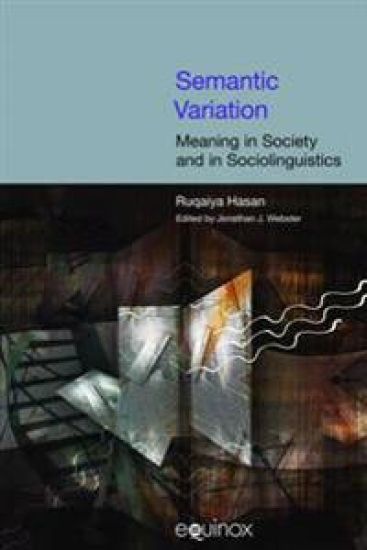
Semantic Variation: Meaning in Society and in Sociolinguistics
The sociolinguistic turn of the 60's has been remarkably successful: variability of language is no longer an issue open to debate. But studies of variation have by and large been restricted to the level of expression. This volume offers a critique of present day sociolinguistic, arguing that since meaning is critical to all contexts of life in society, ignoring it has led to a number of serious problems, foremost among them a mis-conception of the nature of sociolinguistics itself. By examining the possibility of systematic variation at the level of meaning, the volume makes a positive contribution to opening up a debate about the possibility of the neglected/misrepresented notion of semantic variation. Most chapters of the volume present an account of certain aspects of an empirical research which strongly supports the view that systematic variation in the choice of semantic features occurs across different social groups. Mothers and their young children less than four years old showed in their naturally occurring conversation a highly systematic, statistically significant, orientation to distinct styles of meaning, which correlated with their social positioning, and/or with the gender of the children. The comparison of kindergarten teachers' ways of meaning with those of mothers' provides empirical proof that teacher talk is an exaggerated version of middle class mothers' talk. The volume is relevant on the one hand to theoretical issues in linguistics and sociolinguistics and on the other, to any serious discourse about equitable education.
Semantic Variation: Meaning in Society and in Sociolinguistics
The sociolinguistic turn of the 60's has been remarkably successful: variability of language is no longer an issue open to debate. But studies of variation have by and large been restricted to the level of expression. This volume offers a critique of present day sociolinguistic, arguing that since meaning is critical to all contexts of life in society, ignoring it has led to a number of serious problems, foremost among them a mis-conception of the nature of sociolinguistics itself. By examining the possibility of systematic variation at the level of meaning, the volume makes a positive contribution to opening up a debate about the possibility of the neglected/misrepresented notion of semantic variation. Most chapters of the volume present an account of certain aspects of an empirical research which strongly supports the view that systematic variation in the choice of semantic features occurs across different social groups. Mothers and their young children less than four years old showed in their naturally occurring conversation a highly systematic, statistically significant, orientation to distinct styles of meaning, which correlated with their social positioning, and/or with the gender of the children. The comparison of kindergarten teachers' ways of meaning with those of mothers' provides empirical proof that teacher talk is an exaggerated version of middle class mothers' talk. The volume is relevant on the one hand to theoretical issues in linguistics and sociolinguistics and on the other, to any serious discourse about equitable education.
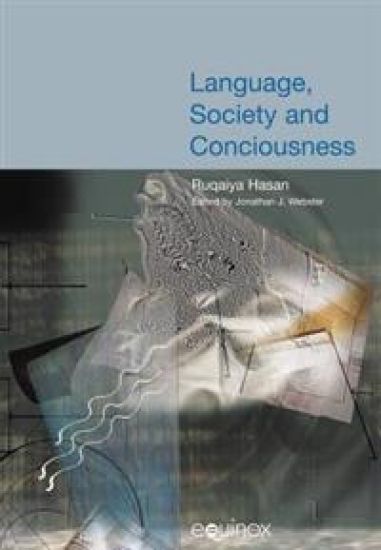
Language, Society and Consciousness

Language, Society and Consciousness

Ruqaiya Hasan

Equinox Publishing Ltd
2005
pokkari
The chapters of this volume explore the intimate relations of society, language and mind: the development of each of these depends on the contribution of the other two. In this sense they are co-genetic: mind has recently been described by the famous neuro-scientist, Susan Greenfield, as 'personalized brain.' The development of human mind depends on what it experiences; for human beings, experience goes beyond sensation: it is made of meaning, and interpretation/meaning, in turn, is construed by the various semiotic modalities, of which language is perhaps the most flexible and most pervasive. But language has itself evolved in the course of attempts to reach an 'other.' By shaping the nature of communication, human relations shape also the nature of language; meanings exchanged in verbal interaction become a major force in shaping forms of consciousness; and our consciousness reveals itself in our cultural practices, our ways of being, doing and saying.
Language, Society and Consciousness

Language, Society and Consciousness

Ruqaiya Hasan

Equinox Publishing Ltd
2005
sidottu
The chapters of this volume explore the intimate relations of society, language and mind: the development of each of these depends on the contribution of the other two. In this sense they are co-genetic: mind has recently been described by the famous neuro-scientist, Susan Greenfield, as 'personalized brain.' The development of human mind depends on what it experiences; for human beings, experience goes beyond sensation: it is made of meaning, and interpretation/meaning, in turn, is construed by the various semiotic modalities, of which language is perhaps the most flexible and most pervasive. But language has itself evolved in the course of attempts to reach an 'other.' By shaping the nature of communication, human relations shape also the nature of language; meanings exchanged in verbal interaction become a major force in shaping forms of consciousness; and our consciousness reveals itself in our cultural practices, our ways of being, doing and saying.