Kirjojen hintavertailu – 12 859 819 kirjaa ja 27 kauppaa

Kirjailija

Russell Jacoby

Kirjat ja teokset yhdessä paikassa: 14 kirjaa, julkaisuja vuosilta 1986–2023, suosituimpiin kuuluu The End Of Utopia. Vertaile teosten hintoja ja tarkista saatavuus suomalaisista kirjakaupoista.

14 kirjaa

Kirjojen julkaisuvuodet: 1986–2023.

Intellectuals in Politics and Academia

Intellectuals in Politics and Academia

Russell Jacoby

Springer International Publishing AG
2023
nidottu
This book addresses the fate of intellectuals in modern culture and politics. Russell Jacoby’s seminal The Last Intellectuals: American Culture in the Age of Academe (1987, 2000) introduced the term “public intellectual” and gave rise to heated controversy. Here Jacoby assesses contemporary public intellectuals, their profound failings and limited achievements. The book includes biting appraisals of well-known intellectuals, such as Noam Chomsky, Hannah Arendt, and Bernard-Henri Lévy, as well as interventions on violence, utopia and multiculturalism.
Intellectuals in Politics and Academia

Intellectuals in Politics and Academia

Russell Jacoby

Springer International Publishing AG
2022
sidottu
This book addresses the fate of intellectuals in modern culture and politics. Russell Jacoby’s seminal The Last Intellectuals: American Culture in the Age of Academe (1987, 2000) introduced the term “public intellectual” and gave rise to heated controversy. Here Jacoby assesses contemporary public intellectuals, their profound failings and limited achievements. The book includes biting appraisals of well-known intellectuals, such as Noam Chomsky, Hannah Arendt, and Bernard-Henri Lévy, as well as interventions on violence, utopia and multiculturalism.
On Diversity

On Diversity

Russell Jacoby

Seven Stories Press,U.S.
2020
sidottu
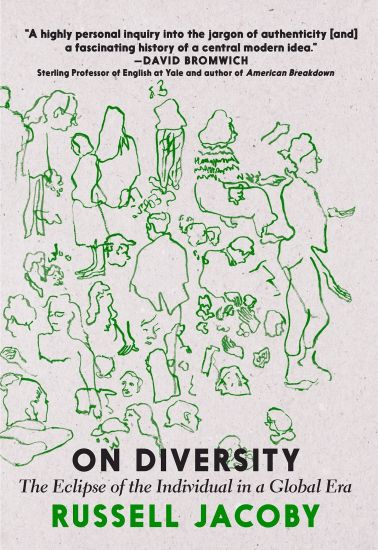
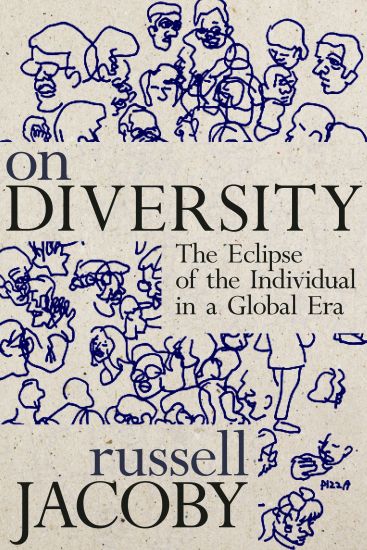
A brilliant examination of a timely concept from one of the nation's great public intellectuals. Diversity. You've heard the term everywhere--in the news, in the universities, at the television awards shows. Maybe even in the corporate world, where diversity initiatives have become de rigueur. But what does the term actually mean? Where does it come from? What are its intellectual precedents? Moreover, how do we square our love affair with diversity with the fact that the world seems to be becoming more and more, well, homogeneous? With a lucid, straightforward prose that rises above the noise, one of America's greatest intellectual gadflies, Russell Jacoby, takes these questions squarely on. Discussing diversity (or lack thereof) in language, fashion, childhood experience, political structure, and the history of ideas, Jacoby offers in plain language a surprising and penetrating analysis of our cultural moment. In an age where our public thinkers seem to be jumping over one another to have the latest correct opinion, Jacoby offers a most dangerous, and liberating, injunction: to stop and think.
Social Amnesia

Social Amnesia

Russell Jacoby

Routledge
2018
sidottu
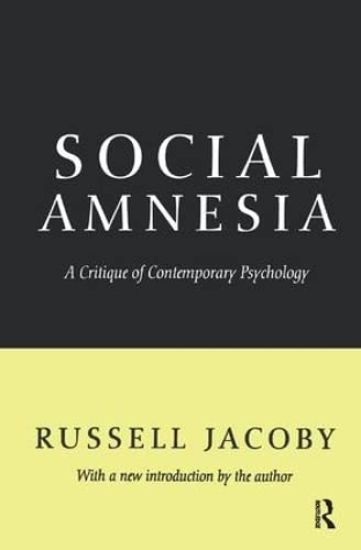
Russell Jacoby defines social amnesia as society's repression of remembrance - society's own past. In this book, Jacoby excavates the critical and historical concepts that have fallen prey to the dynamic of a society that strips them both of their historical and critical content. Social Amnesia is an effort to remember what is perpetually lost under the pressure of society. It is simultaneously a critique of present practices and theories in psychology. Jacoby's new self-evaluation has the same sharp edge as the book itself, offering special insights into the evolution of psychological theory during the past two decades. In his probing, self-critical new introduction, Jacoby maintains that any serious appraisal of psychology or sociology, or any discipline, must seek to separate the political from the theoretical. He discusses how in the years since Social Amnesia was first published society has oscillated from extreme subjectivism to extreme objectivism, which feed off each other and constitute two forms of social amnesia: a forgetting of the past and a pseudo-historical consciousness. Social Amnesia contains a forceful argument for "thinking against the grain - an endeavor that remains as urgent as ever." It is an important work for sociologists, psychologists, and psychoanalysts.
Bloodlust: On the Roots of Violence from Cain and Abel to the Present

Bloodlust: On the Roots of Violence from Cain and Abel to the Present

Russell Jacoby

FREE PRESS
2014
nidottu

Halvin toimitettuna 21,70 €

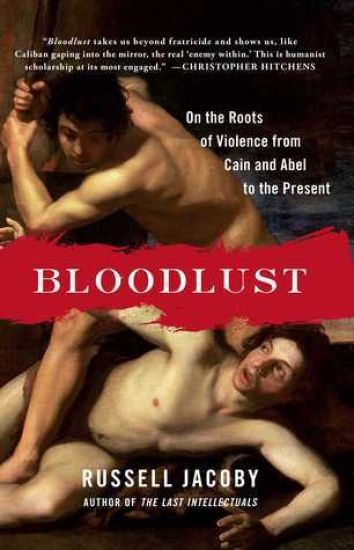
THROUGHOUT HISTORY AND ACROSS CULTURES, the most common form of violence is that between family members and neighbors or kindred communities--in civil wars writ large and small. From assault to genocide, from assassination to massacre, violence usually emerges from inside the fold. You have more to fear from a spouse, an ex-spouse, or a coworker than you do from someone you don't know. In this brilliant polemic, Russell Jacoby argues that violence erupts most often, and most savagely, between those of us most closely related. An Indian nationalist assassinated Mohandas Gandhi, "the father" of India. An Egyptian Muslim assassinated Anwar Sadat, the president of Egypt and a recipient of the Nobel Peace Prize. An Israeli Jew assassinated Yitzhak Rabin, the Israeli prime minister and similarly a recipient of the Nobel Peace Prize. Genocide most often involves kindred groups. The German Christians of the 1930s were so closely intertwined with German Jews that a yellow star was required to tell the groups apart. Serbs and Muslims in Bosnia, like the Hutu and Tutsi in Rwanda, are often indistinguishable even to one another. This idea contradicts both common sense and the collective wisdom of teachers and preachers, who declaim that we fear--and sometimes should fear--the "other," the dangerous stranger. Citizens and scholars alike believe that enemies lurk in the street and beyond, where we confront a "clash of civilizations" with foreigners who challenge our way of life. Jacoby offers a more unsettling truth: it is not so much the unknown that threatens us, but the known. We attack our brothers--our kin, our acquaintances, our neighbors--with far greater regularity and venom than we attack outsiders. Weaving together the biblical story of Cain and Abel, Freud's "narcissism of minor differences," insights on anti-Semitism and misogyny, as well as fresh analysesof "civil" bloodbaths from the St. Bartholomew's Day Massacre in the sixteenth century to genocide and terrorism in our own time, Jacoby turns history inside out to offer a provocative new understanding of violentconfrontation over the centuries. "In thinking about the bad, we reach for the good," he says in his Introduction. This passionate, counterintuitive account affords us an unprecedented insight into the roots of violence.

Picture Imperfect

Picture Imperfect

Russell Jacoby

Columbia University Press
2007
pokkari
"The choice we have is not between reasonable proposals and an unreasonable utopianism. Utopian thinking does not undermine or discount real reforms. Indeed, it is almost the opposite: practical reforms depend on utopian dreaming."--Russell Jacoby, Picture Imperfect Utopianism suffers from an image problem: A recent exhibition on utopias in Paris and New York included photographs of Hitler's Mein Kampf and a Nazi concentration camp. Many observers judge utopians and their sympathizers as foolhardy dreamers at best and murderous totalitarians at worst. However, as noted social critic and historian Russell Jacoby argues in this salient, polemical, and innovative work, not only has utopianism been unfairly characterized, a return to an iconoclastic utopian spirit is vital for today's society. Shaped by the works of Theodor Adorno, Walter Benjamin, Ernst Bloch, Gustav Landauer, and other predominantly Jewish thinkers, iconoclastic utopianism revives society's dormant political imagination and offers hope for a better future. Writing against the grain of history, Jacoby reexamines the anti-utopian mindset and identifies how utopian thought came to be regarded with such suspicion. He challenges standard readings of such anti-utopian classics as 1984 and Brave New World and offers stinging critiques of the influential liberal and anti-utopian theorists Hannah Arendt, Isaiah Berlin, and Karl Popper. He argues that these thinkers mistakenly equate utopianism with totalitarianism. The reputation of utopian thought has also suffered from the failures of, what Jacoby terms, the blueprint utopian tradition and its oppressive emphasis on detailing all aspects of society and providing fantastic images of the future. In contrast, the iconoclastic utopians, like those who follow God's prohibition against graven images, resist both the blueprinters' obsession with detail and the modern seduction of images. Jacoby suggests that by learning from the hopeful spirit of iconoclastic utopians and their willingness to accept new possibilities for society, we open ourselves to new and more imaginative ideas of the future.
Picture Imperfect

Picture Imperfect

Russell Jacoby

Columbia University Press
2005
sidottu
"The choice we have is not between reasonable proposals and an unreasonable utopianism. Utopian thinking does not undermine or discount real reforms. Indeed, it is almost the opposite: practical reforms depend on utopian dreaming."--Russell Jacoby, Picture Imperfect Utopianism suffers from an image problem: A recent exhibition on utopias in Paris and New York included photographs of Hitler's Mein Kampf and a Nazi concentration camp. Many observers judge utopians and their sympathizers as foolhardy dreamers at best and murderous totalitarians at worst. However, as noted social critic and historian Russell Jacoby argues in this salient, polemical, and innovative work, not only has utopianism been unfairly characterized, a return to an iconoclastic utopian spirit is vital for today's society. Shaped by the works of Theodor Adorno, Walter Benjamin, Ernst Bloch, Gustav Landauer, and other predominantly Jewish thinkers, iconoclastic utopianism revives society's dormant political imagination and offers hope for a better future. Writing against the grain of history, Jacoby reexamines the anti-utopian mindset and identifies how utopian thought came to be regarded with such suspicion. He challenges standard readings of such anti-utopian classics as 1984 and Brave New World and offers stinging critiques of the influential liberal and anti-utopian theorists Hannah Arendt, Isaiah Berlin, and Karl Popper. He argues that these thinkers mistakenly equate utopianism with totalitarianism. The reputation of utopian thought has also suffered from the failures of, what Jacoby terms, the blueprint utopian tradition and its oppressive emphasis on detailing all aspects of society and providing fantastic images of the future. In contrast, the iconoclastic utopians, like those who follow God's prohibition against graven images, resist both the blueprinters' obsession with detail and the modern seduction of images. Jacoby suggests that by learning from the hopeful spirit of iconoclastic utopians and their willingness to accept new possibilities for society, we open ourselves to new and more imaginative ideas of the future.
White Collar

White Collar

C. Wright Mills; Russell Jacoby

Oxford University Press Inc
2002
nidottu

Halvin toimitettuna 25,70 €

In print for fifty years, White Collar by C. Wright Mills is considered a standard on the subject of the new middle class in twentieth-century America. This landmark volume demonstrates how the conditions and styles of middle class life--originating from elements of both the newer lower and upper classes--represent modern society as a whole. By examining white-collar life, Mills aimed to learn something about what was becoming more typically "American" than the once-famous Western frontier character. He painted a picture instead of a society that had evolved into a business-based milieu, viewing America instead as a great salesroom, an enormous file, and a new universe of management. Russell Jacoby, author of The End of Utopia and The Last Intellectuals, contributes a new Afterword to this edition, in which he reflects on the impact White Collar had at its original publication and considers what it means to our society today. "A book that persons of every level of the white collar pyramid should read and ponder. It will alert them to their condition for their better salvation."-Horace M. Kaellen, The New York Times (on the first edition)
Dialectic of Defeat

Dialectic of Defeat

Russell Jacoby

Cambridge University Press
2002
pokkari

Halvin toimitettuna 32,90 €

Observing that for both revolutionaries and capitalists, nothing succeeds like success, Russell Jacoby asks us to reexamine a loser of Marxism: the unorthodox Marxism of Western Europe. The author begins with a polemical attack on ‘conformist’ or orthodox Marxism, in which he includes structuralist schools. He argues that a cult of success and science drained this Marxism of its critical impulse and that the successes of the Russian and Chinese revolutions encouraged a mechanical and fruitless mimicry. He then turns to a Western alternative that neither succumbed to the spell of success nor obliterated the individual in the name of science. In the nineteenth century, this Western Marxism already diverged from Russian Marxism in its interpretation of Hegel and its evaluation of Engels’ orthodox Marxism. The author follows the evolution of this minority tradition and its opposition to authoritarian forms of political theory and practice.
The Last Intellectuals

The Last Intellectuals

Russell Jacoby

Basic Books
2000
pokkari
This provocative book chronicles the disappearance of the public intellectual in America. For over thirty years, the cultural landscape has been dominated by the generation of Irving Howe, Daniel Bell, and John Kenneth Galbraith no younger group has arisen to succeed them. Unlike earlier intellectuals who lived in urban bohemias and wrote for the educated public, today's thinkers have flocked to the universities, where the politics of tenure loom larger than the politics of culture. In an incisive and passionate polemic, Russell Jacoby examines how gentrification, suburbanization, and academic careerism have sapped the vitality of American intellectual life.
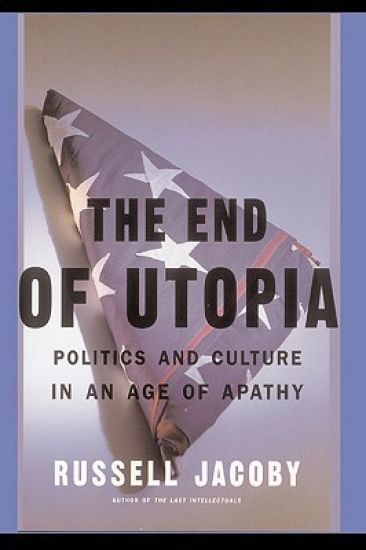
The End Of Utopia

The End Of Utopia

Russell Jacoby

Basic Books
2000
pokkari
We are facing the end of politics altogether, Russell Jacoby argues in The End of Utopia. Political contestation is premised on people's capacity for offering competing visions of the future, but in a world that has run out of political ideas and no longer harbors any utopian visions, real political opposition is no longer possible. In particular, Jacoby traces the demise of liberal and leftist politics. Leftist intellectuals and critics no longer envision a different society, only a modified one. The left once dismissed the market as exploitative, but now honors it as rational and humane. The left used to disdain mass culture, but now celebrates it as rebellious. The left once rejected pluralism as superficial, but now resurrects pluralist ideas in the guise of multiculturalism. Ranging across a wide terrain of cultural and political phenomena,the end of the Cold War, the rise of multiculturalism, the acceptance of mass culture, the eclipse of independent intellectuals,Jacoby documents and laments a widespread retreat from the utopian spirit that has always been the engine for social and political change.
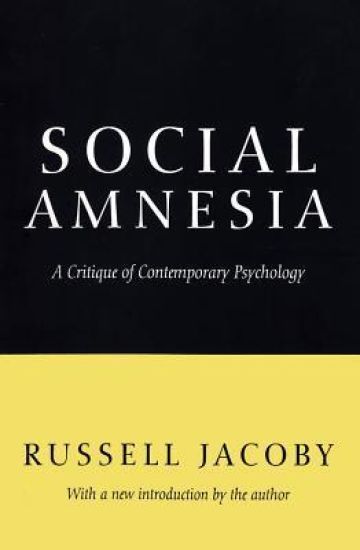
Social Amnesia

Social Amnesia

Russell Jacoby

Transaction Publishers
1996
nidottu
Russell Jacoby defines social amnesia as society's repression of remembrance - society's own past. In this book, Jacoby excavates the critical and historical concepts that have fallen prey to the dynamic of a society that strips them both of their historical and critical content. Social Amnesia is an effort to remember what is perpetually lost under the pressure of society. It is simultaneously a critique of present practices and theories in psychology. Jacoby's new self-evaluation has the same sharp edge as the book itself, offering special insights into the evolution of psychological theory during the past two decades. In his probing, self-critical new introduction, Jacoby maintains that any serious appraisal of psychology or sociology, or any discipline, must seek to separate the political from the theoretical. He discusses how in the years since Social Amnesia was first published society has oscillated from extreme subjectivism to extreme objectivism, which feed off each other and constitute two forms of social amnesia: a forgetting of the past and a pseudo-historical consciousness. Social Amnesia contains a forceful argument for "thinking against the grain - an endeavor that remains as urgent as ever." It is an important work for sociologists, psychologists, and psychoanalysts.
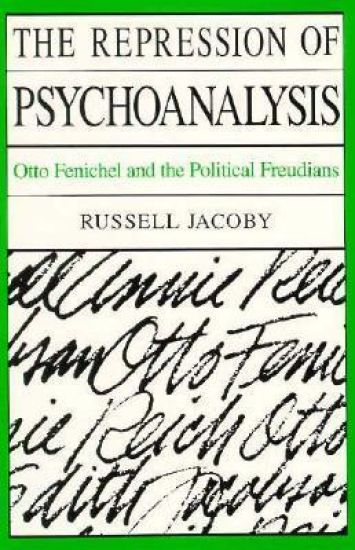
The Repression of Psychoanalysis

The Repression of Psychoanalysis

Russell Jacoby

University of Chicago Press
1986
nidottu
By examining the private correspondence of a circle of German psychoanalyst emigrés that included Otto Fenichel, Annie Reich, and Edith Jacobson, Russell Jacoby recaptures the radical zeal of classical analysis and the efforts of the Fenichel group to preserve psychoanalysis as a social and political theory, open to a broad range of intellectuals regardless of their medical background. In tracing this effort, he illuminates the repression by psychoanalysis of its own radical past and its transformation into a narrow medical technique. This book is of critical interest to the general reader as well as to psychoanalytic historians, theorists, and therapists.