Kirjailija
S Baring-Gould
Kirjat ja teokset yhdessä paikassa: 487 kirjaa, julkaisuja vuosilta 1996–2026, suosituimpiin kuuluu Cliff Castles and Cave Dwellings of Europe (1911). Vertaile teosten hintoja ja tarkista saatavuus suomalaisista kirjakaupoista.
Nimi esiintyy myös muodoissa: S. Baring-Gould, S. Baring Gould, S Baring Gould, S Baring- Gould
487 kirjaa
Kirjojen julkaisuvuodet: 1996–2026.
The Reverend Sabine Baring-Gould (28 January 1834 - 2 January 1924) of Lew Trenchard in Devon, England, was an Anglican priest, hagiographer, antiquarian, novelist, folk song collector and eclectic scholar. His bibliography consists of more than 1240 publications, though this list continues to grow. His family home, the manor house of Lew Trenchard, near Okehampton, Devon, has been preserved as he had it rebuilt and is now a hotel. He is remembered particularly as a writer of hymns, the best-known being "Onward, Christian Soldiers" and "Now the Day Is Over". He also translated the carol "Gabriel's Message" from the Basque language to English. Baring-Gould wrote many novels, including The Broom-Squire set in the Devil's Punch Bowl (1896), Mehalah: a story of the salt marshes (1880), Guavas the Tinner (1897), the 16-volume The Lives of the Saints, and the biography of the eccentric poet-vicar of Morwenstow, Robert Stephen Hawker. He also published nearly 200 short stories in assorted magazines and periodicals. Many of these short stories were collected together and republished as anthologies, such as his Book of Ghosts (1904), Dartmoor Idyllys (1896), and In a Quiet Village (1900). His folkloric studies resulted in The Book of Were-Wolves (1865), one of the most frequently cited studies of lycanthropy. He habitually wrote while standing, and his desk can be seen in the manor. One of his most enduringly popular works was Curious Myths of the Middle Ages, first published in two parts during 1866 and 1868, and republished in many other editions since then. "Each of the book's twenty-four chapters deals with a particular medieval superstition and its variants and antecedents," writes critic Steven J. Mariconda. H. P. Lovecraft termed it "that curious body of medieval lore which the late Mr. Baring-Gould so effectively assembled in book form." ... (wikipedia.org)
This book has been considered by academicians and scholars of great significance and value to literature. This forms a part of the knowledge base for future generations. So that the book is never forgotten we have represented this book in a print format as the same form as it was originally first published. Hence any marks or annotations seen are left intentionally to preserve its true nature.
The lives of the British saints; the saints of Wales and Cornwall and such Irish saints as have dedications in Britain (Volume III)
S Baring-Gould; John Fisher
Alpha Edition
2019
pokkari
The lives of the British saints; the saints of Wales and Cornwall and such Irish saints as have dedications in Britain (Volume II)
S Baring-Gould; John Fisher
Alpha Edition
2019
pokkari
This book has been considered by academicians and scholars of great significance and value to literature. This forms a part of the knowledge base for future generations. So that the book is never forgotten we have represented this book in a print format as the same form as it was originally first published. Hence any marks or annotations seen are left intentionally to preserve its true nature.
The lives of the British saints (Volume IV); the saints of Wales and Cornwall and such Irish saints as have dedications in Britain
S Baring-Gould
Alpha Edition
2019
pokkari
This book has been considered by academicians and scholars of great significance and value to literature. This forms a part of the knowledge base for future generations. We have represented this book in the same form as it was first published. Hence any marks seen are left intentionally to preserve its true nature.
The Village Pulpit: Volume II.
S. Baring-Gould
Createspace Independent Publishing Platform
2018
nidottu
SERMON XXXVII. CHRISTIAN UNITY. (Trinity Sunday.) S. Matt. xxviii. 19. "In the Name of the Father, and of the Son, and of the Holy Ghost." SERMON XXXVIII. GREAT SURPRISES. (1st Sunday after Trinity.) S. Luke xv. 23. "In hell he lift up his eyes, being in torments." SERMON XXXIX. THE HOLY COMMUNION. (2nd Sunday after Trinity.) S. Luke xiv. 16. "A certain man made a great supper."
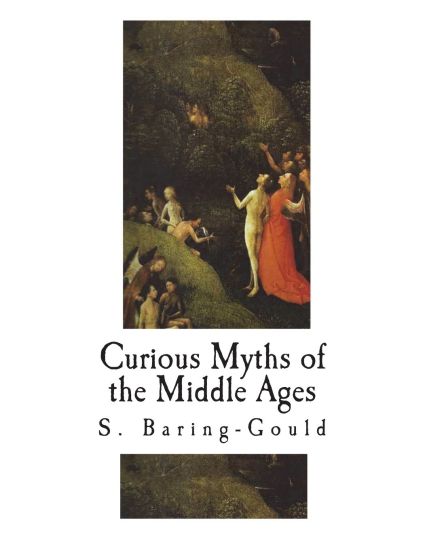
Curious Myths of the Middle Ages
S. Baring-Gould
Createspace Independent Publishing Platform
2018
nidottu
Curious Myths of the Middle Ages by S. Baring-Gould. The Reverend Sabine Baring-Gould, 28 January 1834 - 2 January 1924, of Lew Trenchard in Devon, England, was an Anglican priest, hagiographer, antiquarian, novelist, folk song collector and eclectic scholar. His bibliography consists of more than 1240 publications, though this list continues to grow. His family home, the manor house of Lew Trenchard, near Okehampton, Devon, has been preserved as he had it rebuilt and is now a hotel. One of his most enduringly popular works was Curious Myths of the Middle Ages, first published in two parts during 1866 and 1868, and republished in many other editions since then. "Each of the book's chapters deals with a particular medieval superstition and its variants and antecedents," writes critic Steven J. Mariconda. H. P. Lovecraft termed it "that curious body of medieval lore which the late Mr. Baring-Gould so effectively assembled in book form." Includes: The Wandering Jew, Prester John, The Divining Rod, The Seven Sleepers of Ephesus, William Tell, The Dog Gellert, Tailed Men, Antichrist and Pope Joan, The Man in the Moon, The Mountain of Venus, Fatality of Numbers and The Terrestrial Paradise.
The forest had become very still. Every wood noise held its breath. I felt the dogs pressing against my legs. They too were silent; but every muscle in their bodies trembled, their hair was stiff along their backs and their eyes, fixed on the falling lights, were filmed with the terror glaze. I looked at Anderson. He was staring at the North where once more the beam had pulsed upward. "It can't be the aurora," I spoke without moving my lips. My mouth was as dry as though Lao T'zai had poured his fear dust down my throat. "If it is I never saw one like it," he answered in the same tone. "Besides who ever heard of an aurora at this time of the year?" He voiced the thought that was in my own mind. "It makes me think something is being hunted up there," he said, "an unholy sort of hunt-it's well for us to be out of range."