Kirjojen hintavertailu – 12 903 725 kirjaa ja 27 kauppaa

Kirjailija

S. N. Eisenstadt

Kirjat ja teokset yhdessä paikassa: 17 kirjaa, julkaisuja vuosilta 1984–2024, suosituimpiin kuuluu Japanese Models Of Conflict Resolution. Vertaile teosten hintoja ja tarkista saatavuus suomalaisista kirjakaupoista.

Nimi esiintyy myös muodoissa: S.N. Eisenstadt, S N Eisenstadt

17 kirjaa

Kirjojen julkaisuvuodet: 1984–2024.

Japanese Models Of Conflict Resolution

Japanese Models Of Conflict Resolution

S.N. Eisenstadt; Eyal Ben-Ari

Routledge
2016
nidottu
First Published in 1990. This book forms part of the growing literature on aspects of conflict and conflict management in Japanese society. The explicit aim which has guided the volume's creation, however, has been to add a comparative perspective to this expanding stream of scholarly studies.
Japanese Models Of Conflict Resolution

Japanese Models Of Conflict Resolution

S.N. Eisenstadt; Eyal Ben-Ari

Kegan Paul
1990
sidottu
First Published in 1990. This book forms part of the growing literature on aspects of conflict and conflict management in Japanese society. The explicit aim which has guided the volume's creation, however, has been to add a comparative perspective to this expanding stream of scholarly studies.
The Transformation Of Israeli Society

The Transformation Of Israeli Society

S. N. Eisenstadt; S N Eisenstadt

TAYLOR FRANCIS LTD
2024
nidottu
This book discusses the development and organization of the major spheres of life of Israeli society. It analyses major aspects and trends of development of Israeli society which have been taking place continuously since its beginning, from the early period of Zionist settlement in Eretz Israel.
The Absorption of Immigrants

The Absorption of Immigrants

S.N. Eisenstadt

TAYLOR FRANCIS LTD
2024
nidottu
The Absorption of Immigrants (1954) examines the assimilation of immigrants in the Yishuv (the Jewish Community in Palestine) and in the State of Israel. It provides a historical analysis of the social structure of the Yishuv and of the development of the new Israeli society. The book also applies the general framework to the analysis of some main types of modern migrations and a series of tentative conclusions is given which may serve as detailed hypotheses for subsequent inquiries. In this way a comparative study of different types of migrations and absorption of immigrants is built up, and an objective evaluation can be made of the place of an Israeli Society among other communities, and their special ways of absorbing new immigrants.
The Absorption of Immigrants

The Absorption of Immigrants

S.N. Eisenstadt

TAYLOR FRANCIS LTD
2022
sidottu
The Absorption of Immigrants (1954) examines the assimilation of immigrants in the Yishuv (the Jewish Community in Palestine) and in the State of Israel. It provides a historical analysis of the social structure of the Yishuv and of the development of the new Israeli society. The book also applies the general framework to the analysis of some main types of modern migrations and a series of tentative conclusions is given which may serve as detailed hypotheses for subsequent inquiries. In this way a comparative study of different types of migrations and absorption of immigrants is built up, and an objective evaluation can be made of the place of an Israeli Society among other communities, and their special ways of absorbing new immigrants.
The Transformation Of Israeli Society

The Transformation Of Israeli Society

S. N. Eisenstadt; S N Eisenstadt

Routledge
2019
sidottu
This book discusses the development and organization of the major spheres of life of Israeli society. It analyses major aspects and trends of development of Israeli society which have been taking place continuously since its beginning, from the early period of Zionist settlement in Eretz Israel.
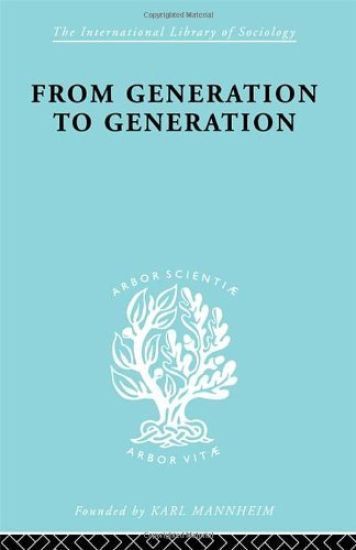
From Generation to Generation

From Generation to Generation

S. N. Eisenstadt

Routledge
2013
nidottu
First published in 1998. This is Volume IX of the fifteen in the Sociology of Gender and the Family series and explores age groups and social structure from generation to generation. The purpose of this book is to analyze the various social phenomena known as age groups, youth movements, etc., and to ascertain whether it is possible to specify the social conditions under which they arise or the types of societies in which they occur. It is the m ain thesis of this book that the existence of these groups is n o t fortuitous or random , and that they arise and exist only under very specific social conditions. The authors have also attempted to show that the analysis of these conditions is not only of purely antiquarian or ethnological interest, but that it can also shed light on the understanding of the conditions of stability and continuity of social systems.
Triumph and Trauma

Triumph and Trauma

Bernhard Giesen; S. N. Eisenstadt

Paradigm
2004
sidottu
This book deals with triumphant and tragic heroes, with victims and perpetrators as archetypes of the Western imagination. A major recent change in Western societies is that memories of triumphant heroism-for example, the revolutionary uprising of the people-are increasingly replaced by the public remembrance of collective trauma of genocide, slavery and expulsion. The first part of the book deals with the heroes and victims and explores the social construction of charisma and its inevitable decay. Part 2 focuses on a paradigm case of the collective trauma of perpetrators: German national identity between 1945 and 2000. After a time of latency, the legacy of nationalistic trauma was addressed in a public conflict between generations. The conflict took center stage in vivid public debates and became a core element of Germany's official political culture. Today public confessions of the guilt of the past have spread beyond the German case. They are part of a new post-utopian pattern of collective identity in a globalised setting.
Triumph and Trauma

Triumph and Trauma

Bernhard Giesen; S. N. Eisenstadt

Paradigm
2004
nidottu
This book deals with triumphant and tragic heroes, with victims and perpetrators as archetypes of the Western imagination. A major recent change in Western societies is that memories of triumphant heroism-for example, the revolutionary uprising of the people-are increasingly replaced by the public remembrance of collective trauma of genocide, slavery and expulsion. The first part of the book deals with the heroes and victims and explores the social construction of charisma and its inevitable decay. Part 2 focuses on a paradigm case of the collective trauma of perpetrators: German national identity between 1945 and 2000. After a time of latency, the legacy of nationalistic trauma was addressed in a public conflict between generations. The conflict took center stage in vivid public debates and became a core element of Germany's official political culture. Today public confessions of the guilt of the past have spread beyond the German case. They are part of a new post-utopian pattern of collective identity in a globalised setting.
Fundamentalism, Sectarianism, and Revolution

Fundamentalism, Sectarianism, and Revolution

S. N. Eisenstadt

Cambridge University Press
2000
pokkari
Fundamentalism, Sectarianism, and Revolution is a major comparative analysis of fundamentalist movements in cultural and political context, with an emphasis on the contemporary scene. Leading sociologist S. N. Eisenstadt examines the meaning of the global rise of fundamentalism as one very forceful contemporary response to tensions in modernity and the dynamics of civilization. He compares modern fundamentalist movements with the proto-fundamentalist movements which arose in the ‘axial civilizations’ in pre-modern times; he shows how the great revolutions in Europe which arose in connection with these movements shaped the political and cultural programmes of modernity; and he contrasts post-Second World War Moslem, Jewish and Protestant fundamentalist movements with communal national movements, notably in Asia. The central theme of the book is the distinctively Jacobin features of fundamentalist movements and their ambivalent attitude to tradition: above all their attempts to essentialize tradition in an ideologically totalistic way. Eisenstadt has won the Amalfi book prize.
Fundamentalism, Sectarianism, and Revolution

Fundamentalism, Sectarianism, and Revolution

S. N. Eisenstadt

Cambridge University Press
2000
sidottu
Fundamentalism, Sectarianism, and Revolution is a major comparative analysis of fundamentalist movements in cultural and political context, with an emphasis on the contemporary scene. Leading sociologist S. N. Eisenstadt examines the meaning of the global rise of fundamentalism as one very forceful contemporary response to tensions in modernity and the dynamics of civilization. He compares modern fundamentalist movements with the proto-fundamentalist movements which arose in the 'axial civilizations' in pre-modern times; he shows how the great revolutions in Europe which arose in connection with these movements shaped the political and cultural programmes of modernity; and he contrasts post-Second World War Moslem, Jewish and Protestant fundamentalist movements with communal national movements, notably in Asia. The central theme of the book is the distinctively Jacobin features of fundamentalist movements and their ambivalent attitude to tradition: above all their attempts to essentialize tradition in an ideologically totalistic way. Eisenstadt has won the Amalfi book prize.
Japanese Civilization

Japanese Civilization

S. N. Eisenstadt

University of Chicago Press
1998
nidottu
This is a synthesis of Japanese history, religion, culture and social organization. The book explores the Japanese historical legacy and its impact on the Japanese experience of modernity, eschewing the polemicism of structuralist or culturalist approaches in favour of a systematic, broadly comparative analysis. What emerges is a focus on the non-ideological character of Japanese civilization as well as its infinite capacity to recreate community through an ongoing past.
From Generation to Generation

From Generation to Generation

S. N. Eisenstadt

Routledge
1998
sidottu
First published in 1998. This is Volume IX of the fifteen in the Sociology of Gender and the Family series and explores age groups and social structure from generation to generation. The purpose of this book is to analyze the various social phenomena known as age groups, youth movements, etc., and to ascertain whether it is possible to specify the social conditions under which they arise or the types of societies in which they occur. It is the m ain thesis of this book that the existence of these groups is n o t fortuitous or random , and that they arise and exist only under very specific social conditions. The authors have also attempted to show that the analysis of these conditions is not only of purely antiquarian or ethnological interest, but that it can also shed light on the understanding of the conditions of stability and continuity of social systems.
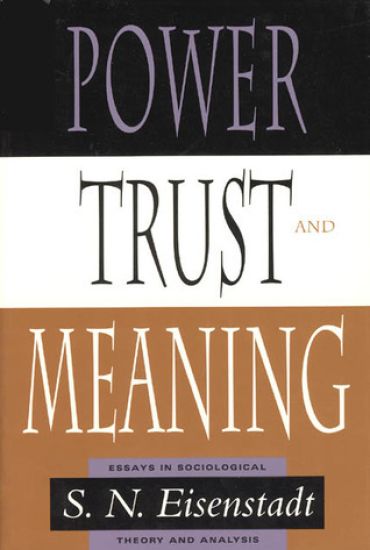
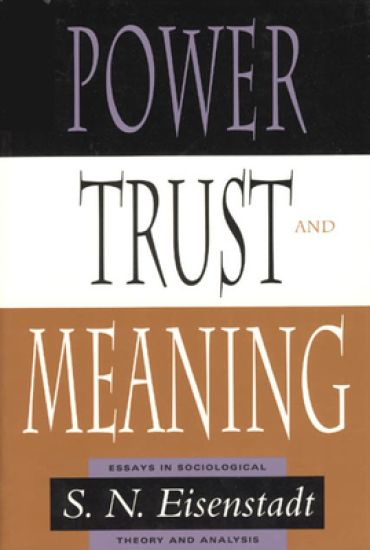
Power, Trust, and Meaning

Power, Trust, and Meaning

S. N. Eisenstadt

University of Chicago Press
1995
nidottu
This collection of 12 theoretical essays explore the bases of human action and society, and trace the major developments of contemporary sociological theory and analysis. Examining themes of trust and solidarity among immigrants, youth groups and generations, in the forms of friendship, kinship, and patron-client relationships, Eisenstadt explores larger questions of social structure and agency, conflict and change, and the reconstitution of the social order. He looks also at political and religious systems, paying attention to historical empires and the major civilizations. United by what they reveal about three major dimensions of social life - power, trust and meaning - these essays offer a perspective on the relations between culture and social structure.

Power, Trust, and Meaning

Power, Trust, and Meaning

S. N. Eisenstadt

University of Chicago Press
1995
sidottu
This collection of 12 theoretical essays explore the bases of human action and society, and trace the major developments of contemporary sociological theory and analysis. Examining themes of trust and solidarity among immigrants, youth groups and generations, in the forms of friendship, kinship, and patron-client relationships, Eisenstadt explores larger questions of social structure and agency, conflict and change, and the reconstitution of the social order. He looks also at political and religious systems, paying attention to historical empires and the major civilizations. United by what they reveal about three major dimensions of social life - power, trust and meaning - these essays offer a perspective on the relations between culture and social structure.

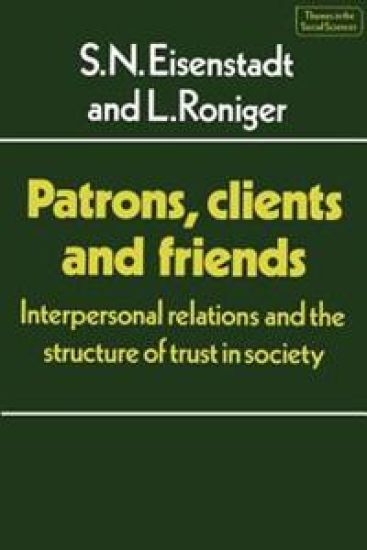
Patrons, Clients and Friends

Patrons, Clients and Friends

S. N. Eisenstadt; Roniger Luis

Cambridge University Press
1984
pokkari
This text analyzes ritual kinship, patron-client relations and friendship, looking at them as mechanisms of social exchange, examining their impact on the institutional structures in which they exist, and assessing the significance of the variations in their occurrence.