Kirjojen hintavertailu – 12 903 725 kirjaa ja 27 kauppaa

Kirjailija

S. S. Iyengar

Kirjat ja teokset yhdessä paikassa: 14 kirjaa, julkaisuja vuosilta 1998–2026, suosituimpiin kuuluu Artificial Intelligence in Practice. Vertaile teosten hintoja ja tarkista saatavuus suomalaisista kirjakaupoista.

Nimi esiintyy myös muodoissa: S.S. Iyengar, S S Iyengar

14 kirjaa

Kirjojen julkaisuvuodet: 1998–2026.

Artificial Intelligence in Practice

Artificial Intelligence in Practice

S.S. Iyengar; Seyedsina Nabavirazavi; Yashas Hariprasad; Prasad HB; C. Krishna Mohan

Springer International Publishing AG
2026
Nidottu
This book provides a comprehensive exploration of how Artificial Intelligence (AI) is being applied in the fields of cyber security and digital forensics. The book delves into the cutting-edge techniques that are reshaping the way we protect and investigate digital information. From identifying cyber threats in real-time to uncovering hidden evidence in complex digital cases, this book offers practical insights and real-world examples. Whether you’re a professional in the field or simply interested in understanding how AI is revolutionizing digital security, this book will guide you through the latest advancements and their implications for the future. Includes application of AI in solving real cyber security and digital forensics challenges, offering tangible examples; Shows how AI methods from machine / deep learning to NLP can be used for cyber defenses and in forensic investigations; Explores emerging trends and future possibilities, helping readers stay ahead of the curve in a rapidly evolving field.

Artificial Intelligence in Practice

Artificial Intelligence in Practice

S.S. Iyengar; Seyedsina Nabavirazavi; Yashas Hariprasad; Prasad HB; C. Krishna Mohan

Springer International Publishing AG
2025
sidottu
This book provides a comprehensive exploration of how Artificial Intelligence (AI) is being applied in the fields of cyber security and digital forensics. The book delves into the cutting-edge techniques that are reshaping the way we protect and investigate digital information. From identifying cyber threats in real-time to uncovering hidden evidence in complex digital cases, this book offers practical insights and real-world examples. Whether you’re a professional in the field or simply interested in understanding how AI is revolutionizing digital security, this book will guide you through the latest advancements and their implications for the future. Includes application of AI in solving real cyber security and digital forensics challenges, offering tangible examples;Shows how AI methods from machine / deep learning to NLP can be used for cyber defenses and in forensic investigations;Explores emerging trends and future possibilities, helping readers stay ahead of the curve in a rapidly evolving field.
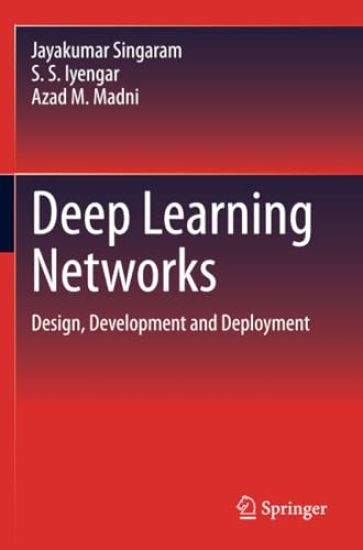
Deep Learning Networks

Deep Learning Networks

Jayakumar Singaram; S. S. Iyengar; Azad M. Madni

Springer International Publishing AG
2024
nidottu
This textbook presents multiple facets of design, development and deployment of deep learning networks for both students and industry practitioners.
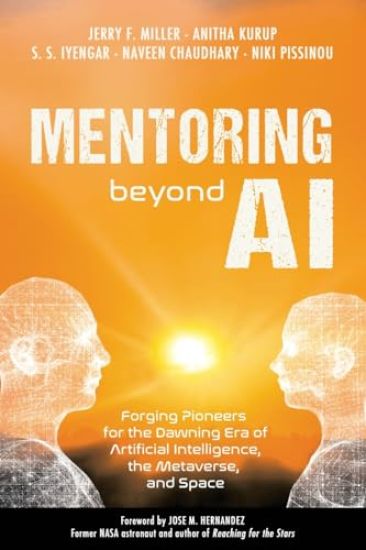
Mentoring Beyond AI

Mentoring Beyond AI

Jerry F Miller; Anitha Kurup; S S Iyengar

Quest Publishing
2024
pokkari
This book not only covers the "tools of the trade" (mentoring how-to), it also examines mentoring's ancient origins since Homer's Odyssey, and peers into its future in virtual and outer space. Mentors are not born; they are mentees first and they evolve through trials and tribulations to success, to pass on their accumulated knowledge so the next generation can carry the torch yet farther. Such has been the experience of every known brilliant scientist in history. While they possessed the seeds of intellect and passion, they were nurtured to greatness by building on the wisdom and successes of others before them. Filled with the authors' case studies and anecdotes from contributors, this book explores how we humans learn and pass on wisdom to those that follow. It explores the "mentoring mindset" needed to retrieve and transfer knowledge to the willing ears of mentees as they reach beyond even our newest frontier that is artificial intelligence. Look for answers in the book to questions like these: How do mentees benefit from their mentors? What are the characteristics of a good mentor? How are bright minds enabled to realize breakthroughs? What are mentoring's origins and trends?
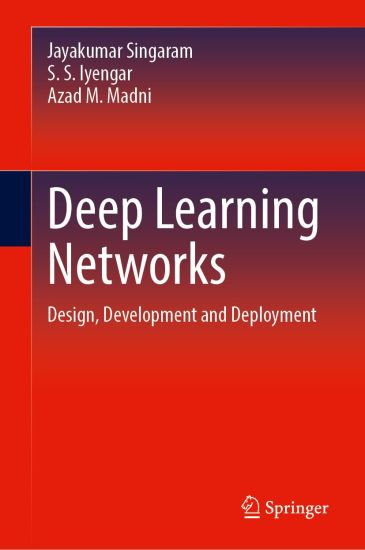
Deep Learning Networks

Deep Learning Networks

Jayakumar Singaram; S. S. Iyengar; Azad M. Madni

Springer International Publishing AG
2023
sidottu

Halvin toimitettuna 126,50 €

This textbook presents multiple facets of design, development and deployment of deep learning networks for both students and industry practitioners. It introduces a deep learning tool set with deep learning concepts interwoven to enhance understanding. It also presents the design and technical aspects of programming along with a practical way to understand the relationships between programming and technology for a variety of applications. It offers a tutorial for the reader to learn wide-ranging conceptual modeling and programming tools that animate deep learning applications. The book is especially directed to students taking senior level undergraduate courses and to industry practitioners interested in learning about and applying deep learning methods to practical real-world problems.
Evolution of Smart Sensing Ecosystems with Tamper Evident Security

Evolution of Smart Sensing Ecosystems with Tamper Evident Security

Pawel Sniatala; S.S. Iyengar; Sanjeev Kaushik Ramani

Springer Nature Switzerland AG
2022
nidottu
This book presents an overview on security and privacy issues in dynamic sensor networks and Internet of Things (IoT) networks and provides a novel tamper evident technique to counter and defend against these security related issues. The mission of this book is to explain the evolution of techniques and strategies in securing information transfer and storage thus facilitating a digital transition towards the modern tamper evident systems. The goal is also to aid business organizations that are dependent on the analysis of the large volumes of generated data in securing and addressing the associated growing threat of attackers relentlessly waging attacks and the challenges in protecting the confidentiality, integrity and provenance of data. The book also provides a comprehensive insight into the secure communication techniques and tools that have evolved and the impact they have had in supporting and flourishing the business through the cyber era. This book also includes chapters that discuss the most primitive encryption schemes to the most recent use of homomorphism in ensuring the privacy of the data thus leveraging greater use of new technologies like cloud computing and others.
Evolution of Smart Sensing Ecosystems with Tamper Evident Security

Evolution of Smart Sensing Ecosystems with Tamper Evident Security

Pawel Sniatala; S.S. Iyengar; Sanjeev Kaushik Ramani

Springer Nature Switzerland AG
2021
sidottu
This book presents an overview on security and privacy issues in dynamic sensor networks and Internet of Things (IoT) networks and provides a novel tamper evident technique to counter and defend against these security related issues. The mission of this book is to explain the evolution of techniques and strategies in securing information transfer and storage thus facilitating a digital transition towards the modern tamper evident systems. The goal is also to aid business organizations that are dependent on the analysis of the large volumes of generated data in securing and addressing the associated growing threat of attackers relentlessly waging attacks and the challenges in protecting the confidentiality, integrity and provenance of data. The book also provides a comprehensive insight into the secure communication techniques and tools that have evolved and the impact they have had in supporting and flourishing the business through the cyber era. This book also includes chapters that discuss the most primitive encryption schemes to the most recent use of homomorphism in ensuring the privacy of the data thus leveraging greater use of new technologies like cloud computing and others.
Mathematical Theories of Machine Learning - Theory and Applications

Mathematical Theories of Machine Learning - Theory and Applications

Bin Shi; S. S. Iyengar

Springer Nature Switzerland AG
2020
nidottu
This book studies mathematical theories of machine learning. The first part of the book explores the optimality and adaptivity of choosing step sizes of gradient descent for escaping strict saddle points in non-convex optimization problems. In the second part, the authors propose algorithms to find local minima in nonconvex optimization and to obtain global minima in some degree from the Newton Second Law without friction. In the third part, the authors study the problem of subspace clustering with noisy and missing data, which is a problem well-motivated by practical applications data subject to stochastic Gaussian noise and/or incomplete data with uniformly missing entries. In the last part, the authors introduce an novel VAR model with Elastic-Net regularization and its equivalent Bayesian model allowing for both a stable sparsity and a group selection.
Mathematical Theories of Machine Learning - Theory and Applications

Mathematical Theories of Machine Learning - Theory and Applications

Bin Shi; S. S. Iyengar

Springer Nature Switzerland AG
2019
sidottu
This book studies mathematical theories of machine learning. The first part of the book explores the optimality and adaptivity of choosing step sizes of gradient descent for escaping strict saddle points in non-convex optimization problems. In the second part, the authors propose algorithms to find local minima in nonconvex optimization and to obtain global minima in some degree from the Newton Second Law without friction. In the third part, the authors study the problem of subspace clustering with noisy and missing data, which is a problem well-motivated by practical applications data subject to stochastic Gaussian noise and/or incomplete data with uniformly missing entries. In the last part, the authors introduce an novel VAR model with Elastic-Net regularization and its equivalent Bayesian model allowing for both a stable sparsity and a group selection.
Smart Grids: Security and Privacy Issues

Smart Grids: Security and Privacy Issues

Kianoosh G. Boroojeni; M. Hadi Amini; S. S. Iyengar

Springer International Publishing AG
2018
nidottu
This book provides a thorough treatment of privacy and security issues for researchers in the fields of smart grids, engineering, and computer science. It presents comprehensive insight to understanding the big picture of privacy and security challenges in both physical and information aspects of smart grids. The authors utilize an advanced interdisciplinary approach to address the existing security and privacy issues and propose legitimate countermeasures for each of them in the standpoint of both computing and electrical engineering. The proposed methods are theoretically proofed by mathematical tools and illustrated by real-world examples.
Smart Grids: Security and Privacy Issues

Smart Grids: Security and Privacy Issues

Kianoosh G. Boroojeni; M. Hadi Amini; S. S. Iyengar

Springer International Publishing AG
2016
sidottu
This book provides a thorough treatment of privacy and security issues for researchers in the fields of smart grids, engineering, and computer science. It presents comprehensive insight to understanding the big picture of privacy and security challenges in both physical and information aspects of smart grids. The authors utilize an advanced interdisciplinary approach to address the existing security and privacy issues and propose legitimate countermeasures for each of them in the standpoint of both computing and electrical engineering. The proposed methods are theoretically proofed by mathematical tools and illustrated by real-world examples.
Scalable Infrastructure for Distributed Sensor Networks
Advances in the miniaturization of microelectromechanical systems have led to battery-powered sensor nodes that have sensing, communication and p- cessingcapabilities. Thesesensornodescanbenetworkedinanadhocmanner to perform distributed sensing and information processing. Such ad hoc s- sor networks provide greater fault tolerance and sensing accuracy and are typically less expensive compared to the alternative of using only a few large isolated sensors. These networks can also be deployed in inhospitable terrains or in hostile environments to provide continuous monitoring and processing capabilities. A typical sensor networkapplication is inventorytracking in factorywa- houses. A single sensor node can be attached to each item in the warehouse. These sensor nodes can then be used for tracking the location of the items as they are moved within the warehouse. They can also provide information on the location of nearby items as well as the history of movement of various items. Once deployed, the sensor network needs very little human interv- tion and can function autonomously. Another typical application of sensor networks lies in military situations. Sensor nodes can be air-dropped behind enemy lines or in inhospitable terrain. These nodes can self-organize th- selves and provide unattended monitoring of the deployed area by gathering information about enemy defenses and equipment, movement of troops, and areas of troop concentration. They can then relay this information back to a friendly base station for further processing and decision making. Sensor nodes are typically characterizedby small form-factor,limited b- tery power, and a small amount of memory.
Scalable Infrastructure for Distributed Sensor Networks
Advances in the miniaturization of microelectromechanical systems have led to battery-powered sensor nodes that have sensing, communication and p- cessingcapabilities. Thesesensornodescanbenetworkedinanadhocmanner to perform distributed sensing and information processing. Such ad hoc s- sor networks provide greater fault tolerance and sensing accuracy and are typically less expensive compared to the alternative of using only a few large isolated sensors. These networks can also be deployed in inhospitable terrains or in hostile environments to provide continuous monitoring and processing capabilities. A typical sensor networkapplication is inventorytracking in factorywa- houses. A single sensor node can be attached to each item in the warehouse. These sensor nodes can then be used for tracking the location of the items as they are moved within the warehouse. They can also provide information on the location of nearby items as well as the history of movement of various items. Once deployed, the sensor network needs very little human interv- tion and can function autonomously. Another typical application of sensor networks lies in military situations. Sensor nodes can be air-dropped behind enemy lines or in inhospitable terrain. These nodes can self-organize th- selves and provide unattended monitoring of the deployed area by gathering information about enemy defenses and equipment, movement of troops, and areas of troop concentration. They can then relay this information back to a friendly base station for further processing and decision making. Sensor nodes are typically characterizedby small form-factor,limited b- tery power, and a small amount of memory.
Introduction to Parallel Algorithms

Introduction to Parallel Algorithms

C. Xavier; S. S. Iyengar

John Wiley Sons Inc
1998
sidottu
Parallel algorithms Made Easy The complexity of today's applications coupled with the widespread use of parallel computing has made the design and analysis of parallel algorithms topics of growing interest. This volume fills a need in the field for an introductory treatment of parallel algorithms—appropriate even at the undergraduate level, where no other textbooks on the subject exist. It features a systematic approach to the latest design techniques, providing analysis and implementation details for each parallel algorithm described in the book. Introduction to Parallel Algorithms covers foundations of parallel computing; parallel algorithms for trees and graphs; parallel algorithms for sorting, searching, and merging; and numerical algorithms. This remarkable book: *Presents basic concepts in clear and simple terms *Incorporates numerous examples to enhance students' understanding *Shows how to develop parallel algorithms for all classical problems in computer science, mathematics, and engineering *Employs extensive illustrations of new design techniques *Discusses parallel algorithms in the context of PRAM model *Includes end-of-chapter exercises and detailed references on parallel computing. This book enables universities to offer parallel algorithm courses at the senior undergraduate level in computer science and engineering. It is also an invaluable text/reference for graduate students, scientists, and engineers in computer science, mathematics, and engineering.