Kirjojen hintavertailu – 12 903 725 kirjaa ja 27 kauppaa

Kirjailija

Sally Price

Kirjat ja teokset yhdessä paikassa: 15 kirjaa, julkaisuja vuosilta 1991–2026, suosituimpiin kuuluu On the Mall. Vertaile teosten hintoja ja tarkista saatavuus suomalaisista kirjakaupoista.

15 kirjaa

Kirjojen julkaisuvuodet: 1991–2026.

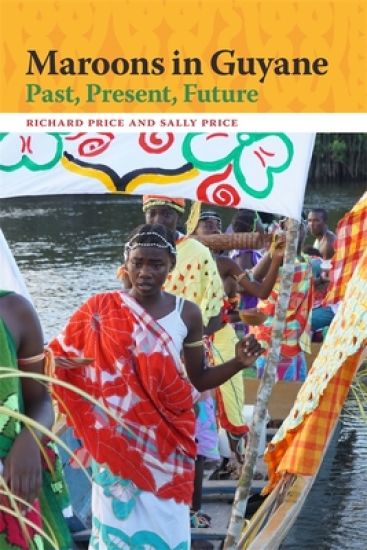
Maroons in Guyane

Maroons in Guyane

Richard Price; Sally Price

UNIVERSITY OF GEORGIA PRESS
2022
sidottu
For more than four centuries, communities of maroons (men and women who escaped slavery) dotted the fringes of plantation America, from Brazil through the Caribbean to the United States. Today their descendants still form semi-independent enclaves—in Jamaica, Brazil, Colombia, Belize, Suriname, Guyane, and elsewhere—remaining proud of their maroon origins and, in some cases, faithful to unique cultural traditions forged during the earliest days of Afro-American history. In 1986, expelled by the military regime of Suriname, anthropologists Richard and Sally Price turned to neighboring Guyane (French Guiana), where thousands of Maroons were taking refuge from the Suriname civil war. Over the next fifteen years, their conversations with local people convinced them of the need to replace the pervasive stereotypes about Maroons in Guyane with accurate information. In 2003, Les Marrons became a local best seller. In 2020, after a series of further visits, the Prices wrote a new edition taking into account the many rapid changes. Available for the first time in English, Maroons in Guyane reviews the history of Maroon peoples in Guyane, explains how these groups differ from one another, and analyzes their current situations in the bustling, multicultural world of this far-flung outpost of the French Republic. A gallery of the magnificent arts of the Maroons completes the volume.
Maroons in Guyane

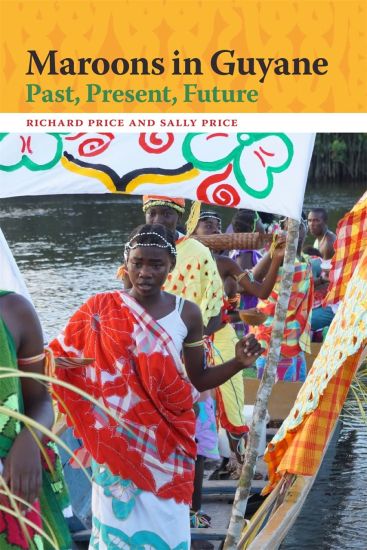
Maroons in Guyane

Richard Price; Sally Price

UNIVERSITY OF GEORGIA PRESS
2022
pokkari
For more than four centuries, communities of maroons (men and women who escaped slavery) dotted the fringes of plantation America, from Brazil through the Caribbean to the United States. Today their descendants still form semi-independent enclaves—in Jamaica, Brazil, Colombia, Belize, Suriname, Guyane, and elsewhere—remaining proud of their maroon origins and, in some cases, faithful to unique cultural traditions forged during the earliest days of Afro-American history. In 1986, expelled by the military regime of Suriname, anthropologists Richard and Sally Price turned to neighboring Guyane (French Guiana), where thousands of Maroons were taking refuge from the Suriname civil war. Over the next fifteen years, their conversations with local people convinced them of the need to replace the pervasive stereotypes about Maroons in Guyane with accurate information. In 2003, Les Marrons became a local best seller. In 2020, after a series of further visits, the Prices wrote a new edition taking into account the many rapid changes. Available for the first time in English, Maroons in Guyane reviews the history of Maroon peoples in Guyane, explains how these groups differ from one another, and analyzes their current situations in the bustling, multicultural world of this far-flung outpost of the French Republic. A gallery of the magnificent arts of the Maroons completes the volume.

Bolero Tropical

Bolero Tropical

Sally Price; Richard Price

Createspace Independent Publishing Platform
2018
nidottu
Dans la moiteur d'une ville tropicale, un Fran ais excentrique met en vente une extraordinaire collection d'art primitif. Les deux anthropologues appel s par un mus e pour expertiser les pi ces se retrouvent rapidement pris dans un univers o les fronti res de l'authenticit et de la duperie se fondent dans la touffeur ambiante. Bol ro tropical est une oeuvre de divertissement que l'on lira autant pour sa stimulation intellectuelle que pour son suspense irr sistible. Le livre reprend le r cit publi par Harvard University Press sous le titre d'Enigma Variations, qui a connu un important succ s aux Etats-Unis. Un objet unique et prodigieux, un roman policier en histoire de l'art r alis avec beaucoup d'intuition, d'intelligence et de sensibilit . Tout comme l'art sur lequel il nous apprend tant, Bol ro tropical est une oeuvre hybride qui ne cesse de vous pousser la lire comme un r cit authentique bien qu'elle soit officiellement pr sent e comme une fiction. ... Pour le lecteur, d m ler l'un de l'autre fait partie du charme singulier de l'ouvrage des Price -un roman fond sur les exp riences anthropologiques des auteurs. -Wall Street Journal Les livres de Richard et Sally Price ont t r compens s par de nombreux prix. Anciens professeurs d'universit , ils partagent aujourd'hui leur temps entre Paris et la Martinique. Bol ro tropical est disponible sur amazon.fr
Saamaka Dreaming

Saamaka Dreaming

Richard Price; Sally Price

Duke University Press
2017
sidottu
When Richard and Sally Price stepped out of the canoe to begin their fieldwork with the Saamaka Maroons of Suriname in 1966, they were met with a mixture of curiosity, suspicion, ambivalence, hostility, and fascination. With their gradual acceptance into the community they undertook the work that would shape their careers and influence the study of African American societies throughout the hemisphere for decades to come. In Saamaka Dreaming they look back on the experience, reflecting on a discipline and a society that are considerably different today. Drawing on thousands of pages of field notes, as well as recordings, file cards, photos, and sketches, the Prices retell and comment on the most intensive fieldwork of their careers, evoke the joys and hardships of building relationships and trust, and outline their personal adaptation to this unfamiliar universe. The book is at once a moving human story, a portrait of a remarkable society, and a thought-provoking revelation about the development of anthropology over the past half-century.
Saamaka Dreaming

Saamaka Dreaming

Richard Price; Sally Price

Duke University Press
2017
pokkari
When Richard and Sally Price stepped out of the canoe to begin their fieldwork with the Saamaka Maroons of Suriname in 1966, they were met with a mixture of curiosity, suspicion, ambivalence, hostility, and fascination. With their gradual acceptance into the community they undertook the work that would shape their careers and influence the study of African American societies throughout the hemisphere for decades to come. In Saamaka Dreaming they look back on the experience, reflecting on a discipline and a society that are considerably different today. Drawing on thousands of pages of field notes, as well as recordings, file cards, photos, and sketches, the Prices retell and comment on the most intensive fieldwork of their careers, evoke the joys and hardships of building relationships and trust, and outline their personal adaptation to this unfamiliar universe. The book is at once a moving human story, a portrait of a remarkable society, and a thought-provoking revelation about the development of anthropology over the past half-century.
Paris Primitive

Paris Primitive

Sally Price

University of Chicago Press
2007
nidottu
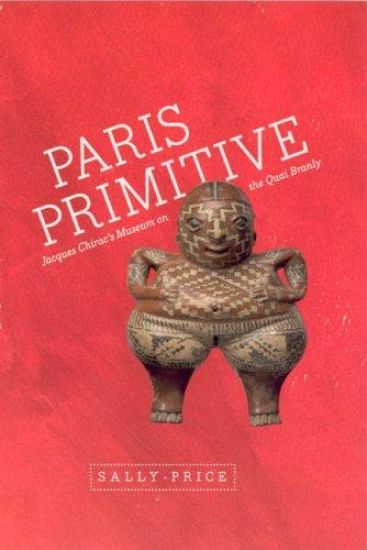
In 1990, Jacques Chirac, the future president of France and a passionate fan of non-European art, met Jacques Kerchache, a maverick art collector with the lifelong ambition of displaying African sculpture in the holy temple of French culture, the Louvre. Together, they began laying plans, and ten years later African fetishes were on view under the same roof as the Mona Lisa. Then, in 2006, amid a maelstrom of controversy and hype, Chirac presided over the opening of a new museum dedicated to primitive art in the shadow of the Eiffel Tower: the Musee du Quai Branly (MQB). "Paris Primitive" recounts the massive reconfiguration of Paris' museum world that resulted from Chirac's dream, set against a backdrop of personal and national politics, intellectual life, and the role of culture in French society. Along with exposing the machinations that led to the MQB's creation, Sally Price addresses the thorny questions it raises about the legacy of colonialism, the balance between aesthetic judgments and ethnographic context, and the role of institutions of art and culture in an increasingly diverse France. Anyone with a stake in the myriad political, cultural, and anthropological issues raised by the MQB will find Price's account fascinating.
The Root of Roots

The Root of Roots

Richard Price; Sally Price

University of Chicago Press
2003
nidottu
Anthropological iconoclasts Richard and Sally Price have spent the last two decades not only creating an unparalleled oeuvre of scholarship in several areas of anthropology but also unabashedly calling foul on any untenable or patronizing concepts of "us" and "them," "primitive" and "modern," that cross their path. For this pamphlet, they crack the yellowing diaries kept by Melville and Frances Herskovits on their famous 1920s expedition deep into the South American jungle, exposing—with their trademark combination of deadpan wit and theoretical rigor—the origins of the field that has come to be known as African diaspora studies.
Primitive Art in Civilized Places

Primitive Art in Civilized Places

Sally Price

University of Chicago Press
2002
nidottu
What is so "primitive" about primitive art? And how do we dare to use our standards to judge it? Drawing on an intriguing mixture of sources-including fashion ads and films, her own anthropological research, and even comic strips like Doonesbury—Price explores the cultural arrogance implicit in Westerners' appropriation of non-Western art."[Price] presents a literary collage of the Western attitude to other cultures, and in particular to the visual art of the Third and Fourth Worlds. . . . Her book is not about works of 'primitive art' as such, but about the Western construction 'Primitive Art.' It is a critique of Western ignorance and arrogance: ignorance about other cultures and arrogance towards them."—Jeremy Coote, Times Literary Supplement"The book is infuriating, entertaining, and inspirational, leaving one feeling less able than before to pass judgment on 'known' genres of art, but feeling more confident for that."—Joel Smith, San Francisco Review of Books"[A] witty, but scholarly, indictment of the whole primitive-art business, from cargo to curator. And because she employs sarcasm as well as pedagogy, Price's book will probably forever deprive the reader of the warm fuzzies he usually gets standing before the display cases at the local ethnographic museum."—Newsweek
Enigma Variations

Enigma Variations

Richard Price; Sally Price

Harvard University Press
1997
nidottu
Noted writers on art, culture, and the tropical Americas, Richard and Sally Price have crafted a mystery at the intersections of art and anthropology. Drawing readers into their quest for a solution, they build an unusual partnership between text and pictures, daringly expanding the possibilities of academic discourse. Enigma Variations--in the tradition of The Recognitions and The Crying of Lot 49--is an entertainment as readable for its intellectual power as for its irresistible drama.
On the Mall

On the Mall

Richard Price; Sally Price

Indiana University, Folklore Institute
1995
sidottu
" . . . engrossing, nuanced, productively and honestly critical in the best sense of the term." —Richard Bauman After recounting their experiences as cultural mediators between African American Maroons from the Suriname rain forest and U. S. festival-goers on the Washington Mall, the authors reflect on how folklorists, anthropologists, and museum curators represent others, as well as themselves.
Equatoria

Equatoria

Richard Price; Sally Price

Routledge
1994
nidottu
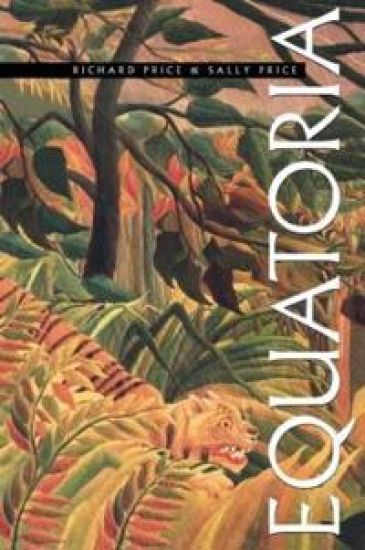
A postmodern romp through the rain forest, Equatoria is both travelogue and cultural critique. On the right-hand pages, the Prices chronicle their 1990 artifact-collecting expedition up the rivers of French Guiana, and on the left, stage an accompanying sideshow that enlists the help of Jonathan Swift, Joseph Conrad, Gabriel Garcia-Marquez, Alex Haley, James Clifford, Eric Hobsbawn, Germaine Greer, and even the noted anthropologist James Goodfellow. Charged with acquiring objects for a new museum, the Prices kept a log of their day-to-day adventures and misadventures, constantly confronting their ambivalence about the act of collecting, the very possibility of exhibiting cultures and the future of anthropology. Probing the nature of museums, collecting, and power relations between "us" and "them," the Prices raise many troubling questions.
Two Evenings in Saramaka

Two Evenings in Saramaka

Richard Price; Sally Price

University of Chicago Press
1991
nidottu
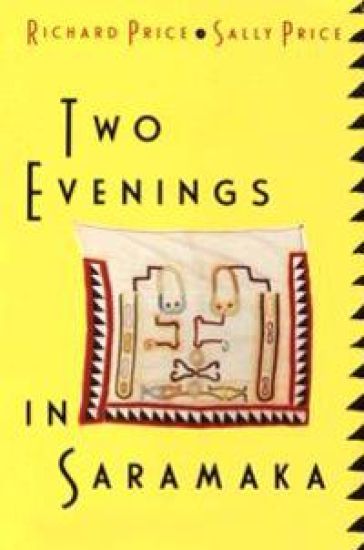
"Whatever has gotten into the Prices?" asks the apocryphal Professor Goodfellow in the opening lines of Two Evenings in Saramaka. "After all those books on history and ethnography," he muses, "why are they now turning to children's stories and nonsense songs—mere folklore?" In this innovative work, Richard and Sally Price explore the fully adult world of Saramaka "folktale-land," where animals speak, the social order is inverted, customs have been only partially worked out, and the weak and clever triumph over the strong and arrogant. Joining the Saramaka of the Suriname rain forest for two tale-telling wakes, we witness mischievous Anasi the spider matching wits with lecherous devils, the scrawny little kid rescuing his nubile sisters in distress, and the bitchy white princess being tamed by the one-sided boy. As seas dry up, books speak out loud, and elephants assume human form, we are present at a whole sequence of world-shaping happenings such as the invention of sex, the discovery of drums, and the arrival of death among humans. Set in the more general context of tale telling by the descendants of Africans throughout the Americas and of recent scholarship in performance studies, these Saramaka tales are presented as a dramatic script. With the help of nearly forty photographs, readers become familiar not only with the characters in folktale-land, but also with the men and women who so imaginatively bring them to life. And because music complements narration in Saramaka just as it does elsewhere in Afro-America, more than fifty songs are presented here in musical notation. Narrative, song, dance, and social interaction merge in these two evenings of multimedia entertainment, bearing witness to an Afro-American cultural tradition that remains alive and vibrant, constantly renewed but always reflecting its links with the past.
Two Evenings in Saramaka

Two Evenings in Saramaka

Richard Price; Sally Price

University of Chicago Press
1991
sidottu
"Whatever has gotten into the Prices?" asks the apocryphal Professor Goodfellow in the opening lines of Two Evenings in Saramaka. "After all those books on history and ethnography," he muses, "why are they now turning to children's stories and nonsense songs—mere folklore?" In this innovative work, Richard and Sally Price explore the fully adult world of Saramaka "folktale-land," where animals speak, the social order is inverted, customs have been only partially worked out, and the weak and clever triumph over the strong and arrogant. Joining the Saramaka of the Suriname rain forest for two tale-telling wakes, we witness mischievous Anasi the spider matching wits with lecherous devils, the scrawny little kid rescuing his nubile sisters in distress, and the bitchy white princess being tamed by the one-sided boy. As seas dry up, books speak out loud, and elephants assume human form, we are present at a whole sequence of world-shaping happenings such as the invention of sex, the discovery of drums, and the arrival of death among humans. Set in the more general context of tale telling by the descendants of Africans throughout the Americas and of recent scholarship in performance studies, these Saramaka tales are presented as a dramatic script. With the help of nearly forty photographs, readers become familiar not only with the characters in folktale-land, but also with the men and women who so imaginatively bring them to life. And because music complements narration in Saramaka just as it does elsewhere in Afro-America, more than fifty songs are presented here in musical notation. Narrative, song, dance, and social interaction merge in these two evenings of multimedia entertainment, bearing witness to an Afro-American cultural tradition that remains alive and vibrant, constantly renewed but always reflecting its links with the past.