
Kirjojen hintavertailu – 12 903 725 kirjaa ja 27 kauppaa

Kirjailija

Salvador Soto-Faraco

Kirjat ja teokset yhdessä paikassa: 2 kirjaa, julkaisuja vuosilta 2019–2020, suosituimpiin kuuluu Multisensory Interactions in the Real World. Vertaile teosten hintoja ja tarkista saatavuus suomalaisista kirjakaupoista.

2 kirjaa

Kirjojen julkaisuvuodet: 2019–2020.

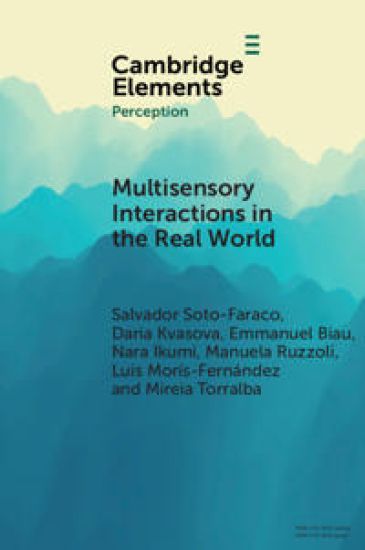
Multisensory Interactions in the Real World

Multisensory Interactions in the Real World

Salvador Soto-Faraco; Daria Kvasova; Emmanuel Biau; Nara Ikumi; Manuela Ruzzoli; Luis Morís-Fernández; Mireia Torralba

Cambridge University Press
2019
pokkari
The interactions between the senses are essential for cognitive functions such as perception, attention, and action planning. Past research helped understanding of multisensory processes in the laboratory. Yet, the efforts to extrapolate these findings to the real-world are scarce. Extrapolation to real-world contexts is important for practical and theoretical reasons. Multisensory phenomena might be expressed differently in real-world settings compared to simpler laboratory situations. Some effects might become stronger, others may disappear, and new outcomes could be discovered. This Element discusses research that uncovers multisensory interactions under complex environments, with an emphasis on the interplay of multisensory mechanisms with other processes.
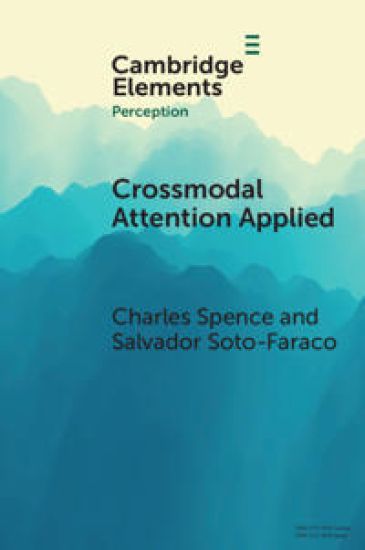
Crossmodal Attention Applied

Crossmodal Attention Applied

Charles Spence; Salvador Soto-Faraco

Cambridge University Press
2020
pokkari
Cognitive neuroscientists have started to uncover the neural substrates, systems, and mechanisms enabling us to prioritize the processing of certain sensory information over other, currently less-relevant, inputs. However, there is still a large gap between the knowledge generated in the laboratory and its application to real-life problems of attention as when, for example, interface operators are multi-tasking. In this Element, laboratory studies on crossmodal attention (both behavioural/psychophysical and cognitive neuroscience) are situated within the applied context of driving. We contrast the often idiosyncratic conditions favoured by much of the laboratory research, typically using a few popular paradigms involving simplified experimental conditions, with the noisy, multisensory, real-world environments filled with complex, intrinsically-meaningful stimuli. By drawing attention to the differences between basic and applied studies in the context of driving, we highlight a number of important issues and neglected areas of research as far as the study of crossmodal attention is concerned.